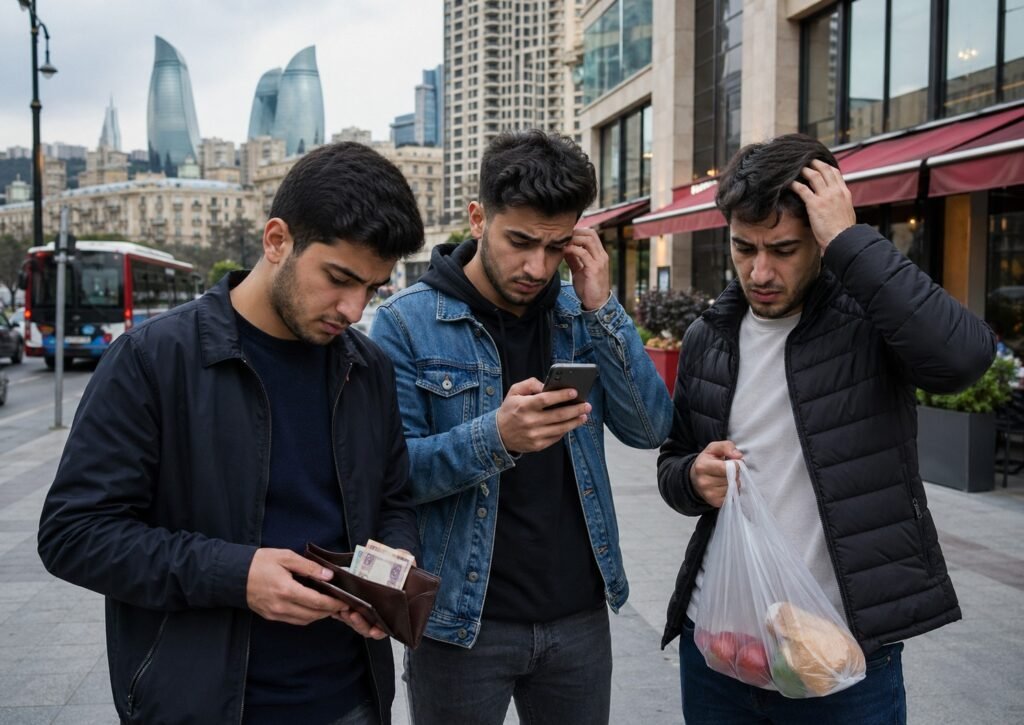
Crowded cafes and restaurants do not necessarily show broad prosperity in Azerbaijan, economist Natiq Jafarli says. For many young workers, spending on leisure reflects the belief that saving will not put homeownership within reach.
Jafarli discussed the pattern in a video interview about housing affordability, wages and changes in the behavior of younger consumers.
He said a worker earning 1,000 to 1,200 manats a month may conclude that buying an apartment or car is impossible without help from parents or grandparents. When saving 200 manats a month does not appear to narrow that gap, the worker may prefer a cafe, a movie or a short holiday.
Small Pleasures Replace Long-Term Plans
Jafarli said this behavior should not automatically be dismissed as carelessness or poor money management. It can reflect the loss of a visible connection between saving today and improving one’s life later.
Young people may choose affordable experiences because major purchases feel permanently out of reach, he said. That helps explain how busy entertainment venues can coexist with low savings and severe housing stress.
The economist said the dynamic is not unique to Azerbaijan. A young European worker earning €2,500 and paying about €1,000 in rent may also see little prospect of purchasing a home priced at €600,000 to €700,000.
Greater mobility reinforces the trend, he said, as younger workers are more willing to move to another country for a better job and feel less tied to one place.
Baku Home Prices Outpace Incomes
Jafarli said Azerbaijan’s problem is especially acute because of the widening gap between pay and residential property prices. Baku apartment prices are approaching levels seen in some European markets, while local incomes leave buyers with far less purchasing power, he said.
Recent data from Azerbaijan’s Chamber of Appraisers underline the pressure. Its September 2026 index put the median price of a new-build apartment at 2,850 manats per square meter, up 8% from the December 2025 benchmark. The median for older apartments was 2,692 manats per square meter, up 6.8% from the benchmark.
The same data placed median monthly rent for both new-build apartments and individual houses at 1,000 manats in September.
A Weaker Middle-Class Bargain
Jafarli linked the spending pattern to a broader weakening of the middle class. Stable employment would traditionally allow people to plan for a home, marriage and children, but work alone no longer provides that confidence for many households, he said.
The result is a paradox: restaurants may be full even as young customers have little accumulated wealth. They permit themselves modest spending now because they do not believe giving it up will solve the housing problem.
The interview was first reported in Russian by Vesti Baku.