Aze.US
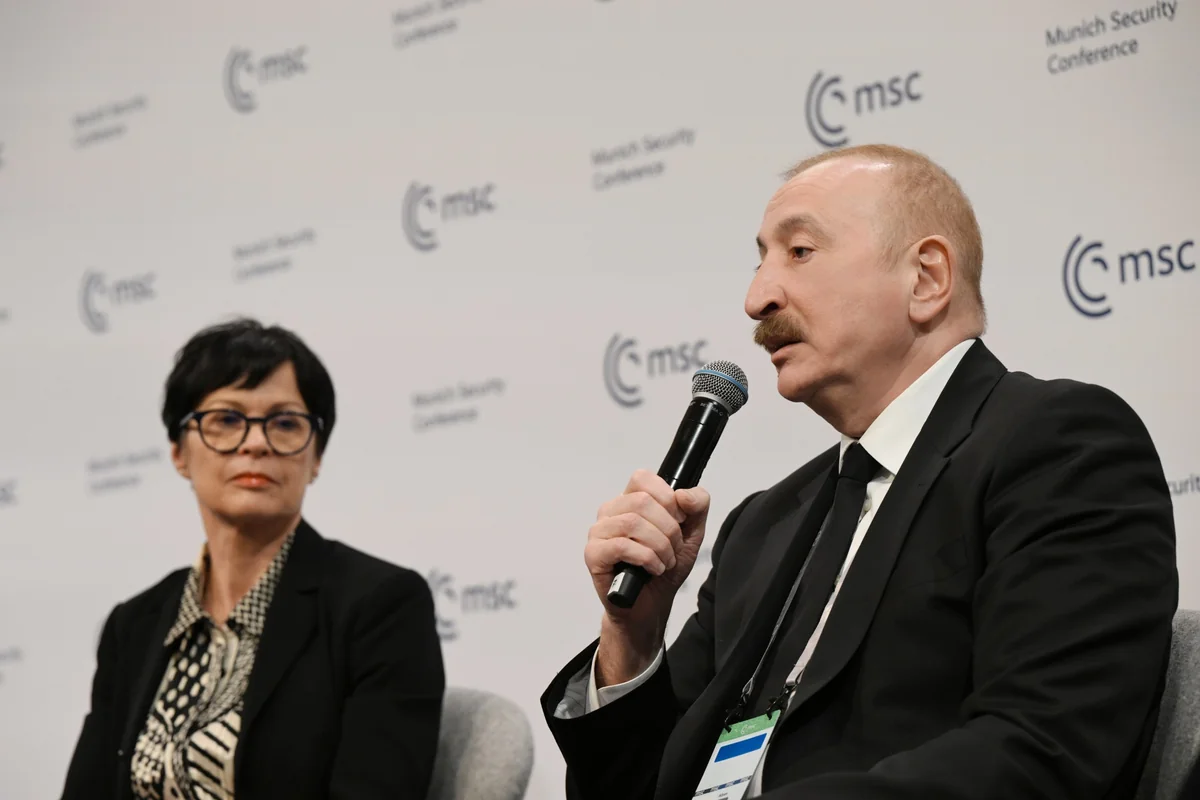
President Ilham Aliyev’s remarks at the Munich Security Conference outlined more than routine diplomatic optimism. Taken together, his statements point to a coordinated shift in three areas: peace timing, transport geopolitics, and U.S. strategic entry into the Middle Corridor.
1. Peace process framed as technically ready, politically conditional
Aliyev’s language suggests Baku views the peace agreement with Armenia as largely finalized in substance, with the remaining obstacle defined narrowly – constitutional language in Armenia referencing territorial claims.
This framing serves two purposes:
-
Positions Azerbaijan as ready for signature, shifting responsibility for delay onto Yerevan.
-
Signals to Western actors that normalization is achievable within a predictable political timeline.
If accurate, this moves the conflict from a military-security phase into a legal-political compliance phase, a critical transition for investors and transit planners.
2. Middle Corridor moving from concept to throughput economics
Aliyev emphasized concrete transport metrics – current cargo volumes above 100,000 transport units and long-term targets approaching 500,000.
This matters because:
-
The Middle Corridor has long been discussed strategically, but not operationally.
-
Volume targets indicate a shift toward commercial viability, not just geopolitical symbolism.
Rail expansion, port investment, and Caspian fiber-optic infrastructure together point to a full-stack corridor model:
physical transit + digital connectivity + energy logistics.
That combination is what historically transforms routes into durable trade systems.
3. TRIPP as a signal of long-term U.S. geopolitical anchoring
Aliyev’s strongest strategic message concerned the TRIPP corridor and its association with U.S. political backing.
Three implications stand out:
a) Institutional, not temporary, U.S. involvement
Referencing ownership structures and century-scale timelines frames TRIPP as structural Western presence, not short-term diplomacy.
b) Competitive positioning versus northern routes
If operational, TRIPP strengthens a non-Russian Eurasian transit axis, aligning with broader Western diversification strategies after 2022.
c) Peace as infrastructure prerequisite
By linking TRIPP directly to Armenia-Azerbaijan normalization, Aliyev ties:
security settlement → transport integration → geopolitical realignment.
That sequence reflects classic post-conflict corridor economics seen in other regions.
4. Controlled signaling toward Russia
Aliyev’s comments on strikes affecting Azerbaijani facilities in Ukraine were calibrated:
-
Clear labeling as unfriendly
-
Response limited to diplomacy
This indicates measured distancing without rupture, consistent with Baku’s multi-vector foreign policy.
Bottom line
Aliyev’s Munich intervention was less about rhetoric and more about timeline management:
-
Peace positioned as imminent but conditional
-
Middle Corridor framed as commercially scaling
-
U.S. role presented as structurally embedded
If these elements converge in 2026, the South Caucasus could shift from a post-war security zone into a trans-Eurasian logistics hub – a transformation with consequences far beyond the region.