Aze.US
As congestion worsens across Azerbaijan’s capital, debate is growing over whether strict vehicle-restriction models used in major world cities could work in Baku. International experience suggests such measures can bring quick relief, but rarely solve the problem on their own.
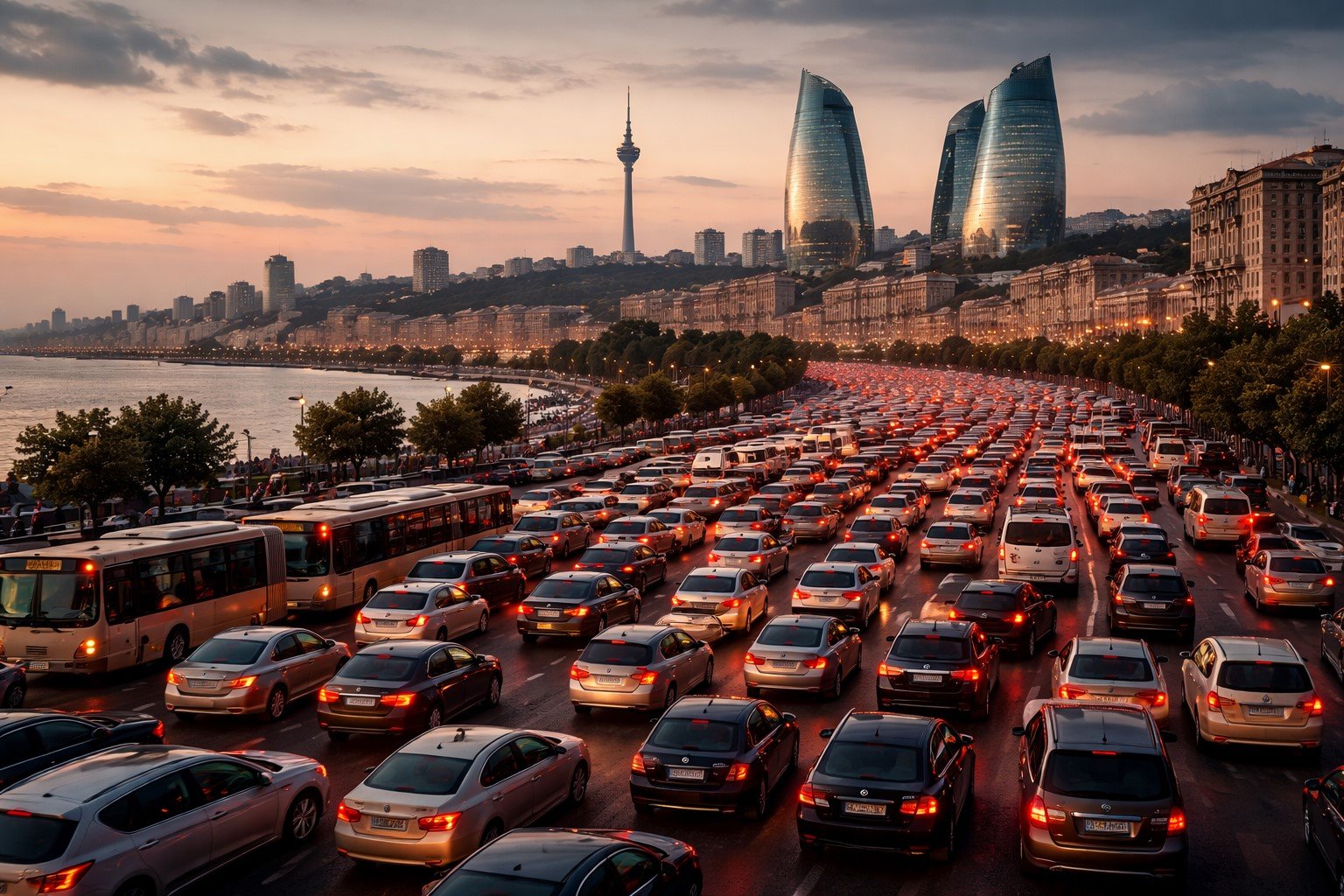
Traffic congestion in Baku has shifted from an occasional inconvenience to a defining feature of daily life. During morning and evening rush hours, even short trips can stretch into long, unpredictable journeys as the number of vehicles continues to rise faster than the city’s road network can adapt. Major highways and inner-city streets alike now face sustained pressure, intensifying discussion about stronger administrative tools to manage mobility.
Among the ideas increasingly mentioned is an odd-even license-plate system, which allows vehicles to enter certain areas or drive on specific days depending on the final digit of their registration number. Variations of this approach have been tested in several global capitals, often delivering immediate - though not always lasting - reductions in traffic.
Beijing has enforced number-based driving restrictions for years, limiting each vehicle’s road access one day per week and tightening rules during periods of severe air pollution. The policy has produced measurable declines in congestion and emissions. In New Delhi, an emergency odd-even scheme temporarily reduced traffic volumes, yet the effect weakened as some households responded by purchasing second vehicles with alternate plate numbers.
Mexico City moved further by embedding circulation limits into long-term urban policy, linking restrictions not only to plate numbers but also to vehicle emissions and environmental conditions. Athens has applied alternating entry rules to its historic center for decades, easing traffic pressure but ultimately relying on expanded public transport to achieve more durable results.
These international cases frame the central question for Baku: whether similar limits could work in practice. In theory, restricting vehicle access can quickly reduce traffic without the time and cost required for major infrastructure projects. In reality, however, such systems often face structural and social constraints.
Where private car ownership remains essential for commuting, households may adapt in ways that dilute the policy’s impact. Restrictions can also raise equity concerns, disproportionately affecting residents who lack viable transport alternatives.
Global evidence suggests that cities achieve lasting congestion relief not through a single restriction, but through coordinated transport reform. Reliable and extensive public transit networks allow residents to leave cars behind without sacrificing mobility. Complementary measures - including congestion pricing, parking controls, and flexible working hours - further smooth demand across the day and reduce peak-hour pressure.
For Baku, the most plausible pathway appears gradual rather than abrupt. Strengthening public transportation and regulating parking would likely precede any strict driving limits. Economic tools such as paid entry into the most congested districts could follow, with targeted number-based restrictions considered only if broader reforms prove insufficient.
The broader lesson from global cities is clear. Traffic congestion rarely disappears simply because driving is restricted. It recedes where urban systems make it practical - and efficient - not to rely on a private car. Baku’s long-term mobility future will therefore depend less on prohibition than on whether meaningful alternatives to car travel can be built and sustained.