AZE.US
Azerbaijan has launched its first major battery energy storage center, marking a significant step in the country’s efforts to modernize its power system and prepare for a larger share of renewable energy.
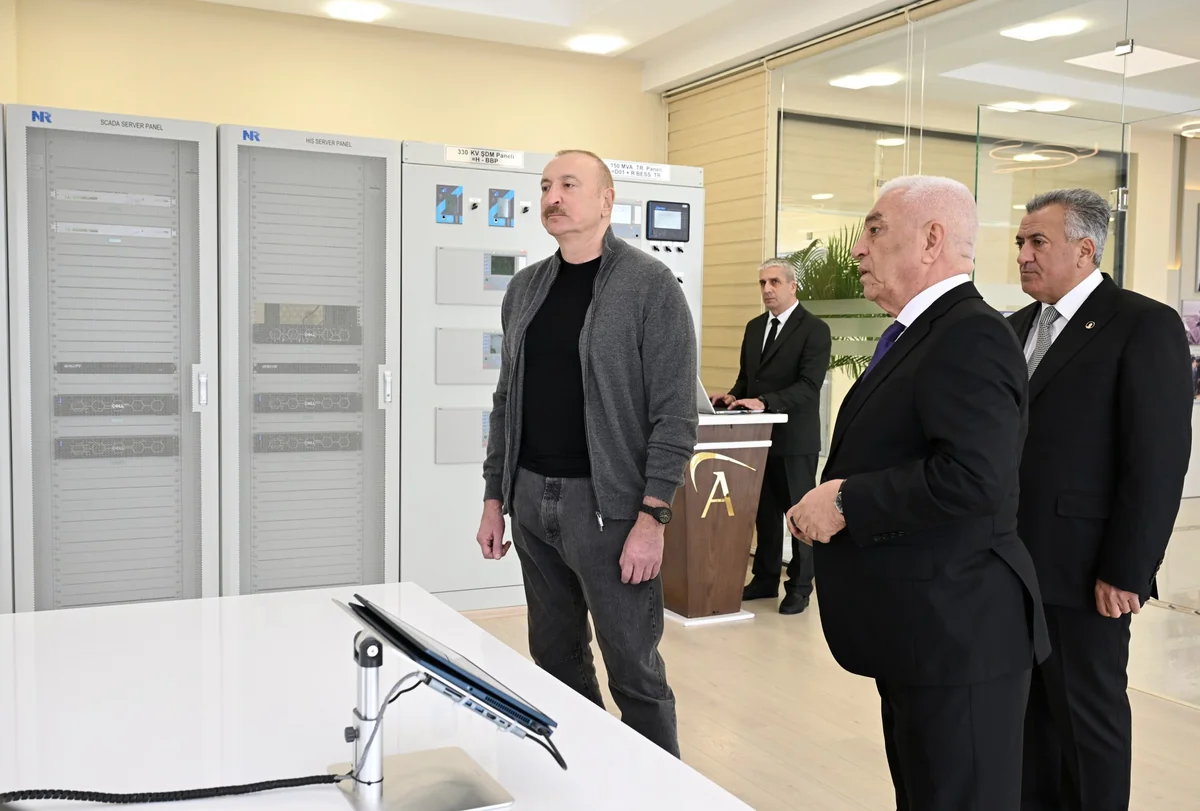
President Ilham Aliyev attended the opening of the “Absheron” Battery Energy Storage Center built by AzerEnerji. According to official information presented during the event, the project is part of a broader plan that also includes a similar facility at the 220 kV “Agdash” substation.
Together, the two storage centers have a total capacity of 250 MW and an energy storage volume of 500 MWh. Officials say projects of this scale are the first of their kind not only in Azerbaijan but across the wider CIS region.
The Absheron facility includes 50 battery containers and 13 inverter containers. Studies conducted by international consulting companies TETRA Tech from the United States and Turkey’s EPRA found that such battery systems are necessary to safely integrate around 1,850 MW of renewable energy into Azerbaijan’s power grid.
The main function of the storage center is to collect excess electricity, including power generated during sunny hours, and release it back into the grid during peak demand periods. The system can be fully charged or discharged within two hours, allowing operators to respond more quickly to changing demand and fluctuations in solar and wind output.
Officials say the center will improve grid flexibility and stability. Through the SCADA system, the power network can be monitored in real time, while frequency and voltage can be maintained more effectively. The storage system is also designed to help manage sudden power shortages, reduce the impact of outages and support restoration of the grid after disruptions.
The project is part of Azerbaijan’s wider push to integrate more renewable energy into the national system. Authorities said that by 2028, more than 2,100 MW of green energy is expected to be connected to the grid.
Officials also presented updates on the AZURE project, which is intended to ensure the stable and secure integration of 2 GW of renewable energy, increase the share of green electricity in the energy supply of Baku and the Alat Free Economic Zone, and strengthen the role of the “Nava hi Green Energy” hub in the country’s power system.
As part of that work, new 500 kV and 330 kV transmission lines have already been built linking key substations and solar power plants. More large-scale transmission infrastructure is planned in the next stage.
Azerbaijan has also expanded the digital side of its energy system. Over the past seven years, the country has built 4,700 kilometers of fiber-optic infrastructure and introduced a centralized SCADA system covering more than 550 energy facilities. Online diagnostic technologies, AI-based fault forecasting systems and renewable generation forecasting tools are also being developed.
Electricity consumption in Azerbaijan is projected to rise by around 17% by 2032. By that time, the country plans to create 8 GW of renewable energy capacity.
Azerbaijan also sees green energy exports as a strategic goal, including through the planned Black Sea cable and other regional energy corridors aimed at connecting to European markets. The Black Sea cable is expected to have a transmission capacity of 1,300 MW.
During the ceremony, President Aliyev pressed the symbolic launch button for the Absheron Battery Energy Storage Center.