Aze.US
Events at a historic mosque in Marneuli have renewed debate over Tehran’s ideological reach in the South Caucasus and the potential implications for regional stability.
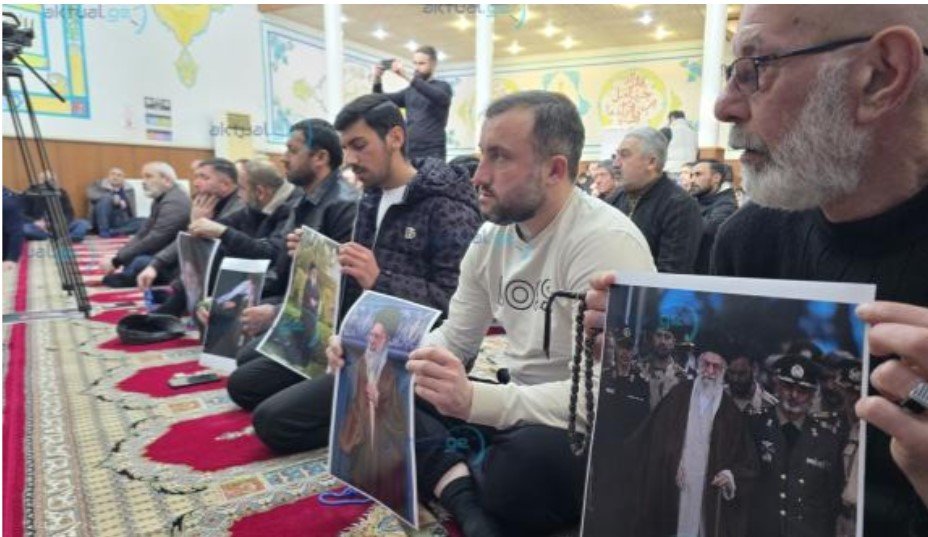
Recent developments in the Georgian town of Marneuli, home to a large ethnic Azerbaijani population, have sparked renewed discussion about Iran’s religious and ideological influence in the region. During a recent Friday sermon at the Imam Ali Mosque, the address focused on Iran’s Supreme Leader, Ayatollah Ali Khamenei, while some attendees displayed his portraits inside the place of worship.
The sermon also referenced the conflicts in Gaza and Palestine, including calls to defend civilians and support oppressed communities. The Imam Ali Mosque, which dates back to the 18th century, has long served not only as a religious site but also as a cultural and social center for the local Azerbaijani Muslim community.
The public display of Iranian political symbolism in a religious setting has raised broader questions among community leaders and analysts about whether Tehran is seeking to expand its soft-power influence among Azerbaijani populations beyond its borders.
Representatives of Azerbaijani civic organizations operating in Georgia say recent patterns suggest a gradual attempt to shape public opinion through religious networks, educational outreach, and ideological messaging. According to these figures, such activity may include financial support mechanisms, promotion of religious study abroad, and dissemination of religious literature aligned with specific political narratives.
Some observers warn that the blending of religious messaging with geopolitical interests could deepen sectarian sensitivities and complicate social cohesion in multi-ethnic regions. They argue that preventing radicalization and preserving trust in state institutions requires stronger community engagement, transparency, and educational initiatives.
Concerns have also been raised that external actors could exploit localized religious activism to influence information environments or amplify political tensions affecting Azerbaijan and Georgia’s strategic partnership. Both countries view bilateral stability as central to broader South Caucasus security, including energy transit routes and regional connectivity projects.
Regional analysts note that competition for influence in the South Caucasus increasingly involves not only traditional geopolitical actors but also religious and cultural networks operating across borders. In this context, developments in Marneuli are being watched less as an isolated incident and more as part of a wider contest over narrative, identity, and alignment in a strategically sensitive region.