Aze.US
Seven consequences that matter more than diplomatic language
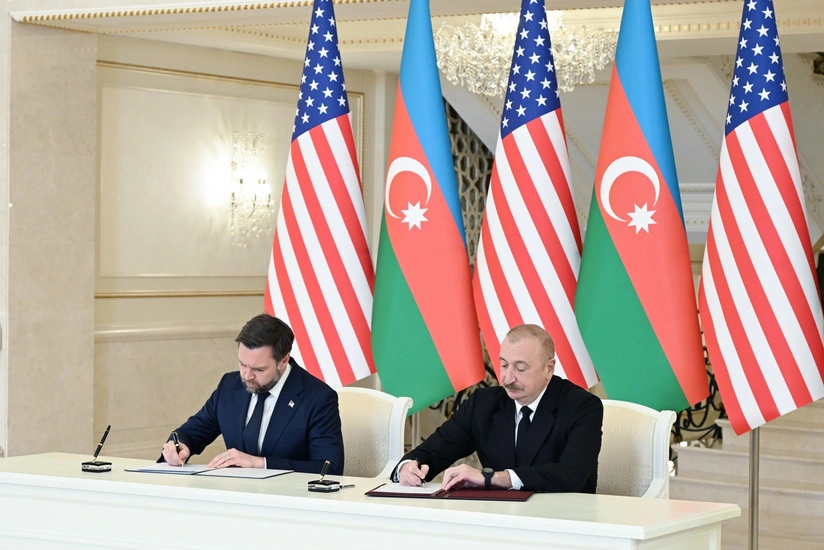
The Strategic Partnership Charter signed in Baku between Azerbaijan and the United States may look like another formal diplomatic document. But behind the carefully worded language lie tangible shifts in regional politics, security architecture, and economic direction.
Here are the seven changes that matter most.
1. The United States is returning to the South Caucasus institutionally
Washington has long been politically present in the region, but without a stable framework.
The Charter creates exactly that – working groups, regular dialogue, and fixed areas of cooperation.
In practical terms, this means the US role becomes systemic rather than episodic.
2. Azerbaijan is закрепляется as a key Western partner in the region
The document directly anchors cooperation in:
-
energy
-
transit and logistics
-
security
-
advanced technologies and AI
Such a spectrum is rarely reserved for an ordinary partner.
It signals recognition of Baku as a strategic regional hub – energy, transport, and increasingly technological.
3. The Baku-Yerevan peace process gains an external stabilizer
The emphasis on the US role in the peace agenda sends a clear signal:
-
the process is now embedded in a broader geopolitical framework;
-
disruption by external actors becomes harder;
-
peace is tied to infrastructure and economic incentives.
In other words, peace shifts from a purely political agreement
to an economically grounded settlement – typically more durable.
4. The TRIPP corridor moves from concept to strategy
By entering the Charter, TRIPP transitions:
from idea → to international commitment.
This increases:
-
investment credibility
-
political protection
-
long-term inevitability.
Simply put, the corridor begins to be viewed as a future regional reality, not a proposal.
5. Technology reshapes the nature of the partnership
Artificial intelligence, data centers, digital infrastructure, cybersecurity –
this is no longer just “energy and security.”
The model becomes:
energy + transit + technology.
That signals:
-
Azerbaijan’s ambition to enter the next-generation economy;
-
US influence extending into the region’s digital architecture,
which is inherently long-term.
6. The message is aimed beyond the region
Every strategic charter is read in multiple capitals:
-
Moscow
-
Tehran
-
Ankara
-
Brussels
-
Beijing
The core message:
The South Caucasus is no longer a zone of monopoly influence,
but a space of competing long-term strategies.
This is one of the region’s most profound geopolitical shifts in years.
7. The real change is about the future’s scale
Perhaps the most important transformation is conceptual.
The region is no longer framed primarily through:
-
conflict
-
post-Soviet instability
-
temporary crisis.
Instead, the language is now about:
corridors, investment, technology, and long-term security.
That is not a policy adjustment.
It is an era shift.
What this means in practice
If the Charter’s provisions are implemented:
-
the South Caucasus could integrate into global logistics chains;
-
Azerbaijan’s role as a regional power center would deepen;
-
external influence in the region would rebalance;
-
the peace process would gain economic foundations;
-
the region could move from conflict management to development logic.
For that reason, this Charter is more than a diplomatic text.
It is a document about the region’s future trajectory.