Aze.US
The signing of a U.S.–Azerbaijan strategic charter signals a broader shift in regional security, transit, and geopolitical alignment.
The visit of U.S. Vice President JD Vance to Baku and the signing of a strategic partnership charter marked one of the most consequential political developments in the South Caucasus in recent months. The document spans regional security cooperation, defense coordination, demining, technology and artificial intelligence, as well as transport and energy connectivity linking the region with Central Asia.
Analysts note that this was only the second visit by a sitting U.S. vice president to the region in decades, following a markedly different geopolitical context in 2008. Today, Washington’s engagement reflects an emerging effort to shape a new security and logistics architecture across Eurasia, with the South Caucasus positioned as a critical junction.
According to political analyst Farhad Mammadov, the charter signed with Azerbaijan differs from earlier U.S. arrangements in the region. Memoranda concluded with Armenia carry limited durations and require periodic renewal, while the agreement with Baku is framed as an equal partnership without binding unilateral security guarantees.
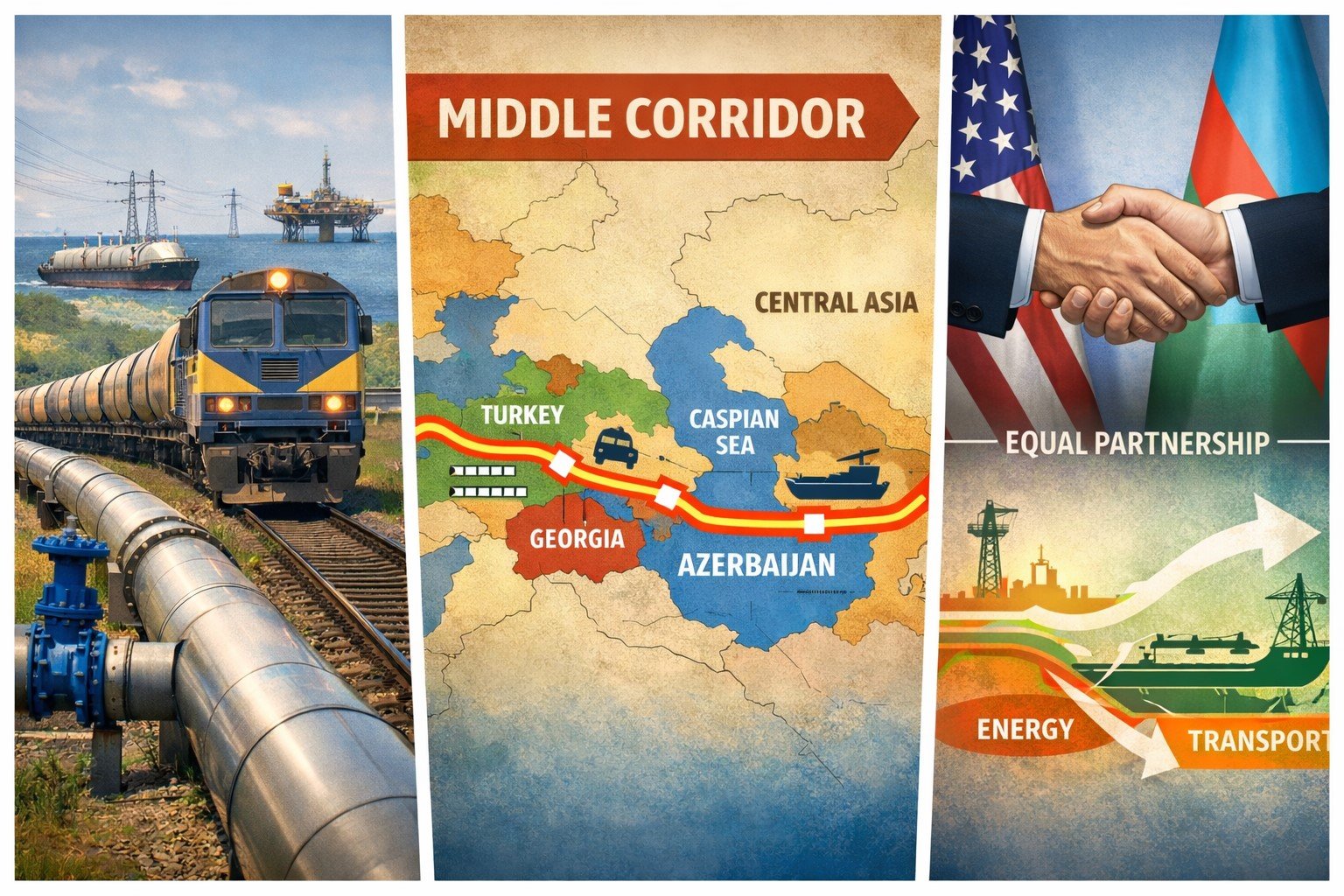
Security cooperation outlined in the charter emphasizes border protection, maritime monitoring, and technological coordination. Particular attention is given to the Middle Corridor, viewed not only as a cargo route but as a broader energy and infrastructure platform connecting Central Asia to European and transatlantic markets through Azerbaijani territory.
Washington increasingly sees Azerbaijan as a central transit and political anchor in the region, reflecting both geography and the country’s track record in delivering large-scale infrastructure-from the Baku–Tbilisi–Ceyhan oil pipeline to the Southern Gas Corridor.
Another factor shaping U.S. interest is Azerbaijan’s ability to maintain working relations simultaneously with Turkey and Israel, two key American partners in the Middle East. In a period of rising regional volatility, such diplomatic positioning carries added strategic value.
At the same time, analysts argue that Russia’s influence in parts of the South Caucasus has weakened following the regional transformations of 2020 and 2023. In Armenia, a gradual shift away from Russian-linked security and energy mechanisms toward alternative partnerships could generate internal political friction and external competition.
The European Union remains engaged but less cohesive, often aligning with U.S. initiatives while seeking continued access to transport corridors and energy projects that connect Europe with Central Asia.
Over the next three years, experts expect Azerbaijan to focus on institutionalizing ties with Washington and deepening cooperation in economic, security, and infrastructure domains. More broadly, the South Caucasus is evolving from a peripheral observation zone into an arena of active geopolitical competition and long-term connectivity planning.