Aze.US
Recent U.S. diplomatic engagement in the South Caucasus is often interpreted through the narrow lens of individual visits or short-term regional crises.
A more durable reading suggests something different: the region is entering a structural transition shaped by the erosion of post-Soviet security arrangements and the gradual emergence of connectivity-driven geopolitics across Eurasia.
For more than three decades, the South Caucasus functioned within an asymmetric order. Russia provided hard-security guarantees and conflict management mechanisms, while Western actors supplied economic integration, financial assistance, and institutional engagement. This division of roles created a fragile but persistent equilibrium in which unresolved conflicts remained embedded within broader power competition.
That equilibrium has weakened substantially since the 2020 war and the subsequent regional transformations culminating in 2023. Moscow retains proximity and residual influence, yet its capacity to define political outcomes across the region has diminished. What is unfolding is not a sudden replacement of one hegemon by another, but a slower reconfiguration of authority, incentives, and infrastructure.
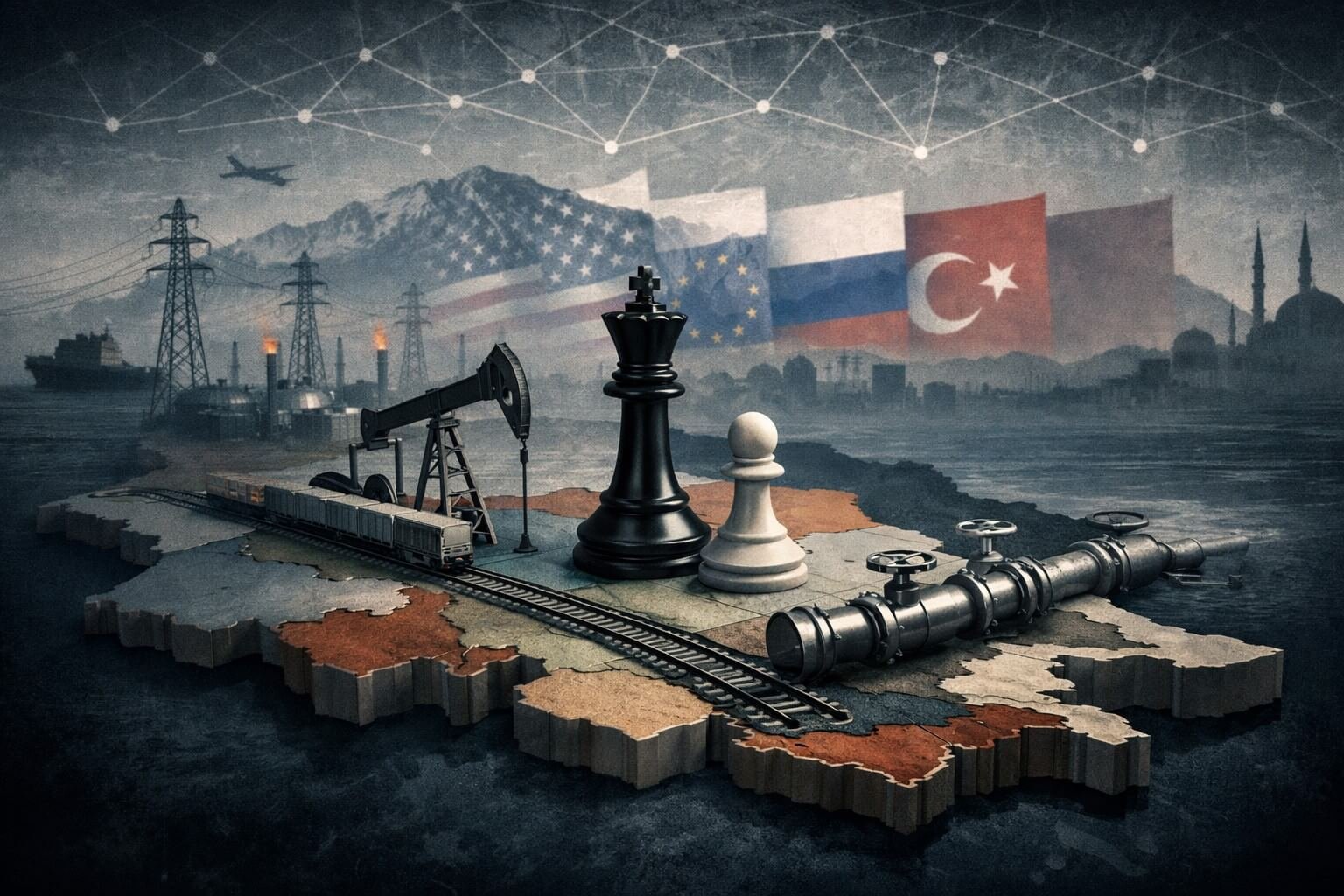
The United States appears to be operating through indirect instruments rather than visible military presence. Energy corridors, transport connectivity, regulatory alignment, and elite-level partnerships increasingly form the architecture of influence. Such tools reflect a wider shift in contemporary geopolitics, where control over flows-of energy, goods, capital, and data-often outweighs territorial positioning.
Within this framework, the South Caucasus is being reinterpreted less as a frontier and more as a junction linking Europe, Central Asia, and the broader Middle East. This geographic reframing elevates the strategic relevance of infrastructure reliability and political predictability over traditional alliance structures.
Azerbaijan’s role grows accordingly. Its geographic location, energy resources, and demonstrated capacity to implement large-scale infrastructure projects position it as a functional node within emerging trans-regional networks. In an era defined by connectivity, operational execution can carry greater strategic weight than ideological affinity.
Türkiye’s parallel involvement suggests a layered model of influence. Washington defines long-term parameters and external guarantees, while Ankara provides regional depth, logistical reach, and sustained political presence. Comparable distributed arrangements have appeared in other theaters where the United States seeks stability without direct administrative exposure.
Armenia, by contrast, embodies the uncertainties of systemic transition. Movement away from entrenched Russian security dependence toward incomplete Western integration generates institutional fragility and domestic political strain. Historical precedent indicates that such transitional spaces often experience prolonged volatility before reaching a new equilibrium.
Beyond the immediate regional triangle, Iran constitutes the principal strategic variable. Any managed political evolution within Iran would accelerate the reordering of connectivity routes, security perceptions, and economic alignments across the wider Eurasian landscape. For this reason, regional diplomacy increasingly intersects with longer-term calculations regarding Tehran’s internal trajectory.
Taken together, these dynamics indicate that the South Caucasus is no longer defined primarily by frozen conflicts or great-power rivalry in its classical form. Instead, it is becoming embedded within a broader restructuring of Eurasian connectivity and governance. Stability, if it consolidates, is likely to emerge less from reconciliation narratives than from the gradual institutionalization of new balances among infrastructure, power distribution, and regional agency.