By Leyla Mammadli for Aze.US
The South Caucasus has entered a post-war phase. Yet this phase cannot fully be described as peace; rather, it represents a transition toward peace. The end of active conflict does not automatically produce stability.
As Johan Galtung distinguished, the cessation of violence constitutes “negative peace,” while durable institutions, economic interdependence, and structural justice form the foundation of “positive peace.” The region now stands at the critical intersection between these two conditions.
A central requirement of this transition is the economic grounding of the peace agenda. Historical experience shows that political agreements remain fragile when not reinforced by economic integration.
Robert Keohane and Joseph Nye’s theory of complex interdependence suggests that expanding institutional and economic linkages between states reduces the likelihood of renewed conflict. Peace, therefore, is not only a diplomatic outcome but also an economic mechanism.
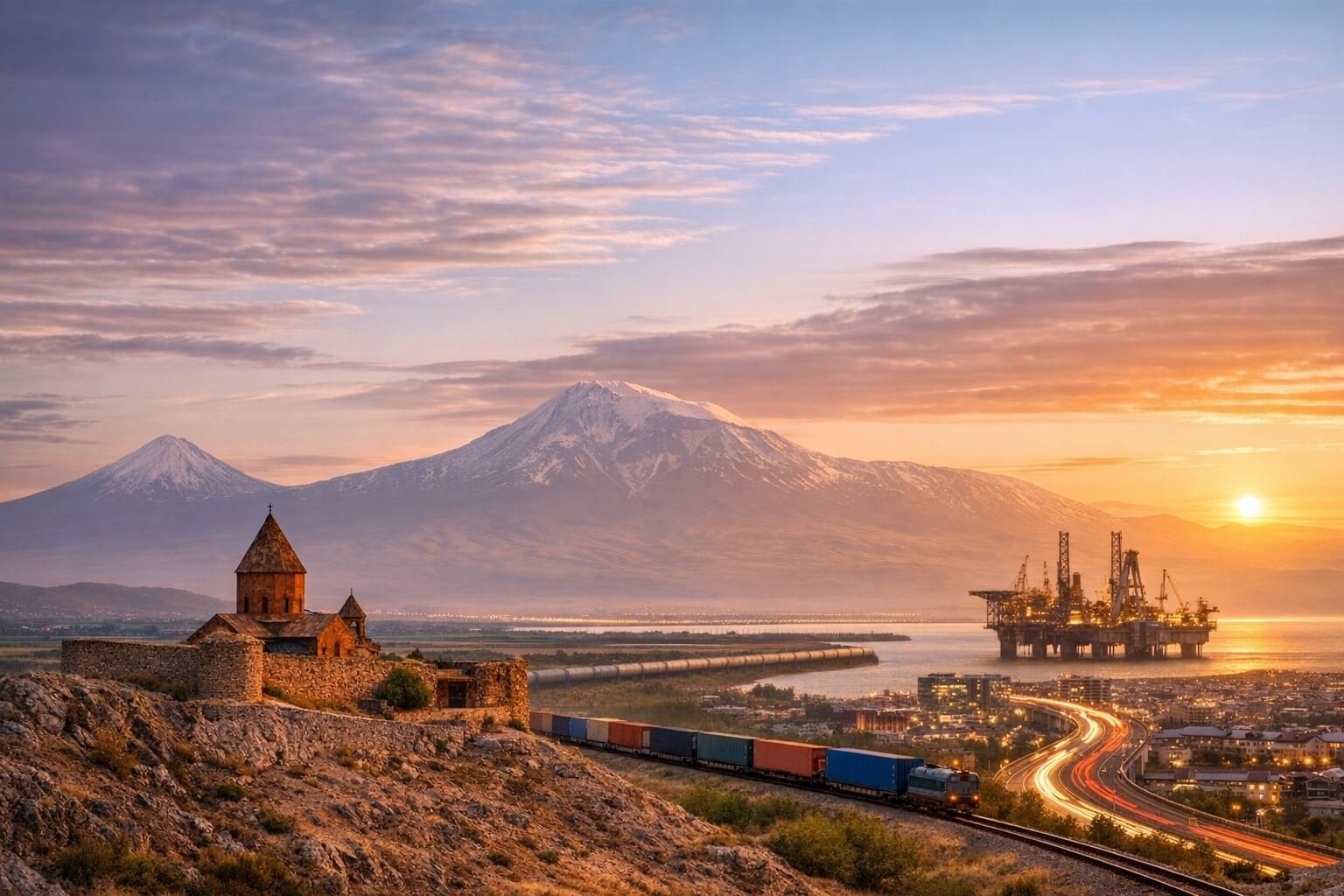
Within this framework, the TRIPP initiative-built on trade, resilience, investment, partnership, and prosperity-emerges as a strategically significant model of regional integration. Its objective is to transform the South Caucasus from a transit corridor into a geo-economic hub. The Middle Corridor, the Trans-Caspian route, and the Southern Gas Corridor have already positioned the region as a bridge between Europe and Asia. Yet functioning as a bridge alone is insufficient; a sustainable economic network must be constructed across it.
Assessments by the World Bank and the Asian Development Bank indicate that diversified transport corridors can substantially accelerate economic growth across the region. Transit revenues are not merely fiscal instruments but also tools of political stabilization.
Converting competing interests into shared economic stakes offers one of the most credible guarantees of peace. Energy security further reinforces this dynamic, as Caspian gas exports to Europe now occupy a strategic place in the global energy balance. The TRIPP framework links energy and logistics security, embedding the region within a broader security architecture.
Another essential dimension of the peace agenda is Armenia’s potential reintegration into the regional economic system. Analyses by international financial institutions suggest that lifting blockades and reopening communications could generate meaningful medium- and long-term growth for the Armenian economy. Tangible economic benefits, in turn, would strengthen the domestic legitimacy of peace arrangements.
Risks, however, remain significant. The South Caucasus lies within a multipolar geopolitical environment shaped by the competing interests of Russia, Turkey, Iran, the European Union, and the United States. Such competition can either destabilize the region or contribute to a balancing equilibrium.
Post-conflict environments are also marked by persistent security dilemmas, in which one side’s strengthening is perceived as a threat by another. For this reason, TRIPP should be viewed not only as an economic initiative but also as a mechanism for confidence-building.
A peace treaty may establish a legal framework, but without economic substance it is unlikely to endure. The opening of regional communications, legal border delimitation, and the creation of multilateral cooperation mechanisms remain essential conditions for a transition toward positive peace. Otherwise, the region risks remaining trapped in a prolonged state of “tension without war.”
The South Caucasus faces a strategic choice: to remain an arena of great-power competition or to evolve into a platform for Eurasian cooperation. If the peace agenda and the TRIPP initiative advance in parallel, the region may achieve a genuine shift from negative to positive peace. Deepening economic interdependence would give political stability a structural and lasting character.
Peace is not an emotional slogan.
Peace is a matter of strategic design.
The future of the South Caucasus will depend on whether its economic architecture is successfully built.