AZE.US
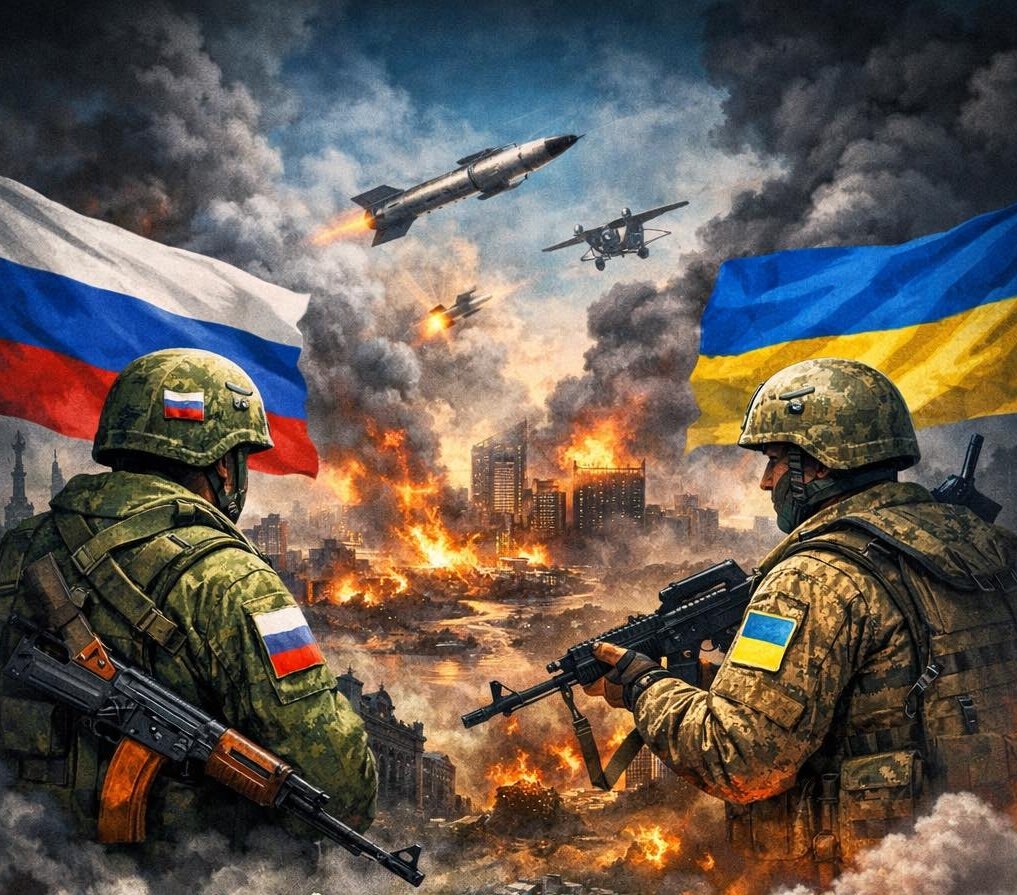
Feb. 24 marks the fourth anniversary of the war that reshaped not only Ukraine and Russia, but the entire architecture of European security. What felt like a geopolitical shock in 2022 has become a prolonged reality in 2026.
Four years is long enough for governments to change, forecasts to collapse and initial emotional reactions to fade. But the war has not ended.
On the battlefield, the intensity remains high. Russia continues strikes on Ukrainian infrastructure using missiles and large waves of drones. Ukraine responds with its own attacks, including operations targeting Russian territory. Daily briefings are filled with numbers – drones launched, drones intercepted, missiles fired, casualties reported. Behind those figures lies a fourth year of life under sirens.
Yet if in 2022 the primary fault line ran across the front, by 2026 it increasingly runs through Europe itself.
Energy has evolved from an economic issue into a strategic political lever. Positions taken by Slovakia and Hungary illustrate that European unity is no longer perceived as monolithic. Threats to block sanctions, delays in approving financial packages, disputes over the Druzhba pipeline – all reflect fatigue and shifting priorities.
Germany argues for firmness. Brussels speaks the language of principles. Budapest emphasizes national interests. The debate is no longer tactical – it is strategic: how long is Europe prepared to absorb the economic and political costs of a prolonged war?
Inside Ukraine, duality defines the mood. There is exhaustion – but also a hardened resolve shaped by years of survival. Illusions have diminished. Adaptation has replaced mobilization.
In Russia, the war has become a structural factor of domestic and foreign policy. Part of society has adjusted to the new reality, part has left, part continues to fight. The economy has been restructured under sanctions, but long-term uncertainty has become permanent.
The central question is no longer simply who will prevail – but what the cost of the eventual settlement will be.
Four years have demonstrated that rapid conclusions are unlikely. Pressure applied to only one side does not produce sustainable peace. Sanctions impose constraints but do not immediately break systems. Military dynamics shift in waves.
Peace remains possible – but it will not resemble the scenarios discussed in the spring of 2022.
For the South Caucasus, this war has never been a distant European crisis.
The prolonged conflict between Russia and Ukraine has fundamentally altered the balance of influence around the region. Moscow has become strategically absorbed by the Ukrainian theater – militarily, economically and politically. That has inevitably reduced the bandwidth available for previous levels of engagement in the South Caucasus.
During this period, the region began to recalibrate.
Azerbaijan strengthened its geopolitical agency, emerging as a key transit hub between East and West. The Middle Corridor, expanded energy routes and increased gas supplies to Europe became integral to a new strategic logic shaped after 2022. As Europe sought to reduce dependence on Russian energy, attention toward the Caspian basin intensified.
For Armenia, the war also became a catalyst for transformation. Russia’s reduced capacity altered strategic calculations in Yerevan. Engagement with the European Union and the United States gained momentum. At the same time, internal debates emerged regarding long-term security guarantees and alliance structures.
The South Caucasus entered a phase where traditional influence frameworks no longer operate automatically.
Russia remains present, but its leverage is recalibrated. Turkey has expanded its strategic footprint. Iran closely monitors transport corridors and security shifts. The EU has increased diplomatic involvement. The United States has become more visible in mediation efforts.
The war accelerated multipolarity in the region.
But risks accompany opportunity.
The longer the conflict persists, the greater the likelihood that the South Caucasus will be viewed as a competitive arena – for transit routes, sanctions circumvention, energy flows and strategic positioning. This dynamic creates leverage but also vulnerability.
For Azerbaijan, this requires increasingly precise balancing. Strategic alignment with Turkey and deepening ties with the European Union must coexist with pragmatic engagement with Russia. The Iran factor and evolving U.S. policy add further complexity.
The fourth year of war is not merely a calendar milestone. It signals the consolidation of a new geopolitical reality in which the South Caucasus is no longer peripheral, but part of a broader strategic equation.
The key question for the region is not only when the war will end, but what kind of post-war order will emerge.
If a settlement reflects a negotiated compromise among major powers, the region will adapt to a restructured framework of influence. If the conflict freezes without a clear security architecture, the South Caucasus risks remaining in a prolonged state of strategic tension.
Four years have shown that instability can become normalized.
In such an environment, those who act strategically – rather than reactively – will shape the outcome.