Aze.US
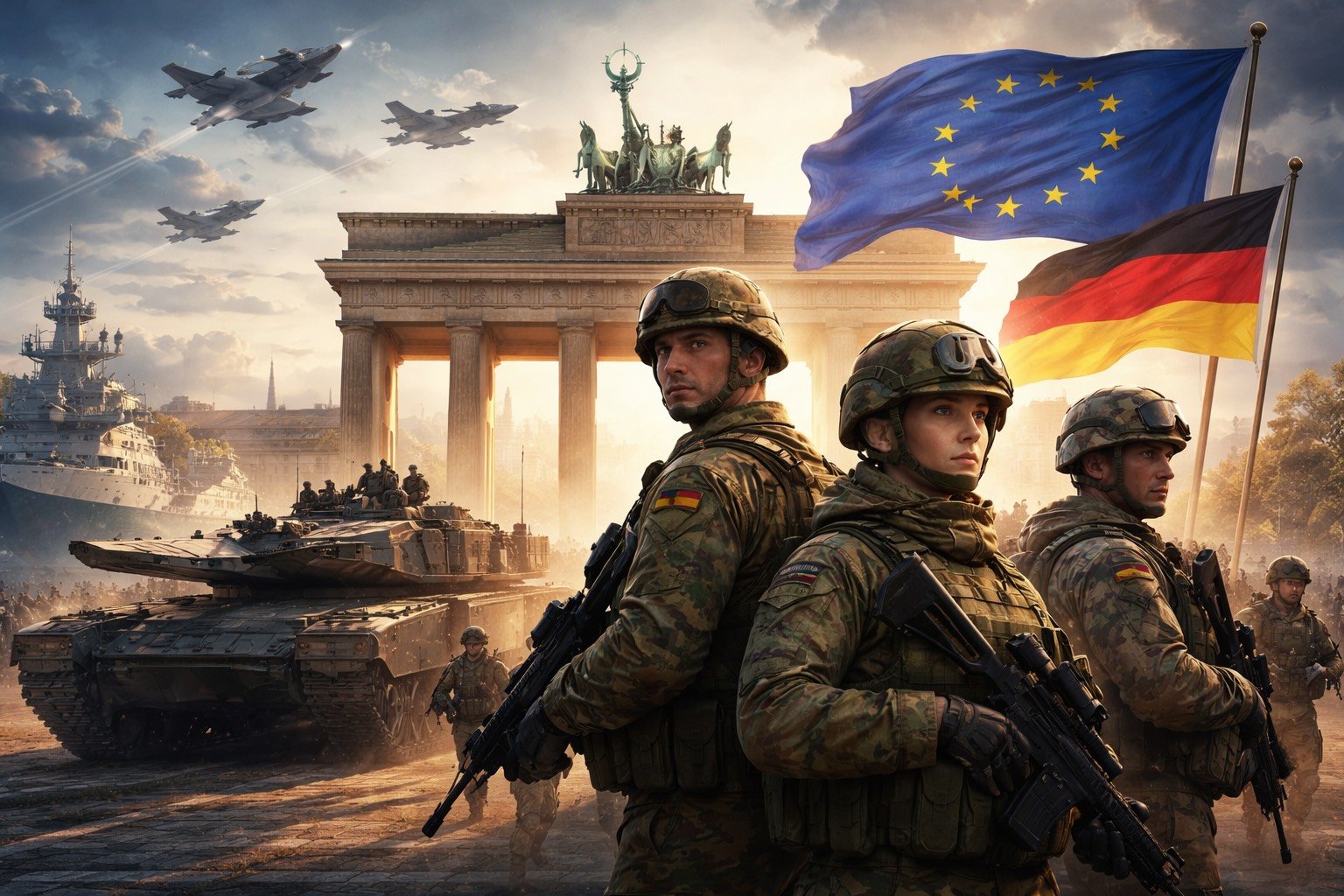
The latest Munich Security Conference underscored a turning point for Europe: the post-World War II security model built around U.S. guarantees is weakening, forcing European states-led by Germany-to reconsider their own military responsibility and strategic autonomy.
For decades, Europe’s stability rested on a simple assumption: the United States would remain the ultimate security guarantor of the continent.
That assumption is now under strain.
Statements from U.S. political leaders emphasizing national interests over alliance commitments, combined with shifting global priorities, have created growing uncertainty inside Europe about the durability of transatlantic protection.
Munich did not produce a formal rupture. But it exposed something more important-doubt. And doubt alone is enough to reshape strategy.
Germany’s Psychological Shift
At the center of this reassessment stands Germany, a country that deliberately limited its military role after World War II.
Today, Berlin is increasingly speaking the language of:
-
higher defense spending,
-
stronger armed forces,
-
greater responsibility for European security.
For Germany, this is not merely policy change. It is a historical and psychological transformation.
Any German move toward military strength inevitably raises sensitivities across Europe. Yet the changing security environment is pushing Berlin toward a leadership role it long tried to avoid.
Europe Between Dependence and Sovereignty
The weakening certainty of U.S. protection is forcing the European Union to confront postponed questions:
Can Europe coordinate its own defense?
Can it act strategically without Washington?
Can it translate economic power into military capability?
The answers remain unclear. EU members still disagree on priorities, spending, and political direction.
But the debate itself marks a shift from comfort to responsibility.
Ukraine as the Strategic Test
Russia’s war in Ukraine has become the defining test of Europe’s geopolitical relevance.
If Europe’s security future is negotiated without Europe at the table, its global influence will inevitably diminish.
Support for Ukraine, therefore, is not only about territory or diplomacy. It is also about Europe’s credibility as a strategic actor.
A Changing Global Balance
The broader message of Munich extends beyond Europe.
As the international system moves toward fragmentation and competing power centers,
countries capable of linking regions-through energy, transport, and diplomacy-gain strategic weight.
This reality is increasingly visible across Eurasia, where connectivity and mediation are becoming as important as military strength.
The End of Guaranteed Peace
Munich delivered a quiet but profound conclusion:
The era of automatic security guarantees is fading.
Europe is entering a period in which peace will depend less on historical memory and more on capability, coordination, and political will.
Whether this transition produces stronger stability or deeper instability remains uncertain.
What is already clear, however, is that Europe has crossed a psychological threshold-and the consequences will shape the global balance for years to come.