AZE.US
A month into the war with Iran, the central illusion has collapsed: this was never going to end with a quick, clean declaration of victory.
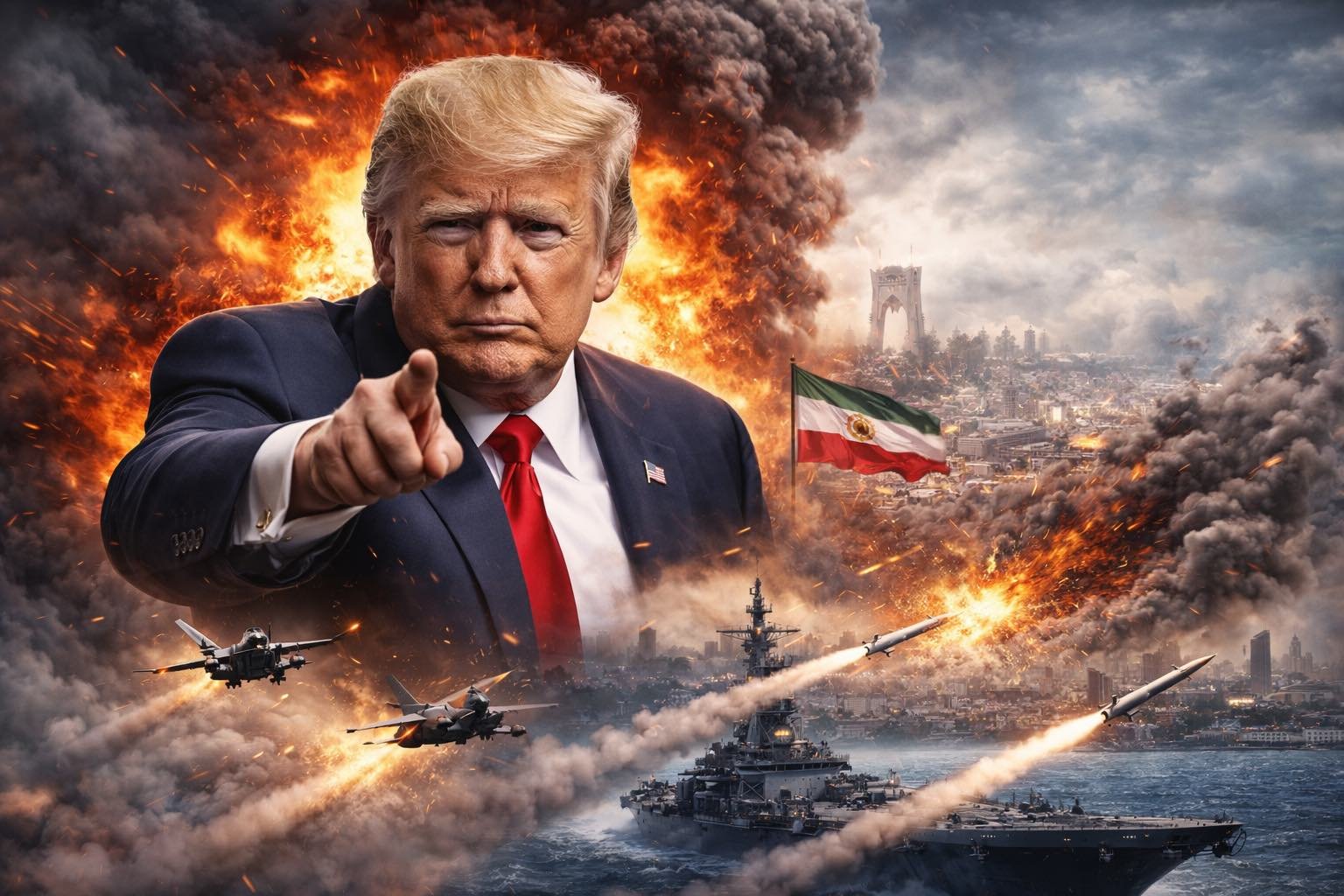
What looked at first like a fast-moving military campaign has hardened into something far more dangerous – a war of attrition, strategic signaling and unfinished objectives. Airstrikes, missile exchanges, attacks on infrastructure and threats around maritime chokepoints have become part of the daily rhythm. The headlines keep changing, but the real question no longer does: what does Washington still need to achieve before Donald Trump can claim the war has reached its endpoint?
Judging by the logic now taking shape around the conflict, the answer appears to come down to two final targets.
The first is Iran’s stockpile of enriched uranium.
Military strikes on facilities, command centers and weapons systems may weaken Iran, but they do not settle the most important question if Tehran still retains the material needed to preserve its nuclear leverage. As long as that stockpile remains intact, any American claim that the mission has been completed would look politically hollow. It would suggest that the infrastructure was hit, but the core problem survived.
That is why the final stage of this war increasingly looks less like a broad ground campaign and more like a highly focused operation aimed at locating, removing or neutralizing the enriched uranium that remains in Iranian hands. Without that, Trump cannot convincingly present the outcome as a strategic success. He can say Iran was punished. He cannot say the threat was truly closed.
The second target is Khark Island.
If the uranium issue is about future strategic danger, Khark is about Iran’s economic lifeline in the present. The island is one of the key arteries of Iran’s oil exports. In practical terms, that makes it not just a geographic point on the map, but a pressure point at the center of Iran’s ability to keep its economy functioning under wartime conditions.
Any move to seize, disable or render Khark unusable would strike directly at the revenue base that keeps the Iranian system alive. And here, the military logic may not even require long-term occupation. In wars like this, total control is not always necessary. Sometimes destroying normal function is enough. If the export artery stops working, the broader strategic effect may be the same.
That is what makes this phase of the war so consequential. It suggests Washington may not be seeking a dramatic, cinematic victory, but rather a controlled point of exit – a moment when Trump can say the essential objectives were met, step back, and leave the next stage to unfold inside Iran itself.
That next stage may be the real calculation behind the campaign.
The military phase weakens air defenses, damages infrastructure, disrupts military industry and raises the cost of resistance. But the political phase begins after the strikes. If Iran emerges with its economy under severe pressure, its export channels damaged and its strategic assets compromised, the burden shifts inward. The regime then faces not just external enemies, but internal anger, economic exhaustion and a population forced to absorb the consequences of a prolonged war.
This is why the claim that Iran has “held on” should be treated with caution. Survival is not the same as stability. A state can remain standing while losing much of its strategic depth. A regime can stay in place while the country underneath it becomes harder to govern, harder to finance and harder to calm.
The other major layer is the Gulf.
The issue of Hormuz and broader Gulf shipping is now widening the meaning of the war. This is no longer only about Washington, Tehran and Israel. It is about Arab states, Asian buyers, European energy interests and the global economy. And this is where Trump’s political instinct becomes visible again: he may be moving toward a position in which the United States declares that its core mission was limited and that the wider consequences – oil flows, maritime security, regional military coordination – are problems for others to confront as well.
That logic is pure Trump: blunt, transactional and destabilizing.
In effect, the message is simple. America handles the part it sees as directly tied to its strategic interest. The rest of the world must stop pretending this is someone else’s problem.
If that becomes the new doctrine, the implications will stretch far beyond Iran. Arab monarchies will be forced to rethink how much they can rely on the U.S. security umbrella. Europe will face new questions about alliance commitments and strategic autonomy. Regional powers such as Turkey, Saudi Arabia and Pakistan will look more seriously at new security alignments built for a more fragmented postwar order.
In that sense, the war around Iran is no longer just a military confrontation. It is becoming a stress test for the larger architecture that has shaped the region for decades.
And that brings us back to Trump’s two final moves.
If Washington manages to deal with Iran’s enriched uranium and cripple the country’s main oil artery, Trump will have the political argument he needs. He will be able to say the central mission was fulfilled, that Iran’s strategic capacity was broken and that the next chapter belongs to the region, to Iran’s own internal dynamics and to the wider international system.
But that next chapter may prove even more dangerous than the first.
Because once the bombing phase gives way to economic shock, internal instability and new geopolitical bargaining, the war will not really be over. It will simply have entered a more uncertain form – one in which the missiles may slow down, but the consequences begin to spread.