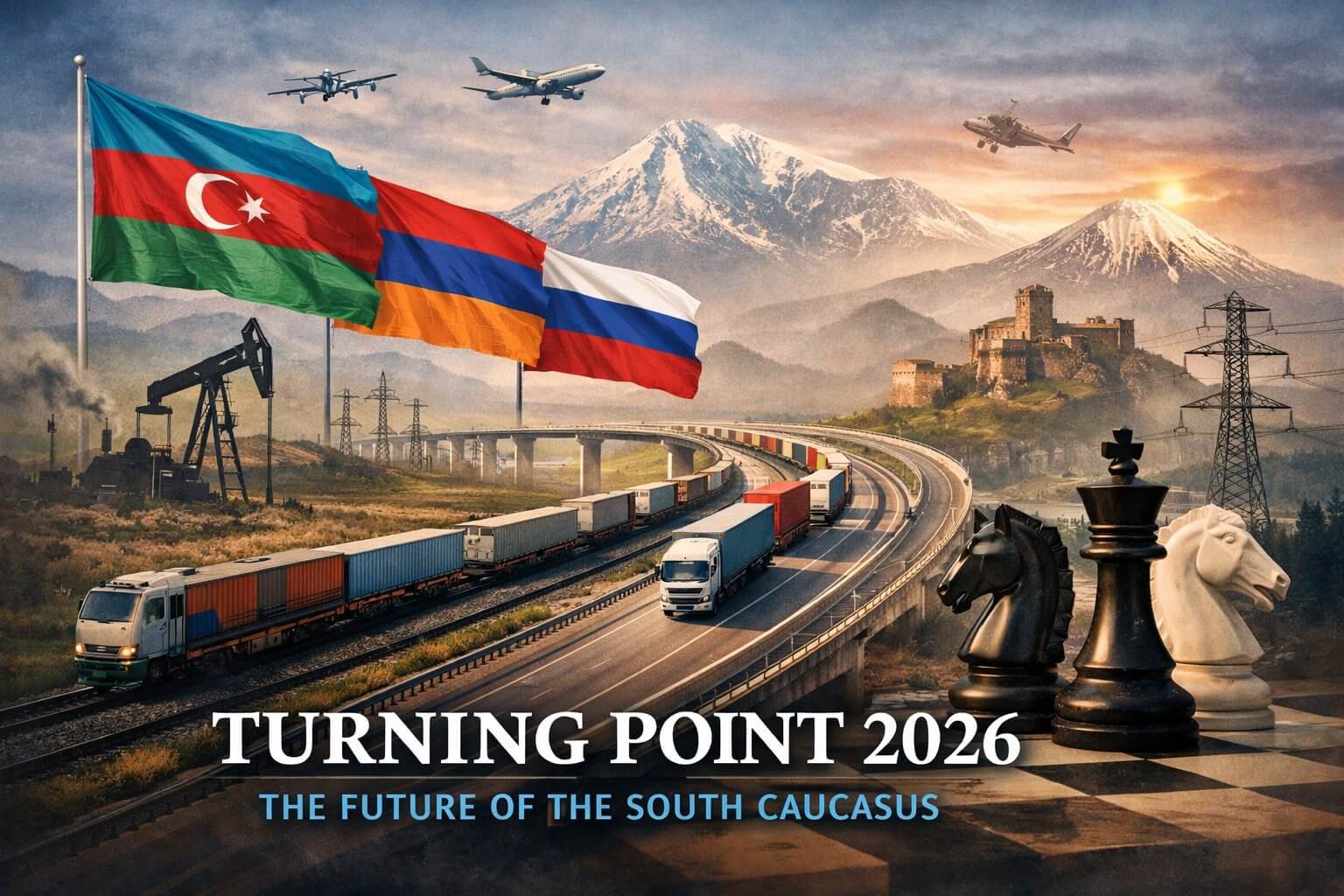
Aze.US
The geopolitical balance in the South Caucasus is entering a phase that analysts increasingly describe as transitional rather than merely tense.
After several years marked by conflict, fragile ceasefires, and shifting alliances, regional dynamics are beginning to evolve toward something more structural: a gradual redefinition of influence, connectivity, and long-term security architecture.
For Azerbaijan, Armenia, and their external partners, the central question of 2026 is no longer confined to post-conflict stabilization.
Attention is steadily shifting toward transport corridors, economic integration, and cautious political normalization, even as deep mistrust persists.
From confrontation to configuration
The period immediately following the 2020 war was dominated by military and humanitarian concerns.
The current phase, by contrast, is increasingly shaped by:
-
transport negotiations
-
border delimitation debates
-
regional mediation formats
-
competing visions of connectivity
These processes remain uneven and politically sensitive.
Yet their very existence signals movement away from pure confrontation toward long-term regional configuration.
External actors and a changing balance
Another defining feature of the moment is the diversification of diplomatic influence.
Traditional regional powers remain central, but newer mediation channels and economic interests are reshaping the diplomatic landscape.
Instead of a single dominant framework, the South Caucasus is now witnessing parallel engagement tracks-a sign of both opportunity and instability.
For Azerbaijan, this environment creates space for:
-
expanded transport diplomacy
-
energy diversification partnerships
-
broader economic positioning between Europe and Asia
But it also demands careful strategic calibration.
The quiet rise of connectivity
Perhaps the most consequential shift is the growing centrality of transport and logistics corridors.
Infrastructure once viewed as theoretical is now treated as economically decisive.
If realized, regional connectivity could:
-
reshape trade flows across Eurasia
-
reduce long-standing isolation dynamics
-
anchor political normalization in shared economic interest
History suggests that shared infrastructure often stabilizes fragile regions more effectively than temporary political agreements.
A fragile but real transition
None of this guarantees stability.
Unresolved disputes, domestic political pressures, and external rivalries continue to pose risks.
Still, 2026 may ultimately be remembered not for dramatic breakthroughs,
but for a quieter transformation – the moment when the region began shifting from war logic toward corridor logic.
And in geopolitics, such quiet shifts often matter most.