AZE.US
The crisis around Iran and the Strait of Hormuz is becoming more than another Middle East confrontation. It is now a test of global energy flows, shipping security and the routes that connect Europe with Asia.
The latest reports from AP and Reuters show that the situation around Hormuz remains highly unstable. AP reported that U.S. President Donald Trump ordered American forces to “shoot and kill” Iranian boats if they attempt to lay mines in the Strait of Hormuz, one of the world’s most important energy routes. The same report said Washington is expanding mine-clearing operations in the area as maritime risks grow.
Reuters reported that oil prices rose sharply on Friday as renewed military tensions in the Middle East pushed markets higher. Brent crude climbed to $106.06 a barrel, while West Texas Intermediate reached $96.56. The rise reflected fears that the current pause in fighting could become a preparation period for another round of escalation rather than a real path toward de-escalation.
The threat is not limited to conventional naval power. Reuters also reported that Iran’s fast-boat tactics remain a serious problem for shipping near Hormuz. These small, armed boats can operate in groups, move quickly and create disruption even when larger naval assets are under pressure. Their use increases risks for commercial shipping, insurance costs and energy transport.
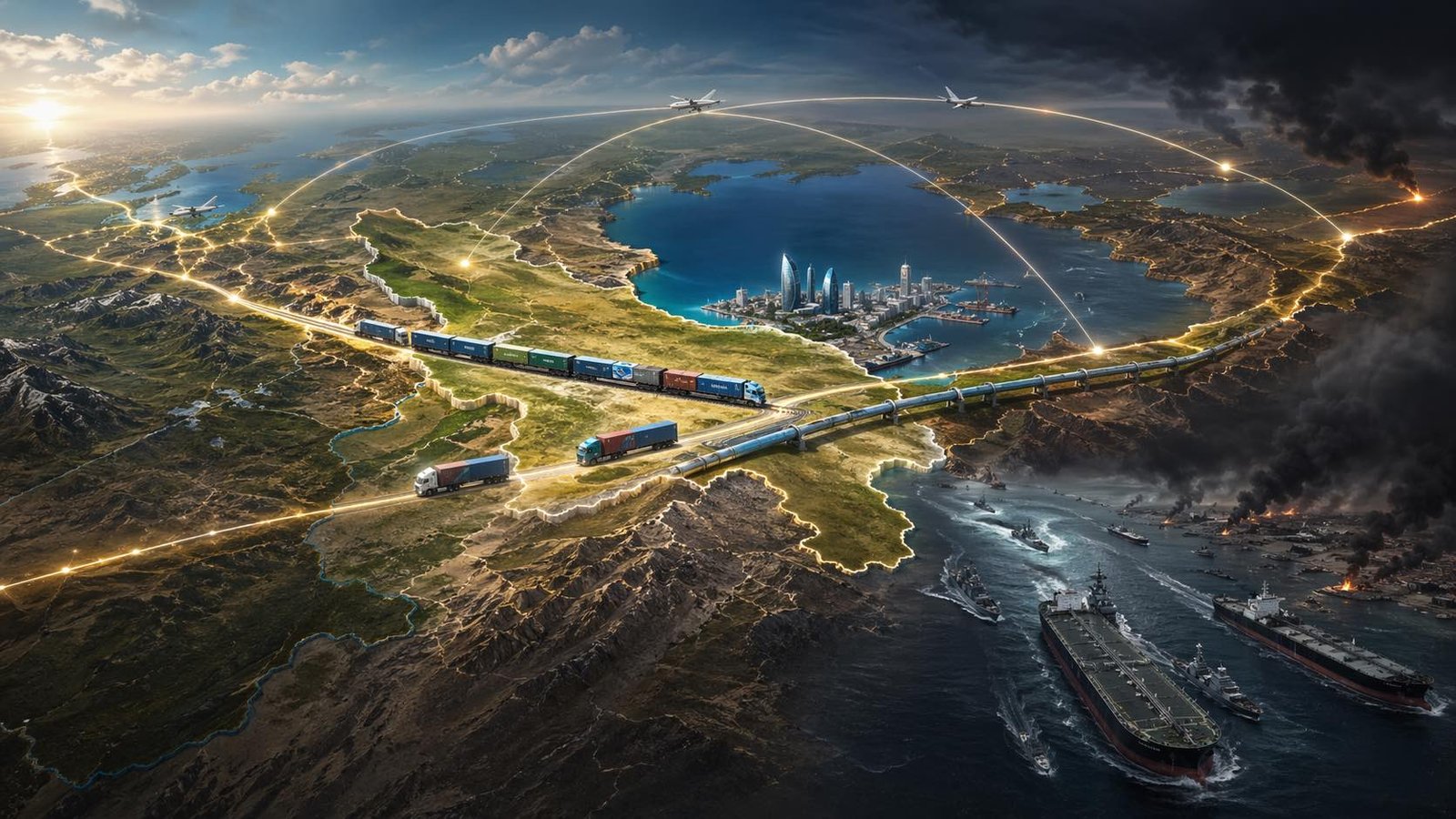
This is where Azerbaijan’s role becomes more important. As instability grows around Iran and maritime routes in the Gulf, the South Caucasus gains additional strategic value as a land and air corridor between East and West. Azerbaijan is not simply watching the crisis from a distance. Its geography places it near the center of the emerging route map.
Former Azerbaijani Foreign Minister Tofig Zulfugarov described the current standoff as both a military and a blockade conflict.

In his view, Iran is using the Strait of Hormuz as a pressure point, while the United States is using maritime restrictions and control over Iranian cargo flows as part of a broader strategy. He argued that the crisis is not only about Iran’s nuclear or missile program, but also about who controls energy and communication routes.
Zulfugarov said the United States may not be interested only in reopening Hormuz as quickly as possible. His assessment is that Washington can also use the crisis to put pressure on major competitors that depend heavily on Gulf energy, especially China, India and parts of Europe. When oil, gas and transport costs rise, industrial costs also rise. That changes the competitive balance between major economies.
For Azerbaijan, the key point is clear: the more dangerous maritime and southern routes become, the more valuable stable overland and air corridors become. Russia’s war against Ukraine has already complicated northern routes. The Iran crisis adds pressure to the south. In between, Azerbaijan and Georgia form one of the few relatively stable bridges between Europe and Asia.
Zulfugarov compared this route to a kind of “land Suez Canal,” a narrow but vital corridor between larger zones of instability. The phrase captures the new reality well. Azerbaijan’s value is no longer only about oil, gas or regional diplomacy. It is also about continuity: keeping cargo, flights, humanitarian traffic and political communication moving when other routes are under pressure.
That does not mean Azerbaijan faces no risk. On the contrary, the country’s growing transit importance also makes stability more valuable and more vulnerable. Any disruption in the South Caucasus would affect not only Baku, but also countries and companies looking for safer routes between Europe and Asia.
The Hormuz crisis therefore changes the way Azerbaijan’s geography is viewed. In calmer times, transit routes are often treated as technical infrastructure. In a crisis, they become strategic assets. The current confrontation around Iran is showing exactly that.
For Baku, the challenge is to preserve the country’s role as a secure corridor without being pulled into the turbulence around it. If Hormuz remains unstable and regional conflict continues, Azerbaijan’s position between East and West will only become more important.
AZE.US