By Leyla Mammadli for Aze.US
Central Asia is moving closer to the center of global geopolitics.
The region was long viewed largely through the lens of outside powers: Russia, China, the West and, to some extent, Turkey. That picture is changing. Central Asian states are increasingly acting as independent players, using their geography, resources and diplomatic flexibility to strengthen their role in global trade, energy and security.
The Silk Seven Plus, or S7+, initiative fits into this wider shift. It is not only about regional cooperation. It is also an attempt to give institutional shape to a new Eurasian model, one in which Central Asia is more deeply connected to global markets and less dependent on any single route, power or political center.
In that model, Azerbaijan has a special role.
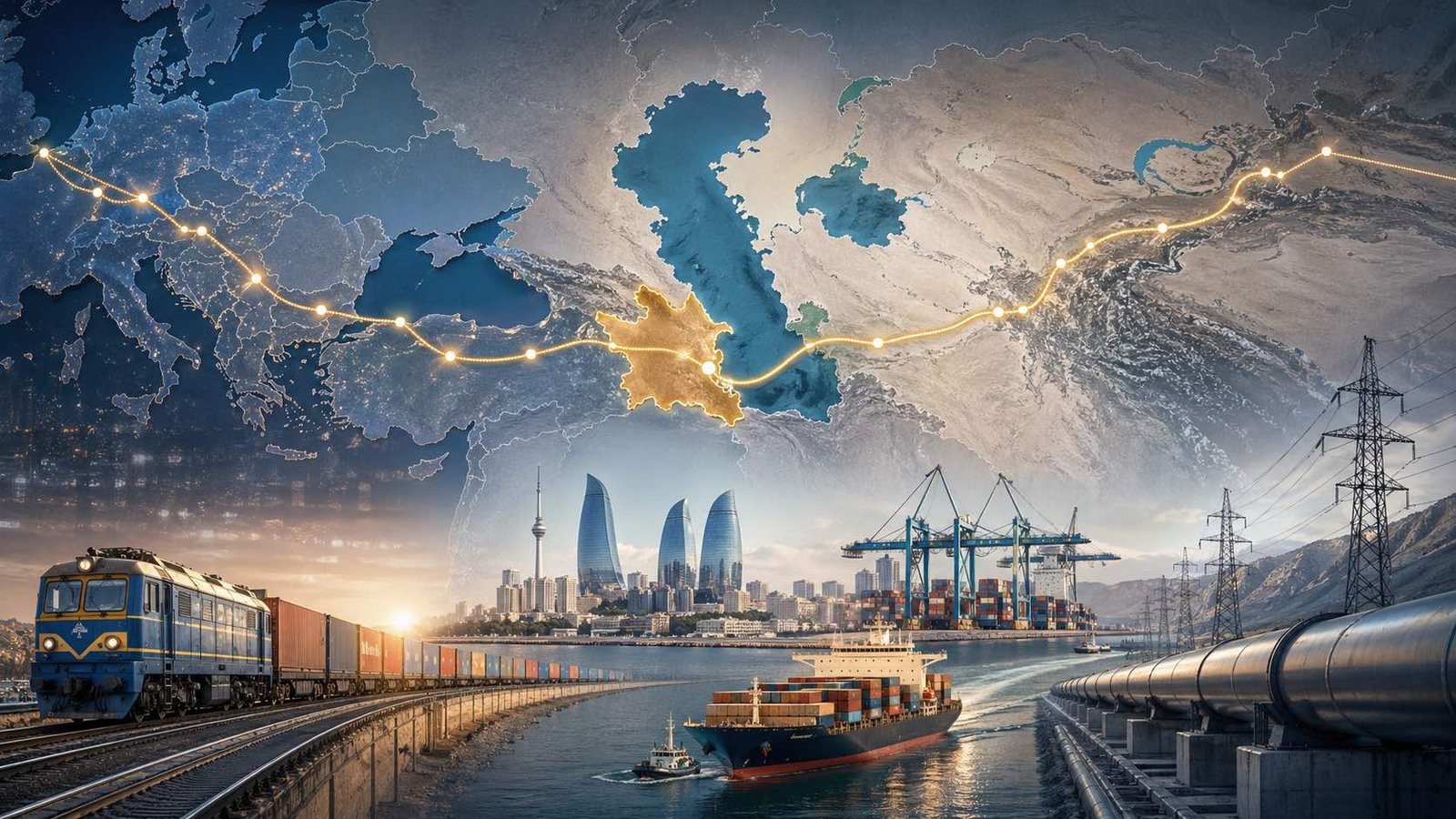
The central idea behind this new phase of integration is connectivity. Trade routes, ports, railways, energy corridors and digital links are becoming as important as traditional diplomacy. That is why the Trans-Caspian International Transport Route, widely known as the Middle Corridor, has gained new relevance since the start of Russia’s war against Ukraine and the disruption of older trade routes.
The Middle Corridor links China and Central Asia to Europe through the Caspian Sea, Azerbaijan, Georgia and Turkey. For this route to work, Azerbaijan is not a side player. It is one of the main operational hubs.
Geography gives Baku an obvious advantage. Azerbaijan sits between the Caspian basin, the South Caucasus, Turkey and European markets. But its role is not based on geography alone. Over the past decade, the country has invested in infrastructure that turns its location into a practical economic asset.
The Baku International Sea Trade Port, the Baku-Tbilisi-Kars railway and other logistics projects have made Azerbaijan a key transit and transport link between Central Asia and the West. In this sense, Azerbaijan is no longer just a corridor on the map. It is becoming part of the institutional machinery of Eurasian integration.
Energy strengthens that position further.
Through the Southern Gas Corridor, Azerbaijan already plays an important role in supplying Caspian energy resources to European markets. That has become more significant as Europe looks for alternatives to Russian energy. In the years ahead, green energy, electricity interconnectors and potential hydrogen projects could expand Azerbaijan’s role beyond oil and gas.
That is why the S7+ framework may eventually become more than a transport initiative. It could also support cooperation in energy security, renewable power, technology and infrastructure finance.
The opportunity is clear, but the obstacles are real.
Regional trade remains limited. Customs procedures are not always synchronized. Logistics systems still need modernization. Large infrastructure projects require long-term financing and stronger institutional coordination. Security risks, including the situation around Afghanistan, also remain part of the wider regional equation.
These challenges help explain why Western involvement matters. The United States and the European Union have a growing interest in alternative routes linking Asia and Europe. Investment, technical support and institutional partnerships could help turn political interest in the Middle Corridor into real economic capacity.
For the West, Azerbaijan offers a practical gateway into the region. It has experience working with European energy markets, maintains a strategic position on the Caspian and can connect Central Asia with the South Caucasus, Turkey and Europe.
Another important factor is the normalization process between Azerbaijan and Armenia. A peace agreement would not only reduce political risk in the South Caucasus. It could also open the way for expanded transport links, stronger regional trade and a more stable environment for long-term infrastructure projects.
The S7+ initiative should therefore be seen not only as an economic project, but as part of a wider reordering of Eurasian connectivity. It brings together questions of trade, energy, diplomacy, culture, academic cooperation and people-to-people ties.
For Azerbaijan, this creates a window of opportunity. The country can strengthen its position as a bridge between Central Asia, the Caspian, Turkey and Europe. If regional governments turn political declarations into practical coordination, S7+ could become one of the pillars of a new Eurasian integration model.
The key question is whether the countries involved can turn geography into durable economic power.
Azerbaijan already has the location, infrastructure and diplomatic experience to play that role. That is why, in the emerging Eurasian landscape, Baku is not just watching the process. It is helping shape the route.
AZE.US