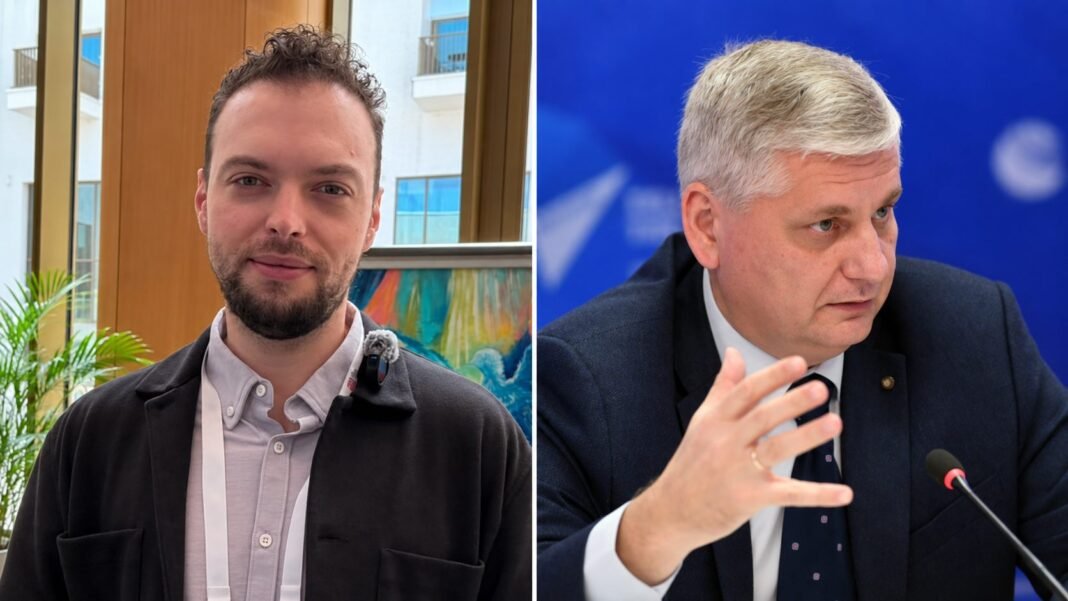
BAKU, Azerbaijan - Azerbaijan is not seeking NATO membership, maintains relations with Russia and has not joined an anti-Russian bloc. Yet a debate between Russian experts Alexey Naumov and Sergey Markedonov showed why those positions have not eliminated mistrust between Baku and Moscow.
The discussion on the Echo Baku YouTube channel centered on whether Russia can cooperate with its neighbors without treating their independent foreign-policy decisions as a threat.
The conversation began with the idea that Moscow could build relations through trade, transport and shared economic interests without demanding military bases, membership in Russian-led organizations or political subordination. But the debate exposed a fundamental disagreement: Azerbaijan may view cooperation with Turkey or Western states as an exercise of sovereignty, while Moscow may interpret the same choices as a challenge to Russian security and influence.
Rejecting NATO Membership Does Not End the Dispute
Naumov argued that Russia should stop treating former Soviet republics as countries that left a shared political home and therefore owe Moscow special loyalty. Pressure and public disrespect drive partners away, he said, while Russia should instead explain the concrete benefits of cooperation.
At the same time, Naumov said neighboring states must take Russia’s “red lines” into account, citing Ukraine’s NATO ambitions as an example.
The program’s host contrasted that argument with Azerbaijan’s position. Baku is not seeking NATO membership or building an anti-Russian coalition, but it continues to face Russian suspicions.
Markedonov said the security debate extends beyond formal alliance membership. He pointed to Azerbaijan’s westward energy links and its close military cooperation with Turkey, a NATO member.
The exchange suggested that Moscow’s concerns are not limited to the possibility of Azerbaijan entering a military alliance. They also cover Baku’s existing network of energy, defense and political relationships, leaving uncertainty over what Russia would consider sufficient reassurance.
Azerbaijan has maintained a long-running partnership with NATO without seeking membership. NATO says formal relations began in 1992 and currently include political dialogue, military interoperability and defense education.
Trade Cannot Erase Historical Memory
Both countries have practical reasons to cooperate. Markedonov cited the delimitation of the Azerbaijan-Russia border and Russian involvement in the 1994 Karabakh ceasefire.
Azerbaijani President Ilham Aliyev and then-Russian President Dmitry Medvedev signed a state-border agreement on Sept. 3, 2010. The 1994 ceasefire was reached through Russian mediation in cooperation with the OSCE Minsk process.
The host argued, however, that economic interests and diplomatic agreements do not erase the historical sources of Azerbaijani distrust. He cited the Soviet military intervention in Baku in January 1990, the Khojaly massacre and Moscow’s long support for the previous status quo in the Karabakh conflict.
Human Rights Watch documented that Soviet troops entered Baku on the night of Jan. 19, 1990, before the state of emergency was publicly announced. In its response concerning Khojaly, the organization said Karabakh Armenian forces and troops of the 366th regiment deliberately disregarded restraints on attacks against civilians fleeing the town.
Markedonov urged a broader discussion of responsibility involving both the Soviet central authorities and local Soviet leaders. The question for the current relationship, however, is whether Moscow can acknowledge the basis of Azerbaijan’s distrust without dismissing it as anti-Russian rhetoric.
Russia Still Has a Role, but Under What Conditions?
Despite the sharp criticism, the host argued against Russia’s complete departure from the South Caucasus. His reasoning was that the presence of several major powers gives Azerbaijan more room to maneuver and reduces the risk of excessive dependence on any single partner.
In that framework, working relations with Moscow can also help Baku preserve autonomy in its partnership with Ankara. Azerbaijan and Turkey are close allies, but their interests do not necessarily coincide on every issue.
Naumov said Russia should use that opening by showing Azerbaijan the advantages of cooperation rather than pushing it closer to other power centers through suspicion and pressure.
The potential basis for partnership is therefore clear: Azerbaijan has an interest in stable relations with Russia, and Russia benefits from dealing with a sovereign Azerbaijan capable of making its own agreements. But that arrangement requires Moscow to accept that Baku will sometimes make decisions Russia dislikes.
Disagreement Is the Real Test
Naumov and Markedonov ultimately agreed more than the debate’s initial framing suggested. Both favored pragmatism and a more respectful Russian approach toward neighboring states. The unresolved issue was how much independent action Moscow is prepared to accept.
Markedonov said neighboring countries should not use new relationships to push Russia out. But the discussion left open who decides when normal geopolitical competition becomes an effort to exclude Moscow.
That question has direct consequences for Azerbaijan. Its energy projects, military partnerships and transport routes inevitably affect several powers, making it impossible to secure unanimous approval for every decision.
Azerbaijan’s refusal to seek NATO membership therefore does not by itself guarantee conflict-free relations with Russia. The more consequential test is whether Moscow can accept Baku’s sovereign choices when they do not align with Russian preferences.
Source: Vesti Baku