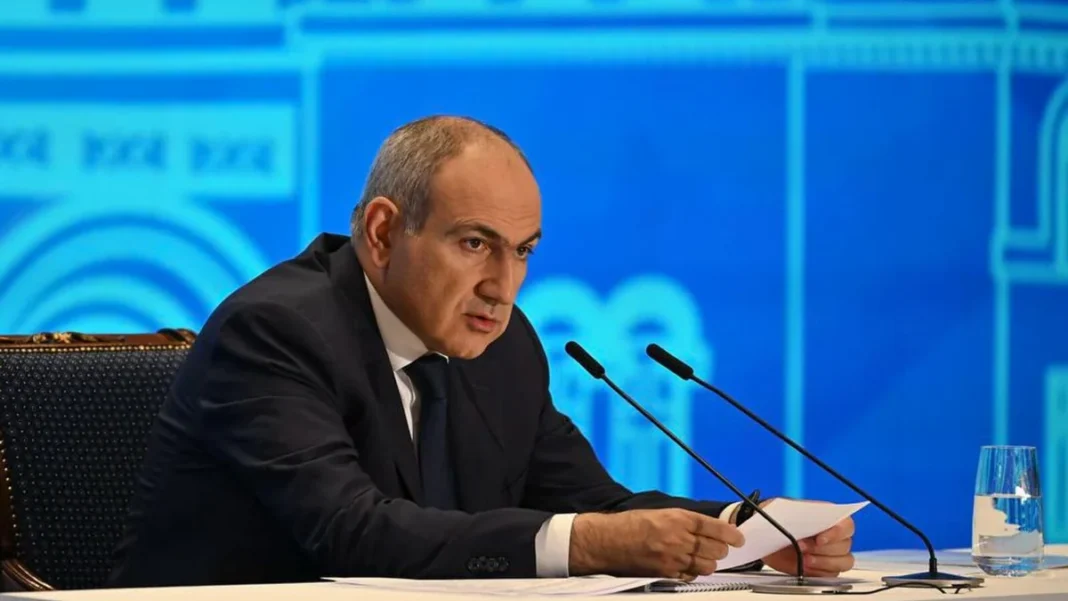
Armenian Prime Minister Nikol Pashinyan has published a draft of a new constitution on a dedicated website, opening it for public review and proposals.
For Azerbaijan, the central question is whether the draft removes provisions Baku regards as territorial claims.
Pashinyan announced the publication on Facebook, saying a new online platform would allow every citizen to review the document and submit comments and suggestions.
The draft is available at yourconstitution.am. Pashinyan also said he would address the public live at 10 a.m.
The Main Question for Baku
The new constitutional draft is directly connected to prospects for a final peace agreement between Armenia and Azerbaijan.
Baku has repeatedly said Armenia’s current constitution contains language that could be interpreted as territorial claims against Azerbaijan.
The principal concern is the preamble’s reference to Armenia’s 1990 Declaration of Independence. That declaration mentions a 1989 resolution on the unification of the Armenian Soviet Socialist Republic and Nagorno-Karabakh.
Azerbaijan has insisted that such language be removed before a peace treaty is finally signed.
Yerevan says the current constitution contains no territorial claims against neighboring countries. Pashinyan, however, has repeatedly said a new constitution should not refer to the Declaration of Independence.
The preamble in the newly published draft does not contain a reference to the 1990 declaration, according to the text cited by Factor TV.
Instead, the draft refers to building an independent, peaceful, secure and prosperous state “on our internationally recognized territory.”
The document is a proposal for public discussion. Armenia’s current constitution has not yet changed.
The Peace Agreement Has Not Been Signed
Azerbaijan and Armenia initialed the text of a peace agreement in Washington on Aug. 8, 2025, with U.S. mediation.
Initialing the text did not amount to final signature or bring the agreement into force.
Constitutional reform in Armenia remains one of the principal unresolved issues. Azerbaijan wants the rejection of territorial claims established in a way that would prevent future Armenian governments from using domestic law to challenge the agreements reached with Baku.
Pashinyan has described a new constitution as part of a transition to his concept of “Real Armenia,” based on recognition of the republic’s internationally recognized borders.
Parliament and Voters Decide Next
Publishing the draft does not mean Armenia has adopted a new constitution. It must go through public discussion, possible revisions and the procedures required by law.
Calling a constitutional referendum requires the support of at least 70 members of Armenia’s 105-seat parliament.
Pashinyan’s ruling Civil Contract party holds 64 seats and therefore needs at least six additional votes.
Parliamentary opposition groups oppose the initiative, accusing Pashinyan of trying to change the constitution under pressure from Azerbaijan.
Pashinyan has invited the opposition to support a referendum and promised to resign within a week if voters reject the new constitution. If voters approve it, he has said he would be prepared not to seek the post of prime minister in the next election.
The proposed reform has therefore become a major domestic political issue as well as a legal one.
For Azerbaijan, the decisive questions will be the draft’s final content and whether it is adopted. If a new constitution removes the disputed language, it could eliminate one of the main obstacles to final signature of an Armenia-Azerbaijan peace agreement.
Source: Vesti Baku.