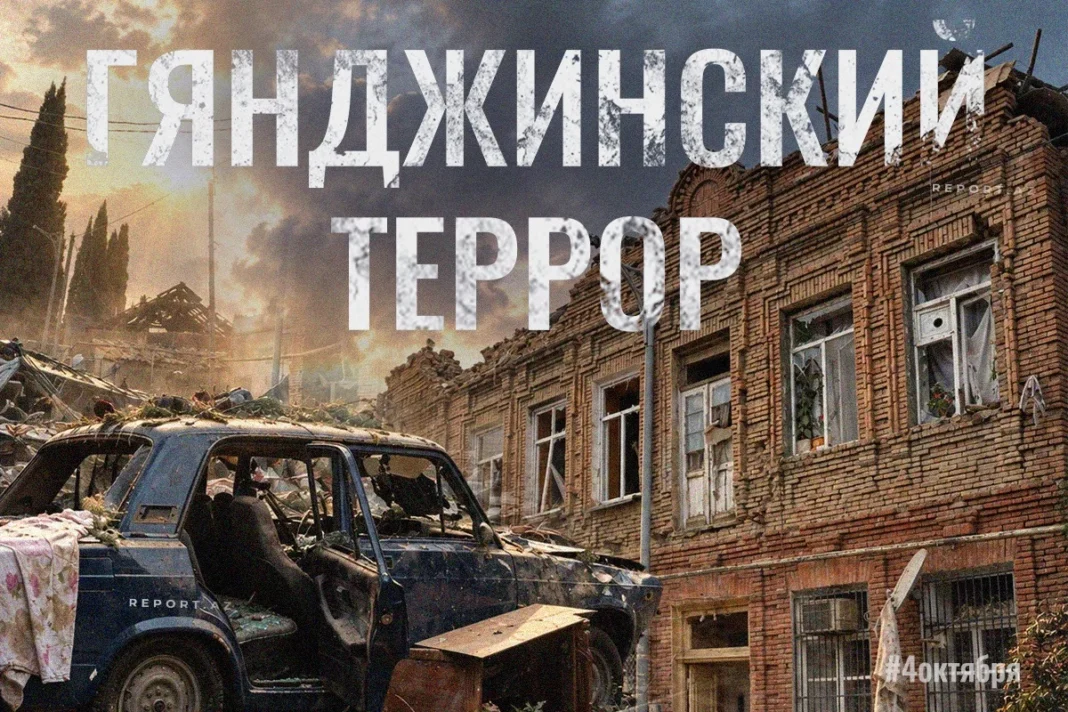
Ganja on Sunday marked six years since the first missile attack on the city during the 2020 Armenia-Azerbaijan war.
The first strike hit residential areas at about 10 a.m. on Oct. 4, 2020. Azerbaijani official materials cited by Vesti Baku say resident Tunar Goshgar oglu Aliyev was killed and 32 people were wounded that day. Private homes, a two-story building, civilian infrastructure and historic structures were damaged.
Ganja, Azerbaijan’s second-largest city, was struck on Oct. 4, 5, 8, 11 and 17. The Azerbaijani account says the five attacks killed 26 civilians, including six children, and wounded 175 people.
Residential Neighborhoods Hit
Azerbaijani authorities said Tochka-U, Smerch and Scud missiles were among the weapons used against the city. Homes, vehicles and other civilian property were destroyed or damaged.
Human Rights Watch, which conducted field investigations after the war, said Armenian forces carried out unlawfully indiscriminate missile and rocket attacks on populated areas of Azerbaijan. The rights group documented Smerch rocket strikes on Ganja on Oct. 4 and Scud-B ballistic-missile attacks on Oct. 11 and 17.
Human Rights Watch said the Oct. 4 barrage killed one civilian and wounded 32, matching the figures cited for the first attack. Its report counted 32 civilian deaths in the attacks it examined in Ganja on Oct. 4, 11 and 17, a higher total than the 26 deaths carried in current Azerbaijani commemorative materials. The sources do not reconcile the difference.
The organization also noted that Azerbaijani military sites were present in or near parts of Ganja, but said that did not permit the use of inaccurate explosive weapons with wide-area effects in populated neighborhoods.
Memorial at the Strike Site
The victims are commemorated at the Ganja Memorial Complex, built at the site of one of the most destructive attacks. The complex preserves the memory of civilians killed and the damage inflicted on the city during the war.
Sources: Vesti Baku; Human Rights Watch.