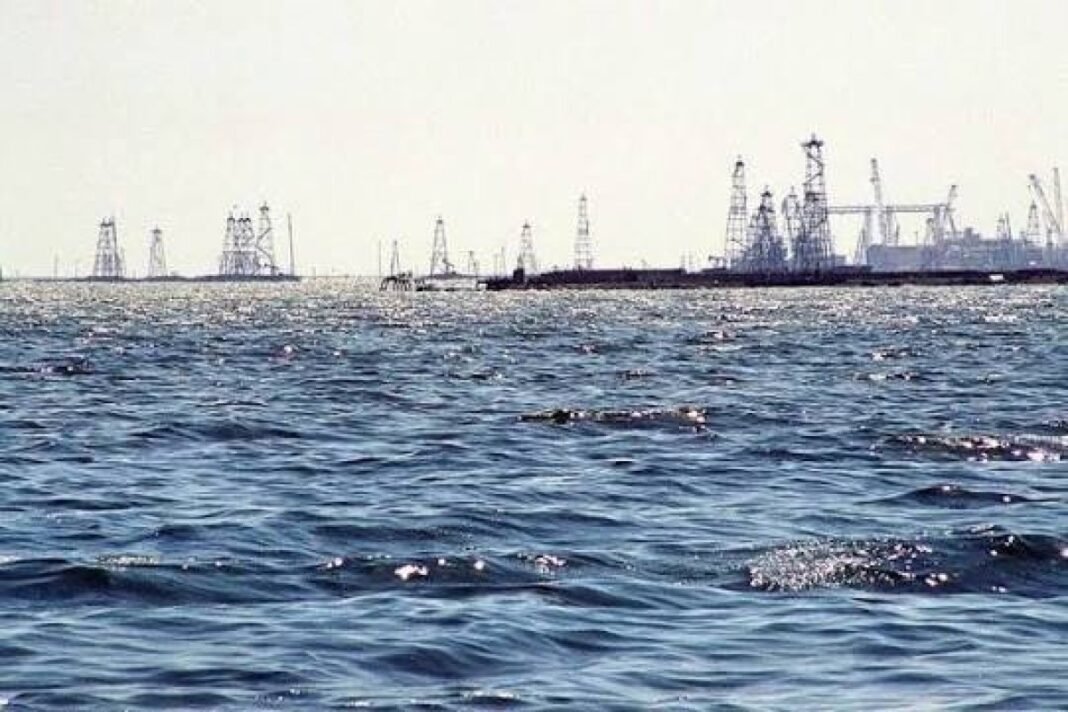
A Kazakhstan-based policy expert said the Middle Corridor’s rapid expansion is increasing the economic importance of the trans-Caspian route, while the retreat of the Caspian Sea threatens to raise shipping costs and disrupt port operations.
Rakhim Oshakbayev, director of Kazakhstan’s TALAP Center for Applied Research, spoke on Oct. 2 at the CAMCA 2026 Regional Forum in Baku. The corridor connects China and Central Asia with Europe through the Caspian Sea, Azerbaijan, Georgia and Türkiye.
APA quoted Oshakbayev as saying the corridor had grown more than 15-fold over two years. A separate Trend report from the same appearance quoted him as saying cargo volumes had increased more than 2.3-fold. The reports did not explain whether the figures referred to different measures, such as container traffic and total cargo volume.
Official figures published separately show the route’s strong recent growth. Cargo shipments exceeded 3 million metric tons in the first eight months of 2026, up 22% from the same period a year earlier, according to Kazakhstan’s vice minister of trade and integration. Slightly more than 4 million tons moved along the route in 2025, compared with a current design capacity of 6 million tons.
Caspian Coastline Retreats 56 Kilometers
Oshakbayev said the coastline in the northern part of the Caspian Sea had retreated by as much as 56 kilometers since 2001. He said the pace of the decline had accelerated over the past five years to about 30 centimeters a year.
“If this process continues, the sustainability and operating costs of the new corridor will become a major challenge for our countries,” APA quoted him as saying.
A Caspian Policy Center assessment similarly found that the northeastern Caspian’s surface area fell from more than 15,000 square kilometers at the beginning of the century to 8,183 square kilometers by October 2024, a decline of nearly 46%. The coastline retreated by about 56 kilometers compared with 2001.
The shrinking sea is already affecting shipping. The assessment said falling water levels have disrupted operations at ports including Aktau and Kuryk in Kazakhstan and Turkmenbashi in Turkmenistan. On some routes, shallow water has forced vessels to operate at only 75% to 80% of capacity.
Why It Matters for Azerbaijan
Azerbaijan occupies the central transshipment point in the route. Cargo crosses the Caspian from Kazakhstan’s Aktau and Kuryk ports to the Port of Baku, then continues by rail through Georgia and Türkiye toward European markets.
The corridor gives shippers an alternative to the northern route through Russia, Belarus and Poland, which Oshakbayev said still handles about 88% of overland freight between China and Europe.
Continued growth will require more than expanded railways and port capacity. Azerbaijan and its partners may also need to adapt berths, navigation channels and vessels to the Caspian’s changing water level. Without coordinated measures among the coastal states, longer transit times and higher operating costs could erode part of the corridor’s competitive advantage.
Source: Vesti Baku