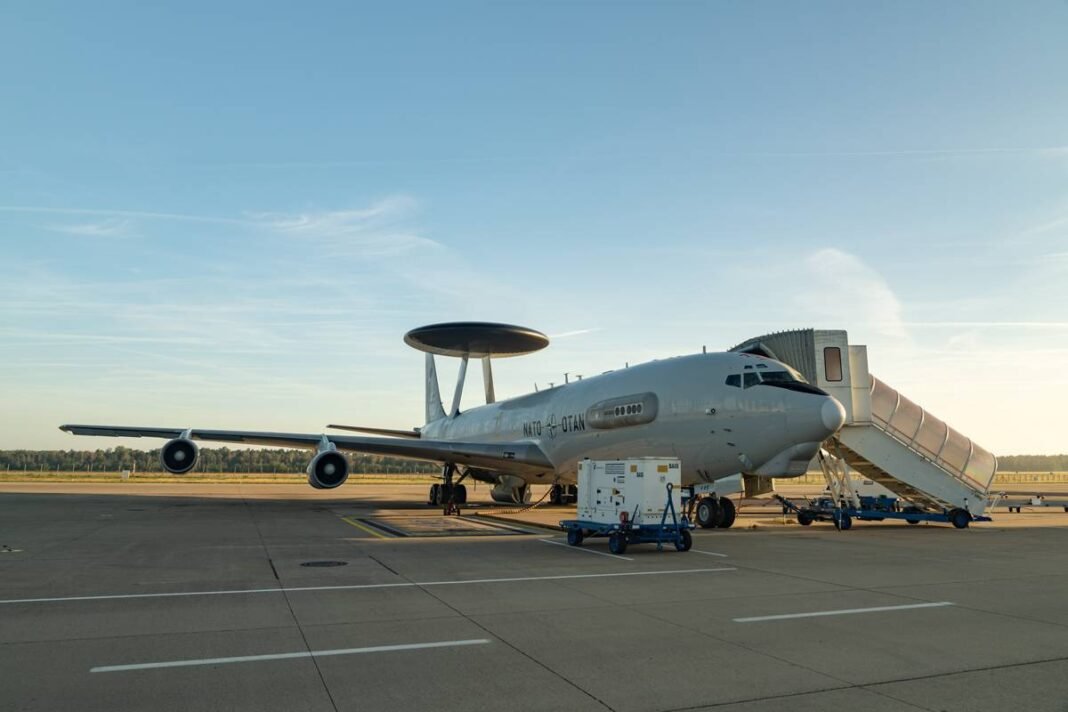
NATO will deploy an Airborne Warning and Control System aircraft to Poland after three Russian Kh-101 cruise missiles fell on Polish territory during a large-scale attack on western Ukraine.
The decision was announced after the North Atlantic Council met in Brussels to discuss the Nov. 20 incident.
Polish Deputy Defense Minister Pawel Zalewski said the early-warning aircraft would be made available to Warsaw to strengthen surveillance of Polish airspace. The system will give Polish forces a broader operational picture and help them respond more quickly to similar threats, he said.
A NATO official told Reuters that Gen. Alexus Grynkewich, the alliance’s supreme allied commander in Europe, authorized the forward deployment of the AWACS aircraft. NATO commanders are also assessing whether to send additional capabilities to strengthen the defenses of Poland and other countries on the alliance’s eastern flank.
Three Missiles Fell in Poland
Polish prosecutors said three Kh-101 cruise missiles fell on Polish territory during Russia’s mass strike on western Ukraine on Nov. 20. Poland’s Defense Ministry said no one was injured and no critical infrastructure was damaged.
NATO Secretary-General Mark Rutte described the episode as a dangerous incident. He said repeated airspace violations underscored the need to protect the interconnected energy networks, transport infrastructure and economies of NATO members.
Why Poland Is Getting AWACS Support
AWACS aircraft carry powerful long-range radar systems and provide a shared picture of air activity to fighter aircraft, naval vessels and command centers. NATO operates 14 of the aircraft from its base in Geilenkirchen, Germany.
Since Russia’s full-scale invasion of Ukraine in 2022, NATO AWACS aircraft have regularly conducted surveillance missions along the alliance’s eastern flank. The new deployment moves the alliance from political support for Poland to a concrete reinforcement of air monitoring after the missile incident.
Source: Vesti Baku. Photo: NATO; archive image from Sept. 19, 2025.