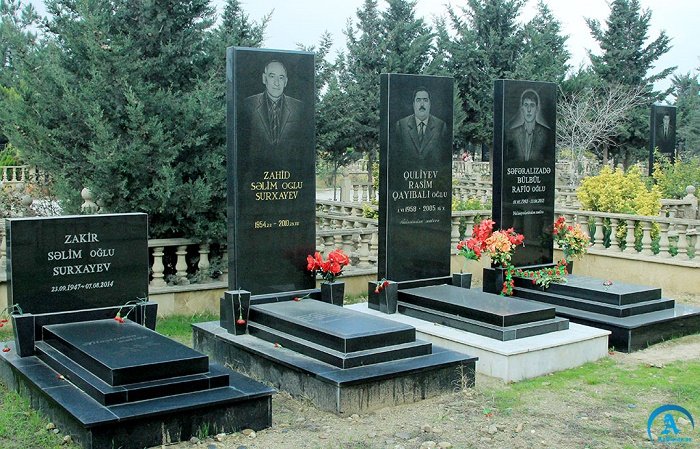
BAKU - Some people in Azerbaijan are choosing cemetery plots, ordering gravestones and preparing their own burial sites long before death, a practice driven by family costs, personal wishes and concern about where they will eventually be buried.
Some say they want to spare their children future expenses. Others want to select a grave beside deceased relatives or decide for themselves what material and design should be used. But high monument prices and alleged informal trade in cemetery plots have turned the practice into a broader social and financial issue.
Rapper Sarkhan Keremoglu recently drew attention to the subject after saying on social media that he had prepared his grave about 25 or 26 years ago. He said he completely renovated the future burial site this year and finished it in marble, according to an ATV Xəbər report cited by Vesti Baku.
His account prompted debate over whether preparing a grave during one’s lifetime is reasonable, whether Islam permits it and whether advance reservations could further drive up the cost of cemetery space.
Why Some People Prepare Graves in Advance
The reasons vary. Some people want to ensure burial near relatives. Others fear their children will face major costs and organizational difficulties after their death. Some want to choose the gravestone, stone type and design themselves.
That reasoning can appear understandable in a country where funerals and related ceremonies can cost families thousands of manats. Still, no one can know where death will occur or whether it will be possible to transport a body to the chosen cemetery. Questions also remain about the legal status of a reserved plot and whether it will be protected for decades.
Gravestones Can Cost From Hundreds to Tens of Thousands of Manats
Prices vary widely depending on the stone, size, workmanship and added elements. Previous market reviews cited by Vesti Baku placed simple white-stone monuments at about 350 to 500 manats. Black marble monuments started at roughly 2,500 manats, while more elaborate models could cost 6,000 to 10,000 manats.
Some granite monuments were priced at about 2,500 manats before extra features. In exceptional cases, large memorial complexes reportedly reached 50,000 to 60,000 manats.
Those figures came from earlier market surveys and are not uniform official rates. They do not mean that every burial costs such amounts. Even so, an ordinary marble monument may equal several months of income for a low-wage worker.
Plots That Should Be Free Are Allegedly Sold for Thousands
The more sensitive issue is cemetery land. Under existing rules, burial plots at state cemeteries should be provided to citizens free of charge. Families, however, have repeatedly reported unofficial payment demands.
Residents of Masazir previously said they were quoted 1,000 to 2,600 manats for a cemetery plot. Complaints and television reports from other parts of Baku cited figures of 2,000 to 5,000 manats. At some of the capital’s most sought-after cemeteries, reported offers reached 20,000 to 30,000 manats.
Those amounts are not legally established prices. They are reported informal payments and allegations from residents. The possibility that plots are being traded nevertheless raises questions about oversight and the allocation of cemetery land.
Advance reservation could further reduce the number of available plots if sites are occupied decades before they are needed.
Funeral Costs Extend Beyond the Grave
Families may also have to pay for grave preparation, transportation, ritual services and memorial gatherings. Azerbaijan’s tradition of ehsan, a meal offered after a death, can become a serious financial burden when families feel pressure to hold a large event.
Participants in earlier public discussions estimated that lavish funerals and memorial ceremonies can cost 20,000 to 50,000 manats. Those figures represent the most expensive events, not an average nationwide funeral cost. In some households, the obligation to arrange an elaborate gathering can lead to debt.
Azerbaijan provides burial allowances to certain groups. A previously published Vesti Baku report placed the benefit at 600 manats for categories covered by law and 960 manats when a labor pension recipient dies. Such assistance covers only part of the expense when a family orders an expensive monument or holds a large memorial ceremony.
That helps explain why preparing a burial site in advance may be seen not only as a psychological choice, but also as financial planning.
What Islamic Teaching Says
A religious specialist interviewed by ATV said Islamic tradition does not contain an unequivocal ban on selecting a burial place or preparing a grave in advance. He said, however, that there is no need to install one’s own monument before death.
The theologian said religious sources do not describe an established practice in which prominent Islamic scholars built their own gravestones during their lifetimes. He emphasized that intention matters: some people may seek to display status, while others genuinely want to reduce the burden on relatives.
Extravagant monuments and excessive spending for appearance may conflict with the principle of moderation. The permissibility of a particular choice, he said, cannot be judged by cost alone; motives and circumstances also matter.
Could Advance Reservations Create a Land Shortage?
Cemetery land is limited, particularly in densely populated Baku and its suburbs. If plots are widely occupied decades before they are needed, authorities may face greater difficulty allocating space for current burials.
Free cemetery land should not become an object of speculation. It also remains unclear under what legal basis a person can reserve a plot in advance and what guarantees relatives have that it will remain available.
Without a transparent registration system, advance reservations could lead to disputes, plots being allocated more than once and other abuses. Clear rules are needed for reserving, maintaining and recording cemetery sites.
Expensive Funerals Are Becoming a Social Problem
Keremoglu’s story is unusual, but it has revived a problem affecting nearly every Azerbaijani family. Funerals are increasingly treated not only as religious and family rites, but also as major financial obligations.
The cost of monuments, ritual services and social expectations surrounding memorial events can place heavy pressure on household budgets. Buying an expensive monument in advance does not address the central issue: the lack of transparency around funeral expenses and the distribution of cemetery plots.
As long as burial space that should be free can become the subject of alleged informal trade, and a monument can cost thousands of manats, preparing a grave during one’s lifetime will remain more than a religious debate. It is also a question of affordable funeral services, protection from unjustified expenses and transparent cemetery management.