The falling level of the Caspian Sea is becoming both an environmental and geopolitical problem for Azerbaijan, threatening ports, raising transport costs and creating new risks for the Middle Corridor linking China and Central Asia with Europe, analyst Rauf Rajabov said.
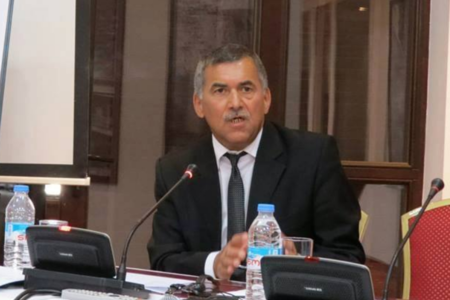
Rajabov, an orientalist and head of the 3rd View Analytical Center, discussed the issue in a Daily Europe Online interview, Vesti Baku reported.
He connected the Caspian’s ecological condition with President Ilham Aliyev’s participation in the COP31 climate summit in Türkiye, Azerbaijan-Türkiye cooperation and Moscow’s efforts to preserve influence in the South Caucasus.
Economic Risks From a Shrinking Caspian
Rajabov said lower water levels are already creating serious problems for port infrastructure in Azerbaijan, Kazakhstan and Turkmenistan. Maintaining navigation requires repeated dredging, adding substantial costs.
The decline may also restrict cargo capacity, lengthen delivery times and reduce the competitiveness of trans-Caspian routes. That matters especially for the Middle Corridor, which carries goods from Central Asia and China across the Caspian, Azerbaijan, Georgia and Türkiye to European markets.
OECD data cited in the report show that the Caspian level fell by about 2.5 meters between 2006 and 2024. Researchers point to higher evaporation, changing precipitation, reduced river inflow and water-management decisions as contributing factors.
Claims About Russia Require Caution
Rajabov argued that decisions concerning rivers flowing into the Caspian can acquire political significance because upstream actions affect other littoral states. He suggested Moscow could view water resources as an additional lever against countries developing transport routes that bypass Russia.
He compared that possibility with past disputes over gas supplies and energy infrastructure.
However, the interview presented no direct evidence that Russia is deliberately lowering the Caspian Sea for political purposes. Scientific research treats the decline as a complex climatic and hydrological process shaped by the Volga and other rivers as well as evaporation. Rajabov’s political assessment should therefore be distinguished from established scientific explanations.
COP31 and Azerbaijan-Türkiye Relations
Rajabov said Aliyev’s COP31 visit to Antalya carried broader significance because it followed Turkish President Recep Tayyip Erdoğan’s visit to Azerbaijan after earlier reports of disagreements between the allies.
He said the successive contacts showed the relationship remained strategic, while the climate agenda had independent importance for Baku after Azerbaijan hosted COP29.
The analyst said the Caspian’s decline affects all five littoral states and requires international cooperation. He also linked environmental policy to planned electricity exports from Azerbaijan and Central Asia to Europe through the South Caucasus and Black Sea region.
The 3+3 Format and Armenia
Rajabov also addressed the regional 3+3 format involving Azerbaijan, Armenia, Georgia, Russia, Türkiye and Iran. He said Moscow favors the mechanism because it preserves a Russian role in discussions about the South Caucasus, while Georgia’s refusal to participate limits its reach.
He expressed concern about Armenia’s ties with Iran and its continuing military, political and economic connections with Russia, arguing that Yerevan was balancing those relationships with its stated European ambitions.
Rajabov said Armenia’s proposed constitutional reform remained important to a final peace agreement because Baku wants language that could be interpreted as territorial claims removed. He warned that the process could be delayed if those questions remain unsettled.
State Reserves and Household Incomes
The interview also examined the contrast between Azerbaijan’s large financial reserves and comparatively modest household incomes.
Rajabov said the reserves support financial stability, an independent foreign policy, infrastructure, reconstruction in territories restored to Azerbaijani control and the attraction of foreign investment. He nevertheless acknowledged that the link between state wealth and citizens’ welfare remains a central public issue.
Azerbaijan’s average nominal monthly salary was 1,172.7 manats, about $690, in January through September 2026, according to the State Statistics Committee. The average does not reflect all workers’ earnings, and many receive less.
Rajabov argued that simply distributing reserves would not replace sustainable development, but the discussion underscored public concern over wages, pensions, inflation and purchasing power.
Infrastructure Depends on Regional Cooperation
Rajabov said Azerbaijan was strengthening its role between the Caspian and Black Sea basins through transport links, energy corridors and cooperation with Türkiye and Central Asian countries.
He cautioned that success depends not only on political agreements but also on addressing the Caspian’s environmental problems, maintaining ports and ensuring reliable, competitive freight services.
For Azerbaijan, the central risk is that multibillion-dollar transport investments could face natural constraints requiring coordinated action by all Caspian states. The political question is whether those governments can manage shared resources despite their wider disputes.