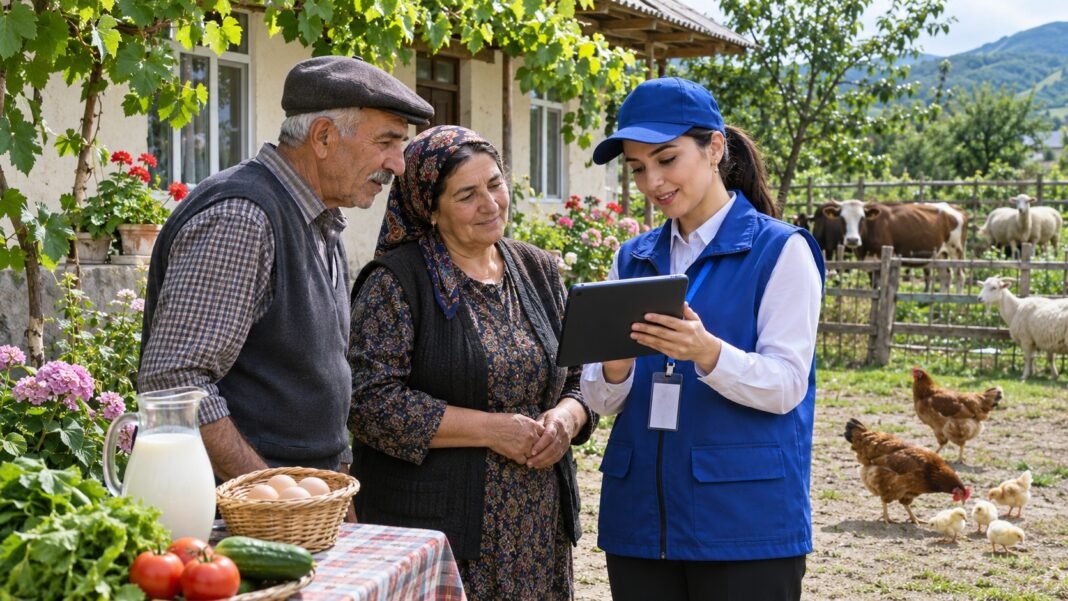
Azerbaijan will move its household accounting system fully online in 2027, creating a unified database with information on residents, employment, income, land, property and agricultural activity.
The government says the system will help authorities identify households that need social assistance more accurately and make better-informed decisions on regional development.
The change does not create a new form of household oversight. It digitizes an accounting system that has existed in Azerbaijan for decades, according to Vesti Baku.
The State Statistics Committee says household records have been maintained in rural communities since the 1940s and in cities and towns since 2012. Until now, much of the information has been collected by local authorities through annual surveys. The government now plans to consolidate the records in a single electronic system.
What Information Will Be Recorded
The new database is intended to provide a more complete picture of households’ social and economic circumstances. It will record the number of people living in a household, their sources of income and employment, whether the household has land and how that land is used.
Agricultural activity will receive particular attention. The database may include information on the number of cattle, sheep and goats, poultry and other farm animals kept by a household.
If a household keeps cows, sheep, chickens, geese or ducks, that information may be included in its electronic record.
In this context, a household does not necessarily mean a family. It can consist of one person or several people who live together and maintain a common household.
How It Relates to Social Assistance
Economist Khalid Kerimli said the main purpose of digitization is to give the state reliable information about living standards.
Authorities need a more accurate understanding of households’ actual financial circumstances so social support can be distributed more effectively, he said. Information about income, employment and property could be considered when assessing whether people qualify for targeted social assistance.
Kerimli said gaps in information about people’s real circumstances currently make some social-policy decisions more difficult.
However, inclusion of property or farm animals in the database will not automatically disqualify anyone from receiving benefits. Eligibility for social assistance is governed by separate rules.
Why Livestock and Land Matter
The household database is intended to support more than social policy.
Kerimli said the records could help the government assess local economies, employment conditions and the state of agriculture more accurately. Authorities could obtain a clearer picture of how much land is actually in use, which types of economic activity are common in individual regions and what resources households possess.
The information could then be considered when designing regional-development, agricultural-support and employment programs.
Will Residents Have to Submit the Information?
One of the main changes is that authorities will stop repeatedly collecting some information that already exists in government databases.
The State Statistics Committee said that beginning in 2027, part of the required information will be drawn directly from existing state information systems. Residents therefore should not have to resubmit data already held by government agencies.
Tablets are expected to be used to collect additional information.
The final method for supplying certain types of data has not yet been specified. Options under consideration include collection by local authorities and allowing residents to enter information themselves through the electronic system.
Where Residents Can Check Their Records
Once the electronic system is introduced, residents will be able to review information about their households through the government’s MyGov platform without filing a separate written request.
The main change in 2027 will be technological: scattered records now collected by local authorities will be replaced by a unified electronic household database.
Officials have not yet clarified which information residents will have to submit themselves, how errors in the database can be corrected or whether penalties will apply when information is not provided.
Source: Vesti Baku