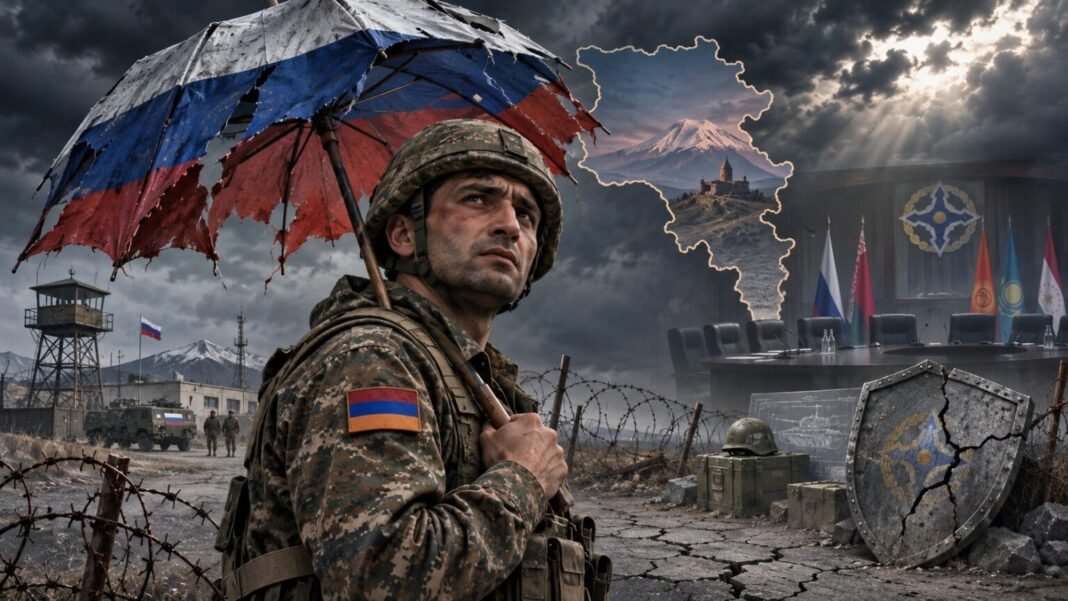
Six years after its defeat in the 44-day war, Armenia is still rebuilding a security system that relied on Russia for decades. Yet Yerevan has not formally left the Collective Security Treaty Organization, Russia’s military base remains in Gyumri, and sharply higher defense spending has not resolved longstanding personnel and discipline problems in the armed forces.
Leonid Nersisyan, a military analyst and senior adviser at APRI Armenia, discussed the state of the country’s security system in an interview with CivilNet.
CSTO Membership Remains, but Its Influence Has Faded
On Nov. 11, Armenia lost its voting rights in the CSTO and the ability to nominate representatives for senior positions because it has not paid membership dues since 2024. Yerevan nevertheless remains a formal member and can regain the restricted rights after paying the debt.
Nersisyan said the decision effectively formalized the position Armenia’s government had sought in recent years. Yerevan says it has frozen participation in the alliance, although the CSTO charter does not provide for such a status.
He said Russia has little interest in expelling Armenia because doing so would further reduce Moscow’s influence over Yerevan. Armenia, meanwhile, may see its formal membership and a possible withdrawal as diplomatic leverage while its relationship with Russia remains under negotiation.
The practical value of membership has already declined. The CSTO previously helped Armenia buy Russian weapons, sometimes on favorable terms, but Yerevan has sharply reduced military cooperation with Moscow and is turning to other suppliers. Nersisyan said membership also once signaled political loyalty to Russia, a role that has largely disappeared.
Russian Base in Gyumri Is Likely to Remain
Nersisyan does not expect a serious discussion about removing Russia’s 102nd Military Base from Gyumri in the next one or two years, despite the deterioration in Russian-Armenian relations.
He said the issue could become more relevant after Armenia and Turkey normalize relations, open their border and establish diplomatic ties. Those steps could reduce Armenia’s economic and infrastructure dependence on Russia.
Nersisyan was skeptical of Moscow’s statements that it would withdraw the base if Yerevan requested it. He suggested that such rhetoric may be intended to prevent the Russian military presence from becoming the subject of financial bargaining.
The interview cited the example of the Gabala radar station in Azerbaijan. Russia stopped operating the facility in 2012 after Moscow and Baku failed to agree on new lease terms.
No New Alliance Has Replaced Russia
After the 2020 war and later events, Yerevan gradually lost confidence in Russian security guarantees. Armenia has not, however, created a new military alliance capable of replacing Russia.
Nersisyan said a combination of positions taken by several outside states has played a deterrent role in recent years. He pointed first to Iran and then to Western countries and the United States.
In his assessment, Armenia’s army was in such poor condition in 2021 and 2022 that it could not by itself guarantee the prevention of another large-scale confrontation with Azerbaijan. His claim about the decisive role of outside deterrence is an analytical judgment, not an established explanation for why another war did not begin.
Yerevan is now pursuing two tracks: strengthening its armed forces and lowering the risk of conflict through normalization with its neighbors. Diplomatic contacts with Baku, trade projects and regional transport initiatives, including TRIPP, are being considered as potential components of a more durable security system. Nersisyan said there is still no guarantee that normalization will succeed.
More Money Has Not Rebuilt the Officer Corps
Armenia has significantly increased spending on its armed forces and defense industry since 2023. Nersisyan said money and new equipment cannot quickly correct problems that developed over decades.
He identified the quality of the officer corps, particularly junior and midlevel commanders, as one of the most serious issues. The army still faces insufficient preparation among some commanders, outdated management practices and discipline problems.
Dismissing large numbers of underprepared officers would create another problem because replacements cannot be trained quickly. Nersisyan argued that Armenia should focus on preparing a new generation of personnel.
He described increased competition for admission to the military university as a positive sign. Military education previously attracted too few applicants to permit meaningful selection, he said. The benefit of better training will become visible only after younger officers move into command positions.
Noncombat Deaths Remain a Systemic Problem
Reports of Armenian service members dying in circumstances unrelated to combat continue despite the reforms. Nersisyan said the situation has not necessarily become worse than in earlier years, but he acknowledged systemic problems.
He cited inadequate professionalism among some commanders, disciplinary violations and problems in relations within military units. In his view, neither a larger budget nor harsher penalties alone can solve them. Armenia needs sustained changes in officer training and the organization of daily military service.
Nersisyan also rejected the idea that noncombat deaths can be explained solely by weaker discipline after the immediate threat of war declined, saying many of the problems existed before.
Shorter Conscription and a Larger Professional Force
Nersisyan said Armenia could eventually reduce compulsory military service to six months or one year while substantially increasing the number of contract troops. He stressed that this was his proposal, not an announced government decision.
He said the professional component of the army should grow threefold or fourfold because increasingly complex weapons require lengthy specialist training. If a conscript enters the reserve soon after completing that training, the army has little time to use the acquired skills. Five- to 10-year contracts would allow better use of trained personnel, he said.
He did not advocate abolishing conscription. A small country still needs a mobilization reserve. Nersisyan also argued that intensive three-month programs in some foreign armies can produce better results than longer training courses in Armenia.
The Lessons of 2020 Are No Longer Enough
Nersisyan said Armenia’s armed forces have begun to address some reasons for the defeat in the 2020 war, but warned against preparing only for a repetition of a six-year-old conflict.
Military technology and methods have changed substantially. The Russia-Ukraine war accelerated the development of drones, strike systems and new tactical approaches. Capabilities regarded as breakthroughs in 2020 may no longer meet current requirements.
He also said Azerbaijan’s armed forces have changed substantially since the autumn 2020 fighting. Armenia, therefore, must account both for new technology and for changes in a potential opponent’s capabilities.
A Prolonged Transition
Armenia remains in a prolonged transition. The Russia-centered security system has lost much of its practical importance, while a new model based on Armenia’s own military capacity, diversified partnerships and normalization with its neighbors is still taking shape.
Yerevan remains a CSTO member despite effectively ending participation in its work. Russia’s base stays in Gyumri. The army has more money and new weapons but continues to struggle with personnel preparation and discipline.
The central question is no longer only whether Armenia will formally leave Russian military and political structures, but whether it can build a sustainable security system without its former dependence on Moscow. Nersisyan’s assessment suggests that process is far from complete.
Source: Vesti Baku