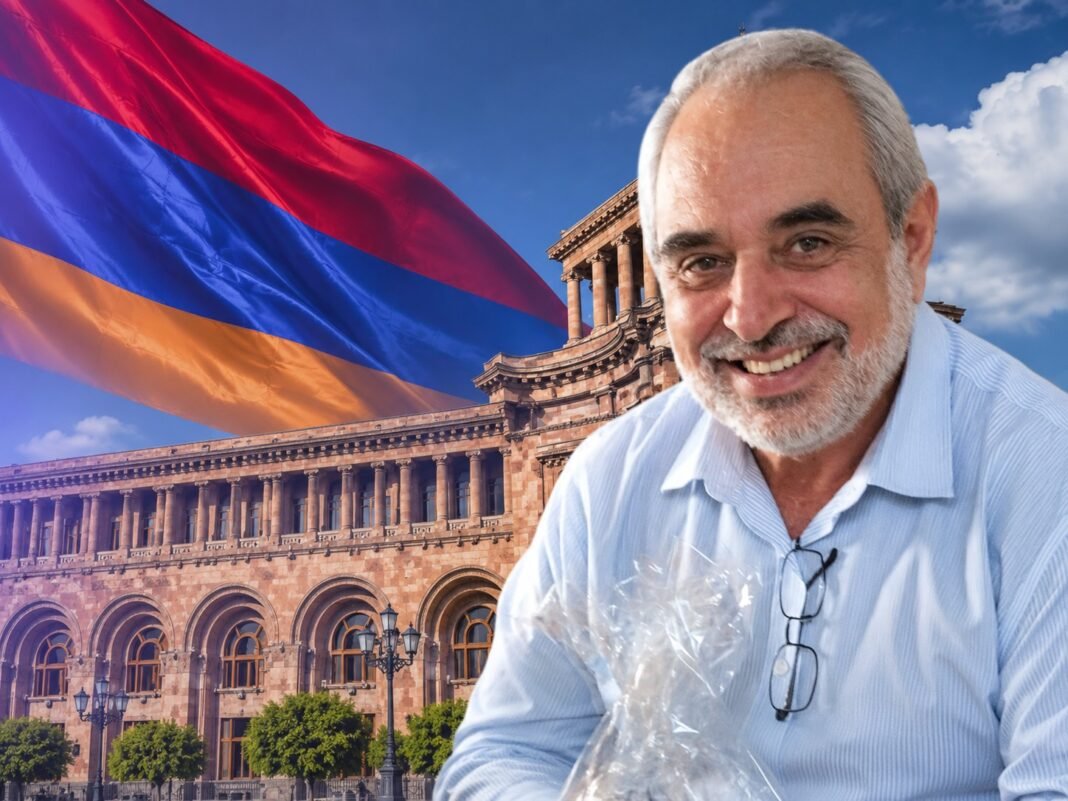
Armenian civic activist and human rights advocate Aram Mkrtchyan said a final settlement between Baku and Yerevan depends on more than the two countries, arguing that Iran has a decisive role in regional developments.
In an interview with Daily Europe Online, Mkrtchyan also said a peace agreement might require political leadership changes in both Armenia and Azerbaijan and again raised the former status of Karabakh, despite Azerbaijan’s restoration of control over all its internationally recognized territory.
He was commenting on the meeting between Azerbaijani President Ilham Aliyev and Armenian Prime Minister Nikol Pashinyan in Dublin.
Dublin Meeting Continued the Peace Process
Aliyev and Pashinyan met Nov. 12 on the sidelines of the European Political Community summit in Ireland. They discussed further normalization, transport links, economic cooperation, border delimitation and implementation of the TRIPP project.
According to the official account, 105,000 metric tons of cargo have traveled through Azerbaijan to Armenia since November 2025. The leaders also considered prospects for connecting the two countries’ electricity grids.
Mkrtchyan welcomed the continuation of talks and said even an imperfect peace was preferable to war. He nevertheless said the meeting produced no fundamentally new decisions and argued that relations between Baku and Yerevan are closely tied to larger international developments.
Call for Both Leaders to Leave Office
Mkrtchyan said Aliyev and Pashinyan should leave office before the conflict can be fully settled. He argued that both are directly associated with the outcome of the 2020 war: Aliyev led the victorious country, while Pashinyan led the defeated one.
Under his proposal, new leaders not connected to the earlier phase of the conflict would conduct future negotiations.
Host Mikhail Katz challenged that position, noting that leaders remain in office or leave through domestic political processes and elections, not because outside observers want them replaced. Mkrtchyan offered no concrete mechanism for simultaneous political change in both countries.
Armenia’s Constitution and the 1990 Declaration
Pashinyan has said a new Armenian constitution should not refer to the 1990 Declaration of Independence, which contains language connected to Karabakh. Baku regards such provisions as an obstacle to final signature of the peace agreement.
Mkrtchyan said focusing only on the preamble distracts from a broader reform of Armenia’s system of government. He called for a complete constitutional review and said voters should be allowed to choose between alternative drafts, including a proposal associated with Armenian dissident and politician Paruyr Hayrikyan.
His assertion that the preamble is not part of the constitution is legally inaccurate. The preamble appears in Armenia’s official constitutional text, and its relevance cannot be dismissed merely because it precedes Article 1.
Karabakh Status Raised Again
Mkrtchyan argued that Armenian-Azerbaijani normalization requires another discussion of Karabakh’s former status, even though Azerbaijan restored full control over the region in September 2023.
He cited documents from the early 20th century, the Soviet era and international agreements linked to the formation of state borders. He also questioned some historical and legal foundations of Azerbaijan’s modern state structure.
Those claims reflect Mkrtchyan’s interpretation and do not alter the internationally recognized status of Karabakh as part of Azerbaijan.
Katz warned that reviving territorial claims could cause another conflict. He noted that Baku and Yerevan have agreed to recognize each other’s territorial integrity under the 1991 Alma-Ata Declaration.
Mkrtchyan continued to argue for revisiting historical documents, an approach that conflicts with the current peace process, which focuses on interstate relations, borders and transport links rather than restoration of Karabakh’s previous status.
Mkrtchyan Says Tehran Controls the Timing
Mkrtchyan said Tehran, rather than Baku or Yerevan, has the decisive influence over when a transport route linking mainland Azerbaijan with Nakhchivan through Armenia can open. He argued that Iran can set conditions for the project and restrict other regional actors.
Katz pointed to a contradiction: If another state decides what happens to transport links on Armenian territory, that raises questions about Yerevan’s sovereignty. Mkrtchyan described his position as a reflection of geopolitical reality.
His claim is not supported by the agreements governing TRIPP. Armenia and the United States signed a strategic cooperation framework for the project in May 2026, and the document explicitly preserves Armenian sovereignty and jurisdiction over the relevant territory.
Iran’s position remains an important factor in regional politics, but that does not give Tehran legal authority over a transport project inside Armenia.
Peace Process Linked to the Ukraine War
Mkrtchyan also suggested that final decisions in the South Caucasus will depend on an agreement between Russia and Western governments over the war in Ukraine. In his scenario, the Ukraine conflict would be settled first and international actors would then turn to regional issues, possibly by May 2027.
He cited no documents or verified information supporting that sequence. Katz also rejected Mkrtchyan’s speculation about a possible partition of Ukraine.
History Versus Pragmatism
Mkrtchyan said historical memory, cultural heritage and national identity should remain central to relations between states. Katz urged a focus on the immediate needs of people in Armenia and Azerbaijan, including security, open borders, trade and economic development.
The discussion also covered competing claims about Karabakh’s historical and cultural heritage. Mkrtchyan criticized Azerbaijani interpretations of regional history, while Katz noted that disputes over monuments and cultural ownership exist on both sides.
Mkrtchyan acknowledged that ordinary Armenians and Azerbaijanis are not separated by insurmountable hostility. He recalled visiting an Azerbaijani family in Georgia in the early 1990s. Despite the tensions of the period, the family welcomed him and protected his safety.
Official Negotiations Follow a Different Course
The interview exposed a contradiction in Mkrtchyan’s approach. He supports peace, restored transport and normalization between the two peoples, but also wants to reopen Karabakh’s status, make settlement dependent on outside powers and link peace to the departure of both national leaders.
The official process is moving in another direction. On Aug. 8, 2025, the Azerbaijani and Armenian foreign ministers initialed the agreed text of a peace agreement in Washington. Later meetings between the leaders have focused on implementing those understandings and expanding interstate ties.
Mkrtchyan’s comments represent an alternative political view that differs from the current negotiating agenda on several central issues. The unresolved question is whether returning to historical territorial disputes could offer a practical route to peace or instead obstruct a process the two governments have begun to put into practice.
Source: Vesti Baku