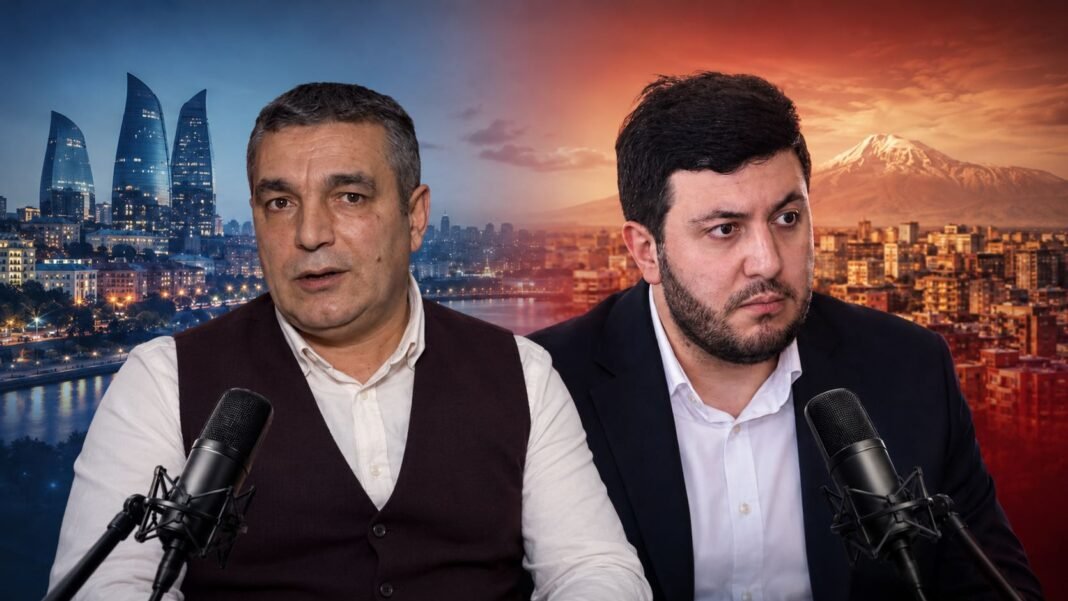
BAKU - Azerbaijan and Armenia could sign a peace treaty in 2027 even if ratification is postponed, Azerbaijani economist and political figure Natig Jafarli said during a discussion with Armenian analyst Areg Kochinyan.
Kochinyan said Baku could help move the process forward by confirming now that it would be ready to sign the agreement after Armenia adopts a new constitution.
The two experts discussed the peace process on Pressclubs TV’s “Events of the Week” program, according to a Vesti Baku report.
Draft Armenian Constitution Could Shift Talks
The discussion followed publication of a draft Armenian constitution that, according to the participants, does not refer to the country’s 1990 Declaration of Independence. Baku has long objected to that reference because the declaration mentions a decision on unifying Armenia and Nagorno-Karabakh.
Jafarli said the new constitutional draft could give momentum to negotiations that have slowed in recent months. He stressed, however, that adoption of Armenia’s constitution is solely an internal Armenian matter.
Kochinyan said Azerbaijan could ease concerns in Armenian society by formally stating that it would sign the peace treaty after the new constitution is approved, reducing fears that Baku might impose additional conditions later.
Jafarli agreed that clear signals are needed but warned against direct Azerbaijani involvement in Armenia’s domestic debate. He said active steps by Baku could be used by Armenian opposition parties to accuse Prime Minister Nikol Pashinyan of carrying out Azerbaijani demands.
Jafarli also noted that Azerbaijan’s leadership has previously said it is ready to sign after constitutional obstacles are removed.
Referendum and Political Risks in Armenia
Pashinyan has called on the opposition to support a constitutional referendum and linked the issue to his political future. Kochinyan said the proposal leaves opposition forces in a difficult position because they seek the prime minister’s resignation while rejecting the mechanism he has offered.
Kochinyan suggested that Moscow’s influence shapes the position of some parliamentary opposition groups and said Russia is not interested in a final Armenian-Azerbaijani settlement.
If the government cannot secure the additional votes needed to put the draft to a referendum, early parliamentary elections could become one option. Kochinyan said that path would return Armenia to an election confrontation without guaranteeing constitutional reform.
Signing Could Come Before Ratification
Jafarli said signing and ratification could be separated.
“Even without ratification, the peace treaty could be signed next year,” he said.
He argued that signing alone could move relations between the two countries to a new level even if later legal procedures take more time.
Kochinyan also did not rule out that scenario, potentially with active U.S. participation. Both speakers emphasized that this was an expert assessment, not an agreed decision by Baku and Yerevan.
TRIPP Moves Toward Implementation
The discussion also covered TRIPP, the transport initiative intended to develop links between Azerbaijan and its Nakhchivan exclave through Armenia.
The experts said an announcement launching the project would not necessarily mean that full-scale construction had begun. Kochinyan identified several possible first steps: establishing the TRIPP Development Company, beginning preparatory construction, or creating border and customs infrastructure.
Jafarli said energy cooperation, including electricity exchanges between Azerbaijan and Armenia, could advance more quickly. Practical progress in transport, energy and trade, he said, could strengthen public confidence that the peace process is irreversible.
U.S. Role and Regional Competition
The participants also discussed U.S. mediation and the possibility that a G20 summit in Miami could provide a venue for further agreements.
Jafarli said Washington wants the Armenian-Azerbaijani settlement to continue and that U.S. President Donald Trump’s involvement provides additional political momentum. Kochinyan said the U.S. administration might seek the signing of a peace agreement without immediate ratification.
Both experts said Russia’s influence in the South Caucasus is changing as the United States, European Union, China and Turkey become more active. Jafarli said Moscow would continue trying to preserve its position, including through political and economic ties with Georgia.
Kochinyan called for Azerbaijan, Armenia and Georgia to develop trilateral cooperation so the three countries do not remain merely objects of competition among larger powers.
The original Pressclubs TV discussion is available on YouTube.