By the Vesti Baku Editorial Board
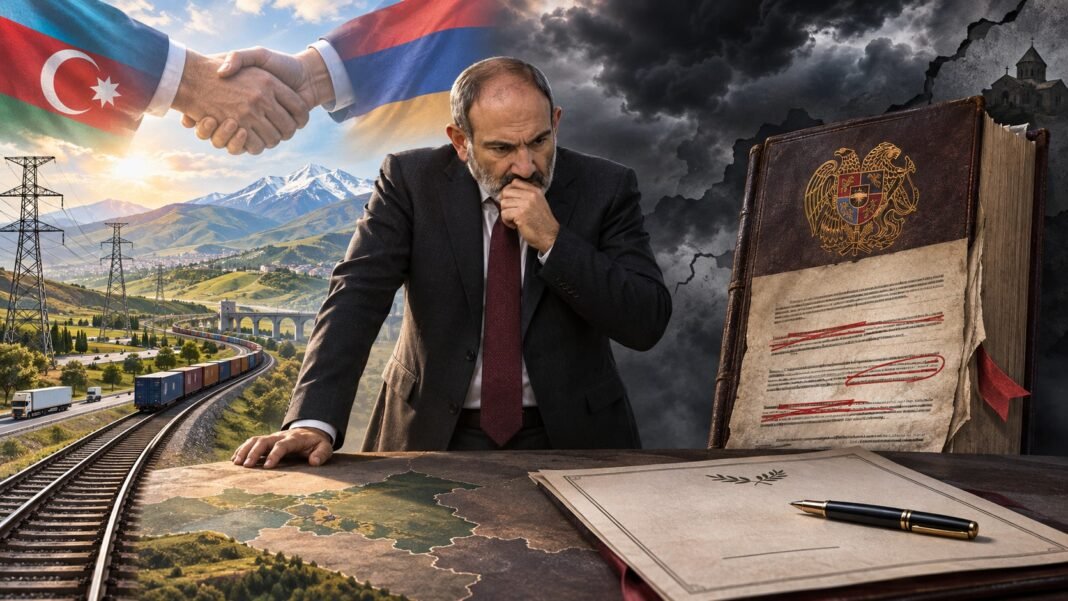
Baku and Yerevan are already trading and discussing energy and transport projects. Yet a peace treaty remains unsigned. The central question is no longer whether Azerbaijan is ready for peace, but whether Armenian Prime Minister Nikol Pashinyan can finally abandon the political legacy of the Karabakh conflict.
Azerbaijan-Armenia relations have reached a peculiar stage. The war is over, the countries’ leaders meet without mediators, freight is moving across borders, and the sides are discussing rail links, electricity supplies and shared water resources. But they still have no peace treaty.
When President Ilham Aliyev and Pashinyan met in Dublin on Nov. 12, their agenda focused less on ending the conflict than on the future economic architecture of the South Caucasus. Behind that promising picture, however, is a problem that cannot be solved by rail projects or new trade routes: Armenia has not yet decided whether it is prepared to close the Karabakh chapter of its history in both law and politics.
Trade Without a Treaty
According to official figures released after the Dublin meeting, 105,000 metric tons of cargo have been transported to Armenia through Azerbaijan since November last year. Only a few years ago, such a figure would have seemed politically unimaginable.
The sides are now discussing power-grid connections, transport links and cross-border rivers. Azerbaijan is, in practice, helping Armenia reduce its economic isolation. This is not charity: Baku has an interest in a stable region, open communications and new markets.
But a fundamental question remains. If economic normalization can move forward without a signed peace treaty, how long can Yerevan benefit from that process while postponing a decision on the main political dispute? Azerbaijan should not be expected to wait indefinitely.
The Constitutional Dilemma
Baku is calling for the removal of provisions in Armenia’s constitutional framework that it views as a basis for territorial claims against Azerbaijan. The concern centers on the Armenian Constitution’s preamble, which refers to the 1990 Declaration of Independence. That declaration mentions a decision on the unification of the Armenian Soviet Socialist Republic and Nagorno-Karabakh.
Yerevan says constitutional change is exclusively an internal matter. Formally, that is true: no state should dictate the contents of another country’s basic law. But Azerbaijan is also entitled to define the conditions under which it will sign an international agreement. In a treaty meant to close a decades-long territorial conflict, legal clarity matters.
Pashinyan understands this problem. On Nov. 2, he promised that a draft of a new constitution would be published within a month. A draft, however, is only the beginning. Public debate, parliamentary procedures and a referendum would still follow, and there is no guarantee Armenian voters would approve the proposed changes.
Pashinyan’s Political Risk
The prime minister’s greatest political concern is not Baku but his own electorate. He must persuade Armenian society to move beyond more than a few constitutional phrases and accept a new national reality.
Karabakh stood at the center of Armenian politics for decades. Careers, parties and civic movements were built around it, and generations were raised with it as a defining issue. After 2023, that political structure lost its territorial basis but did not disappear from the public consciousness.
Pashinyan is trying to replace it with his concept of a “Real Armenia” focused on the country’s internationally recognized borders, economic development and normalized relations with its neighbors. For Armenian society, that means reconsidering one of the foundational ideas of the post-Soviet period. For Pashinyan, it means risking his own political career.
On Nov. 18, Pashinyan told parliament he was prepared to guarantee peace with his political capital and indicated that the government would advance constitutional reform despite resistance from the parliamentary opposition. He is turning the future constitutional process into a choice between the old course and a final reconciliation with Azerbaijan.
There is a danger, however. If the government links a constitutional vote too closely to Baku’s demands, the opposition can argue that Armenia is changing its basic law under foreign pressure. Pashinyan therefore needs to present reform as an Armenian national project. That helps explain both his caution and the repeated delays.
TRIPP and a Changing Regional Balance
While Yerevan wrestles with constitutional questions, the regional economy is beginning to operate under new rules. The TRIPP project, which envisages a transport link through southern Armenia, matters far beyond Azerbaijani-Armenian relations.
Azerbaijan wants a reliable connection to Nakhchivan. Turkey would gain an additional route toward Azerbaijan and Central Asia. Armenia would have an opportunity to emerge from transport isolation. For the United States, the project offers a chance to establish an economic presence in a region long dominated by other powers.
Both Yerevan and Washington should recognize one basic fact: without Azerbaijan, TRIPP would be an ordinary road across Armenia rather than an international transport corridor. Its economic significance depends not only on track mileage but on connections with Azerbaijani infrastructure, Caspian routes and Turkey’s transport network. Baku should therefore participate in setting the route’s practical terms rather than merely observe decisions made by Washington and Yerevan.
The reverse is also true. It would be a mistake to turn the transport project into an instrument of permanent pressure. The more parties acquire an economic stake in the route’s stability, the harder it will be to dismantle it through political decisions.
Russia, Iran and the New Reality
Russia remains another factor in the settlement. Moscow is gradually losing its former influence in the South Caucasus but retains important leverage in Armenia through its military base, transport assets, energy ties and political contacts. The railway infrastructure managed by a Russian company is especially sensitive.
A successful TRIPP project without a decisive Russian role would weaken Moscow’s traditional position. Iran is also watching closely, concerned about changes in the balance along its northern border and a larger U.S. presence.
It would be naive to assume that every outside power will quietly accept a new regional architecture. At the same time, Russia and Iran should not be treated as a single front inevitably preparing to derail peace. Their interests differ, and both could potentially benefit economically from new transport links. Baku’s task is to make peace and connectivity more advantageous than confrontation.
How Long Can the Process Wait?
The year 2027 is increasingly mentioned as a possible deadline for resolving Armenia’s constitutional question. The real problem, however, is not the calendar. A draft constitution that remains trapped in public debate for years would not advance the peace process. A failed referendum would make matters still more difficult. And a change of government in Yerevan before the process is complete could test every current understanding.
That does not mean war must return. But the absence of a legally completed peace creates room for political revanchism and outside interference. Azerbaijan needs more than another declaration of good intentions. It needs a predictable interstate relationship that can survive changes of government, which is why the constitutional issue cannot be dismissed as a formality.
Baku should also resist the temptation to set an endless series of new political conditions. A peace treaty needs a clear and achievable conclusion. Otherwise even justified demands could turn into a perpetual negotiating process.
Peace Cannot Be Deferred Forever
Pashinyan must make several difficult arguments at once. He has to convince Baku that Armenia has definitively abandoned territorial claims; persuade Armenian voters that moving beyond the old policy is not capitulation but a path to development and an independent foreign policy; show the West that Yerevan can honor its commitments; and reassure Moscow that Armenian autonomy does not necessarily mean turning the country into an anti-Russian platform.
Doing all of that simultaneously is exceptionally difficult. Postponing the decision indefinitely is more dangerous.
In Dublin, Aliyev and Pashinyan discussed roads, electricity, trade and water - the ordinary business of leaders whose countries already live in peace. What remains is the foundation of normal interstate relations: unqualified political and legal recognition of each other’s territorial integrity.
Azerbaijan has demonstrated that it is ready to move from conflict toward economic cooperation. Yerevan must now show that the shift is irreversible. An unsigned peace can persist for years, but a historic compromise begins when both sides are prepared to put their names beneath it.
Source: Vesti Baku.