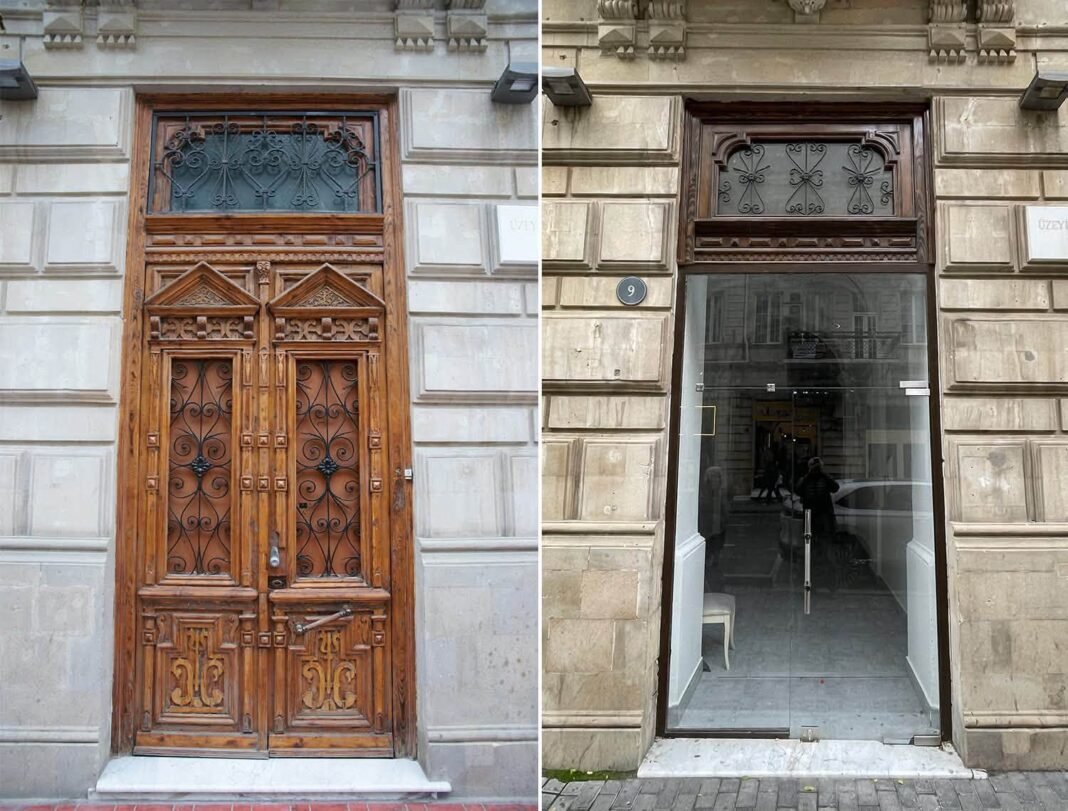
A dispute has erupted in central Baku after an ornate historic wooden door at a protected building was removed and replaced by a modern glass structure, then seemingly “restored” by placing an image of the old door on the glass.
The building at 9 Uzeyir Hajibeyli Street is an architectural monument of local significance listed in the state register under No. 3426. The controversy has left a central question unanswered: Where is the original door, and who authorized its removal?
Prominent Azerbaijani architect Elchin Aliyev drew attention to the case by publishing photographs of the entrance before and after the work, Vesti Baku reported.
Earlier images show a heavy wooden door with elaborate carving, decorative details and metal grilles. It was not merely functional but part of the architectural character of old Baku. New photographs show a glass door more typical of a commercial property than a historic building.
The story then took an almost absurd turn. Photographs appear to show an image of the dismantled wooden door applied to the glass, creating the appearance that it had returned.
“In my opinion, they simply decided to mock people and society,” Aliyev wrote, describing the imitation as a primitive attempt to deceive the public.
Protected Monument, Conflicting Government Accounts
On Nov. 24, the State Service for Protection, Development and Restoration of Cultural Heritage under the Culture Ministry confirmed that the entrance door had been dismantled and replaced with a glass structure.
The agency described the work as an illegal intervention in the monument’s appearance and said an investigation was underway, with measures planned to compensate for the damage and restore the building’s original appearance.
The Sabael District Executive Authority offered a different account.
It said the entrance door of the privately owned nonresidential unit had deteriorated after prolonged use and was temporarily removed for repair and restoration. A glass structure was installed while that work was carried out, the district administration said.
The authority also said the work was conducted under an authorization document issued by the State Service for Protection of Cultural Heritage - the same body that later described the intervention as illegal.
The contradiction raises direct questions. Was permission issued? If it was, why was the work then declared illegal? The public needs an answer supported by the relevant documents.
Where Is the Original Door?
The door’s whereabouts became the main issue in discussion of Aliyev’s post. Commenters speculated that it might have been sold to a private collector or installed in another building, and some described the episode as theft.
No evidence has been presented that the door was sold or stolen, however, and its location has not been publicly established.
Historic doors, light fixtures and other architectural details from dismantled buildings can enter an international market and end up in private interiors abroad, participants in the discussion noted.
If the door was removed for restoration, officials should be able to say where it is stored, who is responsible for its security, who is carrying out the work and when the original will be returned.
A Photograph Is Not Restoration
Replacing a historic door with glass and then applying an image of the original raises serious doubts about whether basic conservation principles were followed.
Restoration means preserving authentic elements, repairing damaged details and respecting a building’s historical appearance. A photograph on glass cannot reproduce carved wood, traditional joinery, the texture of aged material or original metalwork.
At best, the printed image is a temporary visual measure. At worst, it creates the impression that the problem has already been solved.
Architectural monuments are valuable because of their authenticity. If a historic door can be replaced by its photograph, the same approach could be applied to windows, balconies, stucco decoration and facades. Old Baku would then be left with images of its former appearance instead of the structures themselves.
Why Did Authorities React Only After Public Outcry?
The incident occurred in the center of the capital. Removing a massive door, installing glass and changing a protected building’s ground-floor appearance would have been difficult to do unnoticed.
That raises another question: Why did the work become the subject of public scrutiny only after an architect intervened and circulated photographs?
If the alteration was authorized, officials should release the permits. If it was not, authorities should identify who organized the work, who was responsible for oversight and why the intervention was not stopped.
A statement that an investigation has begun is not enough.
Baku Is Losing Its History Piece by Piece
The protection of Baku’s historic architecture goes beyond any one building. Old doors, balconies, window frames, grilles and decorative elements create the capital’s recognizable appearance. Their value lies not only in their age but also in the craftsmanship they embody.
Each detail is part of the city’s memory. Replacing it with a modern component is easy; recovering an authentic element after it disappears can be far more difficult.
Commercial interests associated with privately used premises do not override the duty to protect historic architecture. Private ownership does not give a property owner the right to arbitrarily alter a protected monument. Historic Baku is cultural heritage shared by the wider public.
What Authorities Must Explain
The case at 9 Uzeyir Hajibeyli Street should not end with another generic announcement about an inspection.
The public is entitled to know where the original door is, what condition it is in, who authorized its removal, whether a restoration permit existed and when the historic entrance will be restored.
Officials must also explain the contradiction between the State Service for Protection of Cultural Heritage and the Sabael District Executive Authority, and identify who will be held responsible if the intervention is confirmed to have been illegal.
The issue is larger than one door. It is whether part of a historic monument can be removed, replaced with glass and reduced to a printed image with the expectation that this will be accepted as restoration.
A city’s history cannot be preserved with a printer. If the original door still exists, its place is not in an unknown warehouse, a private collection or a photograph. It belongs where it stood for decades.