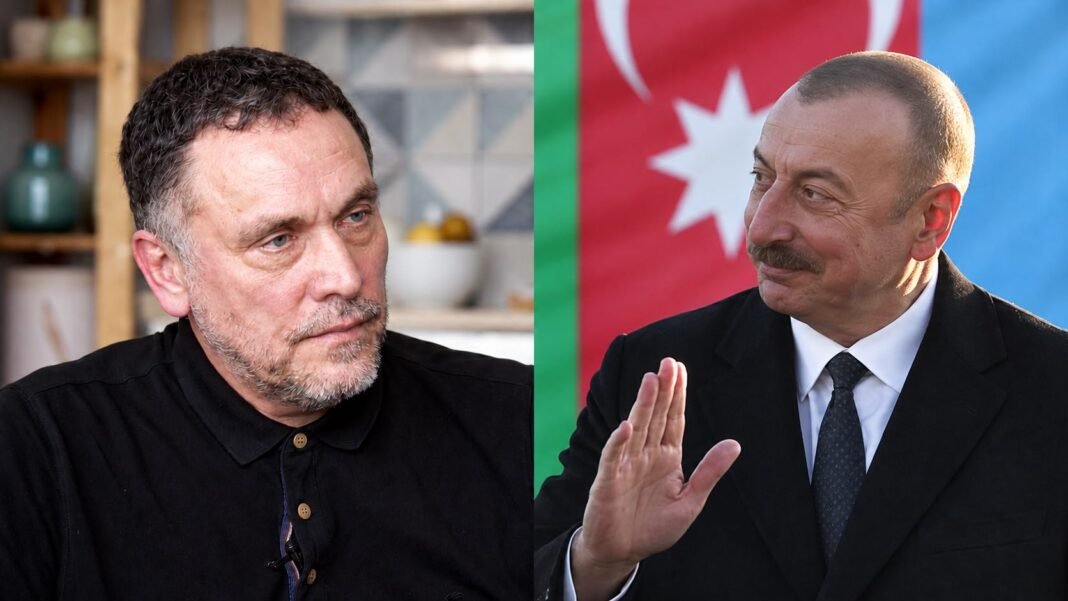
Russian journalist Maxim Shevchenko said President Ilham Aliyev’s description of the United States and China as the world’s two superpowers should not be interpreted in Moscow as an unfriendly signal toward Russia.
Shevchenko made the comments on the YouTube program “Boiling Point”, discussing Aliyev’s Oct. 2 address to the eighth congress of the New Azerbaijan Party. The remarks were reported by Vesti Baku, citing Vestnik Kavkaza.
In the officially published speech, Aliyev said Azerbaijan had recently established strategic partnership relations with both China and the United States. He described them as the world’s two superpowers and said Azerbaijan’s partnerships with both reflected international trust in Baku and its independent foreign policy.
Shevchenko said Aliyev’s formulation should be understood in terms of global capabilities and Azerbaijan’s practical relations with Washington and Beijing. Russia, he said, had no reason to take offense at the statement.
He argued that the superpower label applies to states capable of carrying out projects on a planetary scale. Shevchenko also recalled that Russian President Vladimir Putin has previously said Moscow did not claim superpower status. In a 2016 interview published by the Kremlin, Putin said the role was costly and “meaningless”; he made a similar point in a 2013 address, saying Russia did not seek hegemony.
China and the United States in Azerbaijan’s Strategy
Shevchenko said China’s importance to Azerbaijan rests on its economic strength, technological capacity and transport infrastructure. Azerbaijan occupies a key position on the route connecting China and Central Asia with Europe across the Caspian Sea and the South Caucasus, he said.
That relationship, in his assessment, extends beyond moving freight. It also includes the potential development of enterprises, infrastructure and broader economic links. Baku’s engagement with Beijing is therefore tied to Azerbaijan’s role in regional connectivity and its effort to expand trade and investment.
The United States, Shevchenko said, remains central to the international system through its military reach, the dollar’s global role and Washington’s influence over world finance. Against that background, Azerbaijan’s pursuit of practical relations with the United States is a rational element of its foreign policy, he said.
Shevchenko described Azerbaijan’s ties with both countries as grounded in trade, logistics, energy and investment rather than alignment with a single geopolitical bloc.
Sovereignty at the Center of Aliyev’s Address
The central theme of Aliyev’s speech, Shevchenko said, was Azerbaijan’s sovereignty and its ability to make independent decisions. Aliyev presented the restoration of the country’s territorial integrity and sovereignty as a development that strengthened Azerbaijan’s international position.
Aliyev also emphasized that Azerbaijan had paid for its weapons with its own funds. Shevchenko said that point was intended to underline the country’s political and financial independence rather than dependence on an outside patron.
In the same address, Aliyev said Azerbaijan would not join competing international camps and would continue relations with major centers of power while defending its own interests. He also cited the country’s growing transit role, including the Middle Corridor linking Asia and Europe.
Armenia and Relations With Russia
Shevchenko said the regional situation also created opportunities for further normalization between Azerbaijan and Armenia. He pointed to the possibility of opening borders, expanding economic cooperation and sustaining direct dialogue between the two countries.
On Russia-Azerbaijan relations, he argued against using Aliyev’s remarks to fuel a new round of tension. Shevchenko alleged that what he described as an anti-Azerbaijani group in Russia regularly exploits such statements in an effort to damage bilateral ties.
He characterized the relationship between Putin and Aliyev as respectful and based on mutual interest. Differences in how the countries describe the global balance of power, he said, should not be treated as evidence of hostility.
Aliyev’s speech came as Azerbaijan seeks to deepen economic and political ties with both Beijing and Washington while maintaining working relations with Moscow. His statement about the United States and China formed part of a broader argument that Baku can cooperate with rival powers without surrendering its freedom of action.