By AZE.US Editorial Team
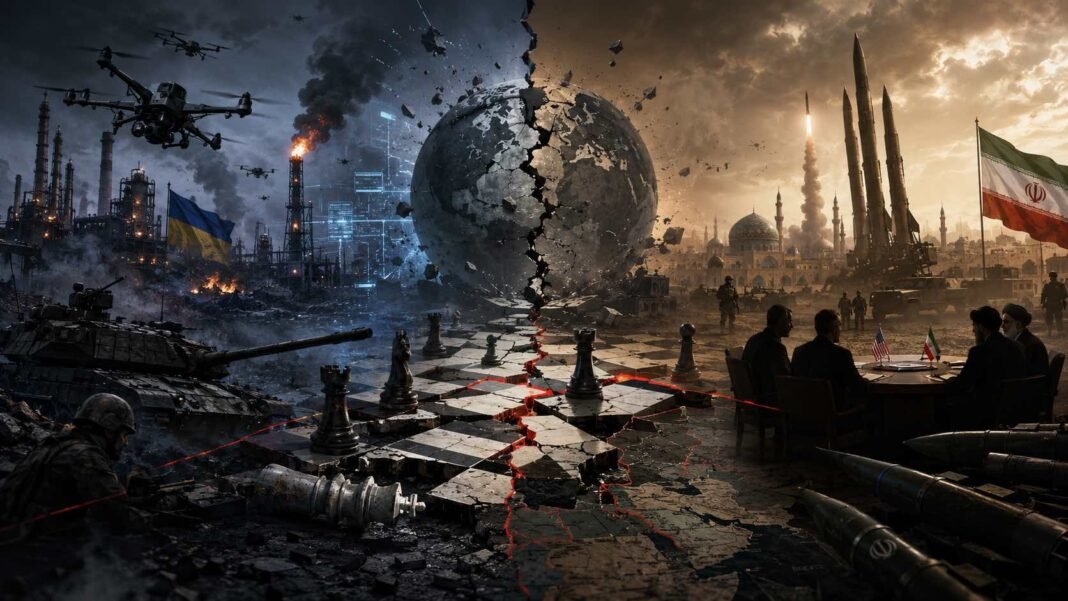
The war in Ukraine and the crisis around Iran may look like two separate stories. They involve different regions, different actors and different political histories. Yet they are increasingly connected by one larger reality: the old formulas of power are no longer producing the old results.
Russia entered the war against Ukraine with a familiar imperial calculation. It had more territory, more troops, more missiles and a much larger military machine. Moscow’s strategy was built on pressure, exhaustion and time. Ukraine was expected to break. The West was expected to tire. Russia was expected to impose its terms as something inevitable.
That did not happen.
The war has shown that size alone no longer guarantees victory. Technology, drones, long-range strikes, flexible military production and international cooperation have changed the nature of modern conflict. The battlefield is no longer limited to trenches and front lines. It now includes oil refineries, logistics hubs, airfields, supply chains and the psychological sense of security inside major cities.
For Moscow, the most painful part is not only the damage to infrastructure. It is the fact that the war, long presented to Russian society as distant and controlled, is now coming back home. When energy facilities are hit, when Moscow itself feels pressure and when ordinary citizens begin to see the cost of war outside their windows, the political mood changes.
This does not mean Russia will collapse tomorrow. But it does mean that the old formula of “we will simply outlast them” no longer looks convincing. If the war has become a contest of technology, adaptation and resilience, then Moscow no longer has the overwhelming advantage it once claimed.
A similar shift is visible in the Middle East, around Iran.
For decades, Tehran built its foreign policy around revolutionary rhetoric, anti-American slogans, proxy networks and the idea of permanent resistance to the West. But pressure has exposed a hard question: can a country live forever on ideology alone?
Iran now faces a difficult choice. If it moves toward a major agreement with the United States, opens its economy, allows investment and changes its regional behavior, it will no longer be the same Iran. Such a step would strike at the ideological foundation on which the system has stood for nearly half a century.
If Tehran rejects a deal and returns to confrontation, it risks renewed military pressure, deeper isolation and economic damage that could become harder to control.
This is the paradox. Sometimes peace talks are more dangerous for old regimes than war. War allows governments to mobilize society, speak about enemies, demand patience and silence internal questions. A peace deal forces them to explain why yesterday’s “great enemy” is now a partner in negotiations, investment and regional security.
That is why the Iranian debate is so tense. For pragmatists, opening the economy may look like a chance to survive and modernize. For the ideological core, it may look like surrender without the word “surrender.”
On the surface, the dispute is about nuclear enrichment, sanctions, missiles, Lebanon and regional influence. At a deeper level, it is about the future of the Iranian model itself.
Ukraine and Iran are different cases, but they point to the same conclusion. Large powers and rigid regimes are increasingly discovering the limits of force. It is no longer enough to invade, intimidate, wait out the opponent or demand that the world accept a new reality. Nor is it possible to keep an entire country trapped in permanent ideological mobilization while also expecting growth, investment and a normal future.
The old world relied on ultimatums. The new world answers with asymmetry. Tanks meet drones. Blockades meet alternative routes. Propaganda meets social fatigue. Ideology eventually meets the economy.
Russia wanted to prove that a large military machine could still decide the fate of its neighbors. Iran wanted to prove that revolutionary rhetoric could endlessly replace a normal development strategy. Both cases suggest otherwise.
The central question today is not who speaks more loudly about victory. It is who understands the new reality faster.
And that reality is clear: power without adaptation becomes vulnerability. The longer Moscow and Tehran pretend that the world has not changed, the higher the price they may have to pay.
AZE.US