By AZE.US Editorial Team
Azerbaijan’s long-term security will depend less on finding another geopolitical patron than on building enough reliable connections that no single outside power can control the country’s access to markets, finance or political options.
That is the central lesson of a recent discussion by Georgian analyst Gela Vasadze on the Diqqət Mərkəzi program, and it is also a practical test for Baku’s foreign policy. Azerbaijan and Georgia complement each other geographically and economically. The resilience of one increasingly depends on the resilience of the other and on both countries’ ability to reach wider markets.
Ports, railways and intergovernmental agreements are essential, but they are not enough by themselves. A route can still fail farther down the line because of a political crisis, customs delays, payment problems or a sudden administrative restriction. Sovereignty therefore includes the ability to keep connections functioning beyond one’s own borders.
Georgia Is a Strategic Link
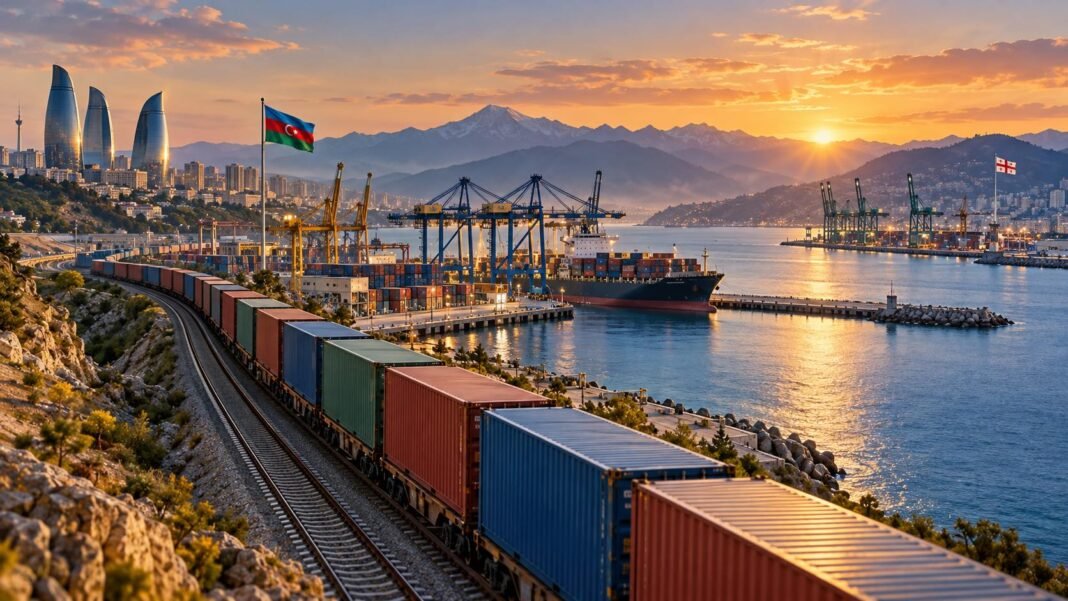
If Azerbaijan wants to consolidate its role as a transport hub, customers must be able to rely on predictable delivery times, understandable costs and rules that are not overturned by an unexpected political decision. Georgia is central to that effort because it connects Azerbaijan to Turkey and the Black Sea.
That makes Georgia’s relations with Europe a practical concern for Baku, not merely a debate over Tbilisi’s political direction. The European Commission said in its 2024 enlargement assessment that Georgia’s European Union accession process had been “de facto halted” because of the Georgian government’s course since spring 2024.
This does not mean that trade or transport links have ended. It does mean that political uncertainty can affect investment, regulations, financing and confidence in the route. Azerbaijan does not need to take sides in every internal Georgian dispute, but it cannot responsibly treat Georgia-EU relations as irrelevant.
Vasadze also raised a hypothetical scenario involving sanctions on Georgian ports. That was a warning about a possible vulnerability, not a report that such sanctions had been imposed. The proper response is contingency planning before a crisis: transport agencies, customs services and private operators should agree on procedures, information sharing and business rules in advance.
The Middle Corridor Needs Institutions
The commercial opportunity is substantial. A World Bank study published in 2023 found that the Middle Corridor could triple freight volumes and cut travel time in half by 2030 if the countries along the route combine investment with better governance and operational efficiency.
The important word is “if.” Geography creates potential, but institutions turn it into dependable service. Without coordinated customs, transparent pricing, synchronized rail and port operations and enforceable commercial terms, infrastructure alone will not make the corridor competitive.
Azerbaijan should also seek more value than transit fees. Processing, warehousing, equipment repair, insurance, digital logistics and other services can create jobs and make the route harder for partners to abandon. The more economic functions the country performs, the more costly an abrupt rupture becomes for everyone involved.
Multiple Routes, Not New Dependencies
The same logic applies to Iran. President Ilham Aliyev met Iranian President Masoud Pezeshkian in Turkmenbashi, Turkmenistan, on October 9, 2026, showing that high-level dialogue continues even as differences between Baku and Tehran remain.
Azerbaijan benefits from working relations with Iran, transport projects and a predictable border. Economic cooperation, however, should not be confused with accepting ideological influence or political interference.
Every route should be judged by cost, speed, reliability and legal terms. An additional path that reduces dependence strengthens Azerbaijan. A path that merely replaces one dependency with another deserves much closer scrutiny. Several functioning exits are safer than one supposedly indispensable corridor.
This principle applies equally to relations with Russia, Turkey, the United States and Europe. Each has domestic politics, commercial interests and institutional limits. Governments change, parliaments shift and public moods turn. Foreign policy cannot rest on personal chemistry or assumptions of permanent sympathy; it must be anchored in contracts, institutions and relationships capable of surviving political change.
Facts Protect Regional Trust
Information policy also matters. Routine commercial disputes, border incidents and sharp political statements can quickly be presented as proof of permanent hostility. Yet it is equally damaging to dismiss every problem as a foreign provocation. Official mistakes, rights violations and business disputes should be investigated on the facts and corrected where necessary.
The South Caucasus will become more independent when its states can protect mutual economic benefit even while political disagreements continue. For Azerbaijan, success should be measured concretely: cargo delivered on time, enterprises opened, costs reduced and partners fulfilling their obligations.
The strategic goal is not to choose a new guardian. It is to build enough routes, institutions and productive capacity that no outside actor holds the only key to Azerbaijan’s future.
Source: Vesti Baku.