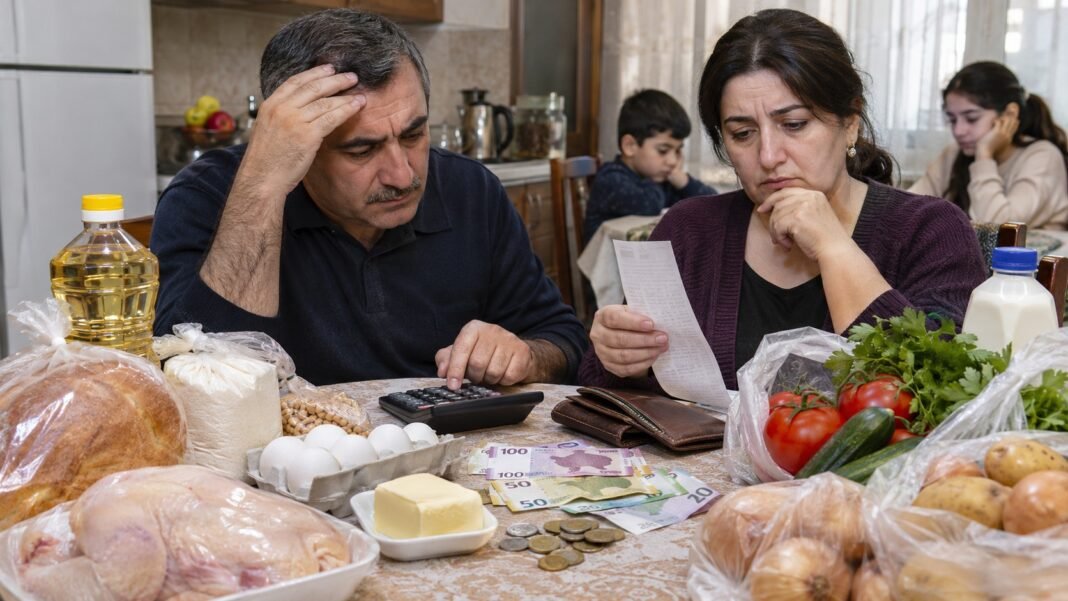
Food accounted for an average 43.3% of consumer spending in Azerbaijan during the first half of 2026, leaving many households with limited money for housing, transportation, health care and savings.
The share is even higher for many low-income families. Consumers increasingly choose cheaper foods, while meat, butter and other relatively costly staples place a heavier burden on household budgets.
People interviewed for an economic video report said rising grocery bills were consuming more of their pay. One shopper said food once took about one-third of the household salary but now requires half or more. Another estimated that food accounts for about 70% of the family budget.
Those are personal estimates rather than nationwide statistics, but they illustrate how sharply food inflation is felt by households with limited incomes.
406 Manats in Income, 393 Manats in Spending
Figures cited in the report put average monthly income per person at about 406 manats, or $239, in the first half of 2026.
Average consumer spending reached 393 manats, about $231, including roughly 170 manats, or $100, for food. That made food 43.3% of consumer spending.
Applied to a family of four, the per-capita figure would equal about 680 manats, or $400, in monthly food expenses.
National averages do not show the full picture. Food can consume a substantially larger share of the budget in single-income households, families with several children and homes where earnings are well below the average. The figures also do not mean every household has the same amount of money available.
Consumers Shift Toward Cheaper Food
Retailers say customers increasingly ask for more affordable products, particularly chicken, eggs, chicken breast and drumsticks. Some imported goods, including Belarusian butter, also remain in demand.
With limited budgets, families first have to cover daily meals, often reducing purchases of costlier products or replacing them with cheaper alternatives.
Meat remains a major expense. One participant in the report said it could cost the household 200 to 300 manats, about $118 to $176, with butter and other groceries adding to the bill.
Choosing cheaper goods does not necessarily mean families consume less overall. Many substitute one product for another in an effort to maintain their usual diet at a lower cost.
Why Food Absorbs So Much Income
The high share reflects both grocery prices and household income levels. Food is a basic need that cannot be postponed in the same way as buying clothes, furniture or electronics.
Even a moderate price increase can therefore cause serious pressure when incomes are low. A family spending 400 manats, about $235, on food each month would see that bill rise to 440 manats, about $259, after a 10% increase. The additional 40 manats, or about $24, would have to come from money intended for other needs or from cuts in consumption.
That is why food inflation hits low-income households and pensioners particularly hard. Nominal wage growth offers little relief when essential goods and services become more expensive faster than incomes rise.
Food Takes a Smaller Share in the U.S. and Britain
International comparisons show how strongly the structure of consumer spending depends on income.
U.S. Department of Agriculture data show that American consumers spent an average 9.7% of disposable income on food in 2025, including groceries and meals outside the home.
In Britain, government statistics for the financial year ending in 2025 showed that food and nonalcoholic beverages consumed at home accounted for about 10.9% of average household spending. The share reached 15.2% among the lowest-income households.
The measures are not directly comparable with Azerbaijan’s 43.3% figure. The U.S. calculation is based on disposable income, the British figure is a share of expenditure, and the categories included are different.
The broad pattern is nevertheless clear: the lower household income is relative to the cost of essential food, the larger the share of the budget required for groceries. As incomes rise, the food share usually falls even if people spend more on food in absolute terms.
Little Left After Groceries
When nearly half of consumer spending goes to food, the remainder must cover utilities, transportation, medicine, clothing, education and other needs.
The pressure is especially severe for families that rent housing or repay loans. The 43.3% food share does not include rent, utilities or transportation, which must be paid from the remaining budget.
Saving also becomes difficult. An unexpected medical bill, appliance repair or urgent trip can force a household to use what savings it has or borrow money.
Food spending is therefore more than an indicator of grocery prices. It is also a measure of households’ financial resilience.
Income Growth Matters as Much as Prices
Families cannot solve the problem simply by searching for ever-cheaper goods. Expanding domestic production, increasing retail competition, lowering logistics costs and stabilizing supplies could restrain price growth in some food categories.
Real income growth is equally important. If food prices rise faster than wages and pensions, purchasing power continues to decline.
When a substantial share of earnings is needed just to feed a family, households have fewer opportunities to improve their housing, pursue education, protect their health or build financial reserves.
Source: Vesti Baku. Watch the original video report.