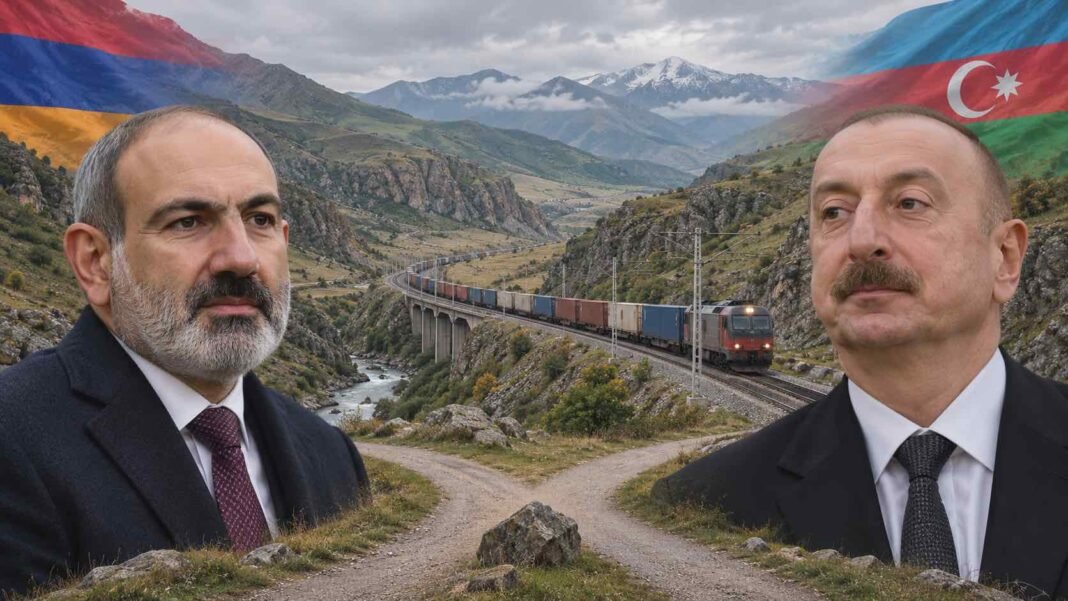
The publication of Armenia’s proposed new constitution and the formal launch of the TRIPP transport project have marked a new phase in relations between Baku and Yerevan, though implementation of the agreements will depend heavily on the outcome of Armenia’s constitutional referendum.
Emin Aliyev, editor-in-chief of the Trend News Agency, television and radio host Gia Saralidze, and analyst Marina Lagutina discussed the issue on the “Glavnoye” program on the Vestnik Kavkaza channel, according to Vesti Baku. The program is available on YouTube.
Constitutional Referendum Seen as Key Test
Aliyev said it was especially important that the draft constitution remove a reference to Armenia’s Declaration of Independence, which in turn refers to a decision on the unification of Armenia and Karabakh.
Baku has repeatedly argued that retaining that language could create a legal basis for renewed territorial claims against Azerbaijan if Armenia’s government changes.
Aliyev also described the proposed definition of Armenia’s people through civic rather than ethnic identity as a significant change. He said, however, that the referendum would be the main test for Prime Minister Nikol Pashinyan and that its outcome was far from certain because of divisions within Armenian society.
If voters reject the new constitution, Aliyev said, Azerbaijan and Armenia could continue to have a de facto peace without a signed treaty. Trade and limited contacts could develop, but prospects for large joint projects would remain uncertain.
Transport Potential and Outstanding Questions
Azerbaijan has invested heavily in modernizing port, rail and customs infrastructure in recent years. Growing freight traffic between China and Europe is already increasing the need for more capacity.
Armenia remains outside the region’s main transport routes. TRIPP could change that by connecting the country to international transit flows. Additional opportunities could come from an energy corridor carrying electricity from Central Asia through the South Caucasus to Europe.
Aliyev cautioned that the project’s formal launch should not be confused with the start of full construction. The railway’s technical parameters and operating rules would have to be agreed with Azerbaijan because the line would connect with Azerbaijan’s rail network at both ends. That would require an appropriate interstate legal framework.
Saralidze said the South Caucasus could not become an international transport hub without coordinated infrastructure development across all three countries in the region.
Russian and Iranian Factors
Saralidze also pointed to two unresolved issues: Russia’s concession to manage Armenia’s railways and Tehran’s concern about a U.S. presence near the Iranian border.
Aliyev said the Iranian factor may be overstated, while Saralidze warned that Tehran’s potential pressure on Yerevan should not be underestimated. He said much would depend on the future course of U.S.-Iranian relations. The Armenian government’s discussions with Russia over railway infrastructure also remain complicated.
“Without a peace treaty, I do not see any serious joint infrastructure projects,” Saralidze said.
Baku-Moscow Economic Relations
The speakers also discussed Russian-Azerbaijani economic ties. Aliyev said the decline in bilateral trade in 2026 was driven primarily by Azerbaijan’s reduced purchases of Russian gas, rather than a broader fall in business activity.
At the same time, exports of Azerbaijani agricultural products to Russia and direct Russian investment in Azerbaijan are increasing. Cooperation with Russian regions, particularly Tatarstan, is becoming more important in the oil and gas, petrochemical and automotive industries.
Western sanctions against Russia continue to complicate trade and raise business costs. Aliyev said he expected bilateral trade growth to resume in 2027 as political relations between Baku and Moscow recover.