Vesti Baku Editorial
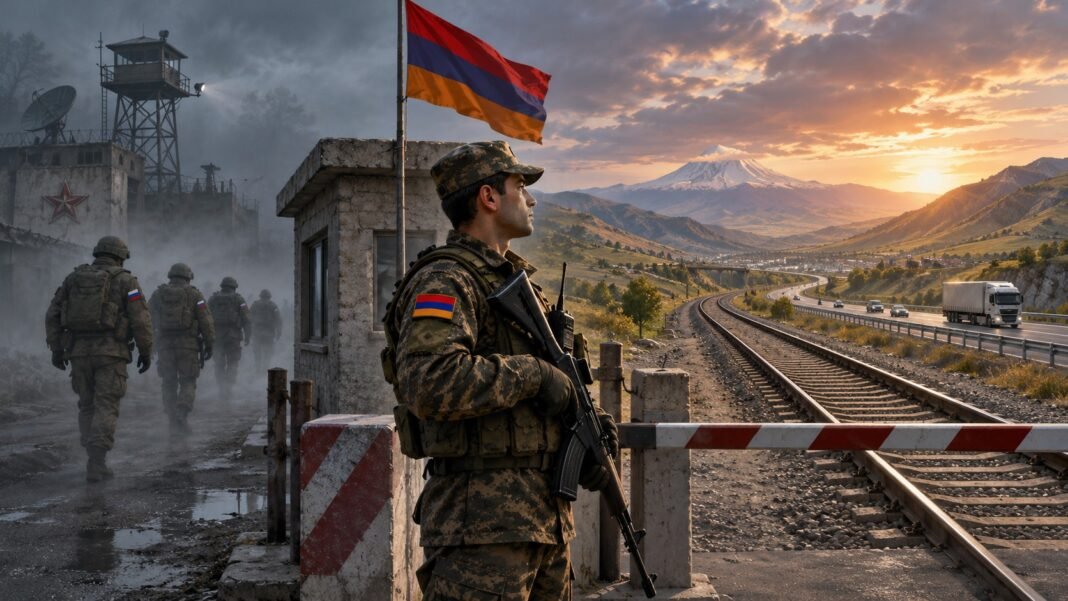
Yerevan’s intention to stop relying on Russian border guards could become one of the most consequential geopolitical developments in the South Caucasus since the Soviet Union collapsed.
Empires rarely leave voluntarily. They generally lose the ability to dictate terms, then lose political influence and only afterward withdraw from territories they treated for decades as part of their exclusive sphere of interest.
That process is becoming increasingly visible in the South Caucasus.
Armenian Prime Minister Nikol Pashinyan has said Armenia intends in the coming years to assume full responsibility for guarding its borders and end its reliance on Russian border guards. He also thanked the Russian side for its years of service.
Behind that diplomatic wording lies a fundamental political shift.
For decades, Armenia’s security policy rested on the belief that the state would be endangered without a Russian presence.
Moscow promoted that concept, while much of Armenia’s political establishment turned it into something close to state doctrine. Yerevan is now gradually moving away from that model.
Geography Proves Stronger Than Ideology
Armenia cannot change its geography. It can dispute history, seek patrons thousands of miles away and appeal to international institutions and its diaspora, but its economic future and long-term security depend in large part on relations with its immediate neighbors, above all Azerbaijan and Turkey.
Azerbaijani television journalist Kamran Hasanli highlighted that point in a Media Turk TV program.
In his view, Pashinyan’s policy signals Yerevan’s gradual rejection of its former regional model. Opening transport links, restoring economic ties and reducing the Russian presence could fundamentally change Armenia’s position.
The country’s railways deserve particular attention because they are managed by a Russian company. If Armenia wants to become an independent participant in international transport projects, it will eventually have to consider the economic instruments of its sovereignty as well.
State sovereignty is defined not only by the flag over government buildings but also by who controls borders, railways and strategic infrastructure.
Moscow Is Losing a Political Model
For Russia, this development is more significant than the possible withdrawal of a few border-service units.
For decades, unresolved conflicts across the former Soviet region helped Moscow preserve its role as an indispensable mediator. States unable to settle relations with their neighbors had an incentive to accept a Russian military and political presence.
Peace between Baku and Yerevan could strip much of the logic from that model.
If Armenia normalizes relations with Azerbaijan, opens its border with Turkey and joins regional trade routes, its need for an outside military patron will decline substantially.
That is why Armenian-Azerbaijani normalization has implications far beyond ending a long territorial conflict. It could change the architecture of influence across the South Caucasus.
Russian influence would not disappear with the last border guard. Moscow would retain economic, energy, military and political leverage over Yerevan. But for the first time in many years, Armenia’s leadership is showing a willingness to question whether the system of dependence itself remains useful.
Why Baku Benefits From an Independent Armenia
There is a temptation in Azerbaijan to view weakening Russian influence in Armenia only as a geopolitical victory. Baku’s long-term interests are broader.
Azerbaijan benefits from an Armenia able to make its own decisions, fulfill international commitments and avoid turning its territory into a tool in confrontations among outside powers.
A sovereign neighbor that recognizes Azerbaijan’s territorial integrity and has an interest in trade is preferable to a state whose foreign policy is set according to the interests of third countries. Durable peace cannot be built with a government that needs authorization from a foreign capital for every major decision.
Armenian independence should therefore be seen in Baku not as a threat but as a potential strategic advantage.
The Hardest Work Is Still Ahead
Pashinyan must persuade Armenian society that good-neighborly relations with Azerbaijan and Turkey are not a rejection of national identity but a condition for the state’s development.
Azerbaijan, for its part, should demonstrate the economic benefits of peaceful coexistence. Transport corridors, rail service, trade and investment could do more to sustain peace than hundreds of diplomatic declarations.
The intention to remove Russian border guards does not yet mean abandoning all Russian military presence in Armenia. A considerable distance remains between a political statement and the final dismantling of the old security system.
But the direction of travel has been set.
Decades from now, historians may view the end of the Karabakh conflict not only as the restoration of Azerbaijan’s territorial integrity but also as the event that began the South Caucasus’s release from post-imperial dependence.
The clearest sign that the era has ended will not be the departure of the last Russian soldier. It will be the moment when Baku and Yerevan no longer need Moscow in order to speak to each other.
Source: Vesti Baku.