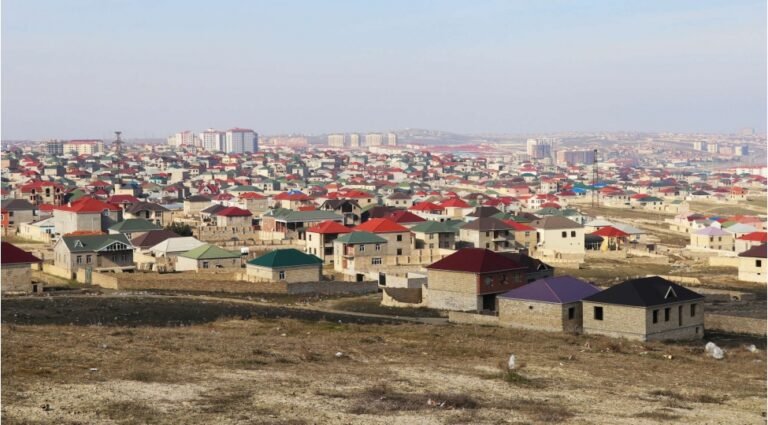
BAKU, Azerbaijan - Hundreds of thousands of Azerbaijani families have lived for decades in homes whose ownership has never been officially registered. They built their houses, raised children and paid for repairs but never received an extract from the state real estate registry.
Azerbaijan is again discussing a broad property amnesty. At a plenary session of the Milli Majlis, a proposal was made to simplify registration of such homes and, in some cases, remove the need for citizens to go to court.
The scale is substantial.
Estimates presented in parliament put the number of undocumented homes at about 500,000 in Baku and the Absheron area, with as many as 300,000 more in other parts of the country.
Behind those figures are hundreds of thousands of families whose homes remain a source of legal uncertainty.
Two Decades at Home Without Ownership Rights
Lawmaker Zahid Oruj presented findings from a study of families living in unregistered detached houses in Baku and Absheron.
The study found that 33.2% of respondents had lived in such homes for more than 20 years, while another 36.8% had been there for 10 to 20 years. In other words, about 70% of the families had been unable for at least a decade to register the homes in which they permanently live.
Monthly household income was no more than 400 manats for 28% of respondents. For those families, securing registration through the courts, collecting numerous documents and paying related costs can be a serious financial burden.
Oruj proposed a nationwide inventory of unregistered houses and land parcels, a unified database and a phased property amnesty.
Properties meeting established requirements would be registered through a simplified process without litigation.
A First Step Has Been Taken
Although an amnesty for residential buildings remains a parliamentary proposal, more concrete movement has occurred on registration of land parcels.
The Milli Majlis approved in the first reading amendments to the Civil Code and the law on the state real estate registry. The measures concern household plots allocated to citizens many years ago that never received full legal status.
Before July 6, 2006, ownership certificates were issued for land distributed under agrarian reform. After issuance stopped, some citizens received only site plans and measurements, which could not serve as a basis for registering ownership.
The result was a paradox: people who obtained land on the same legal basis ended up with different property rights.
The proposed changes are intended to correct that disparity. Under certain conditions, a land plan and survey could become grounds for obtaining an extract from the state registry.
What Could Happen to Prices?
For the real estate market, a potential amnesty would mean the arrival of many properties with full legal status.
Two nearly identical houses on the same street can now differ substantially in price simply because one has a registry extract and the other does not. Buyers of undocumented property assume greater risk: banks generally do not accept such homes as full collateral, and complications can arise in a sale or inheritance.
Real estate expert Elnur Farzaliyev said formal registration could affect market values, particularly in Baku’s suburbs and Absheron, where many unregistered homes are concentrated.
That would not necessarily produce an overall rise in housing prices. If many legalized properties enter the market at the same time, the additional supply could restrain increases. Much would depend on the scale and pace of the amnesty.
Property That Cannot Fully Work
The problem reaches well beyond the housing market. Azerbaijani families invested their savings in homes over decades, but a significant share of that capital has effectively remained outside the formal economy.
A person may control a house worth tens of thousands of manats but be unable to use it as collateral for a business loan. Missing documentation can complicate insurance and residence registration and, in some cases, make it harder to enroll children in schools or receive health services where a family lives.
The state also has an interest in resolving the issue. Legalization would broaden the tax base, support the insurance and banking sectors and make the housing market more transparent. In effect, it would bring a large volume of household capital accumulated over decades back into the legal economy.
Who Could Be Excluded?
All 800,000 homes cannot simply be legalized by a single decision. Some buildings stand in protected zones around engineering infrastructure, in high-risk areas or in places where residential construction is prohibited for safety reasons.
The proposal would leave those properties outside the amnesty while providing alternative solutions for residents.
That raises another important question: What will the state offer people who have lived in such homes for 15 or 20 years?
Simply refusing registration would not be enough. Clear mechanisms would be needed for relocation, compensation or alternative housing where existing structures cannot remain.
At the same time, an amnesty should not become a signal for a new wave of unauthorized construction. The state would have to draw a clear line between resolving problems accumulated over decades and preventing them from recurring.
Time for a Final Resolution
Undocumented homes are no longer a private problem affecting only individual owners. At this scale, they reflect systemic shortcomings in land records, urban planning enforcement and real estate registration.
Hundreds of thousands of unregistered homes did not appear overnight. They were built over years, connected to utilities and occupied by families as entire residential districts took shape.
Azerbaijan now has an opportunity to bring that long-running issue to a close.
No nationwide property amnesty has yet been approved, and the amendments involving land parcels have passed only their first reading. But for hundreds of thousands of families, the goal should be more than another procedural simplification: it should be the chance to become full legal owners of homes in which they have spent a substantial part of their lives.
Source: Vesti Baku.