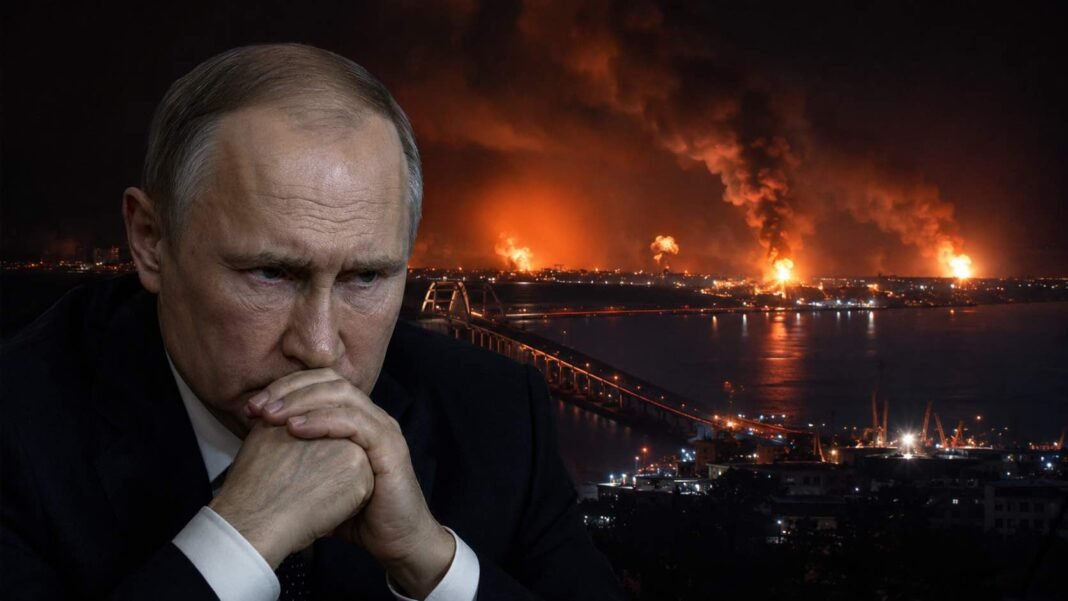
Moscow can continue fighting, striking Ukrainian cities and seizing small areas of territory. What it can no longer do is explain what victory is supposed to look like.
By AZE.US Editorial Team
For years, one of the most convenient explanations for Russia’s failures has been that President Vladimir Putin is not being told the truth.
According to this theory, frightened officials soften military reports, hide economic problems and present the Russian leader with a carefully edited version of reality. Putin makes disastrous decisions because his subordinates tell him what he wants to hear.
It is a comforting explanation for almost everyone inside the system.
Officials can avoid responsibility. State television can preserve the image of an infallible leader. Ordinary citizens can repeat the familiar formula that the ruler is good, while the people around him are incompetent or corrupt.
The reality may be far worse.
Putin is probably broadly aware of Russia’s battlefield losses, the pressure on its energy infrastructure, the growing reach of Ukrainian drones and the increasing cost of protecting targets deep inside the country.
The problem is no longer that the Kremlin lacks information.
The problem is that even accurate information does not offer Russia a good solution.
A Victory Moscow Cannot Define
Russia can continue advancing in eastern Ukraine. It may capture more villages, towns and industrial areas. Each gain can be presented by state media as proof that the Russian military remains on the offensive.
But tactical advances do not answer the strategic question.
What would Russia actually achieve by capturing another 20 or 30 kilometers of Ukrainian territory?
Modern warfare is no longer determined only by the location of the front line. A so-called buffer zone near the border cannot protect Moscow, St. Petersburg, oil refineries or military facilities hundreds of kilometers away from long-range drones.
Russia entered the war believing that military power was measured largely in territory, tanks and artillery.
Ukraine has gradually turned the conflict into a technological war in which relatively inexpensive drones can threaten extremely costly industrial, military and logistical targets far from the battlefield.
That change has placed Russia in a deeply uncomfortable position.
It may still be able to occupy land, but it cannot guarantee the security of its own infrastructure.
The War Is Coming Home
For several years, an unspoken arrangement existed between the Kremlin and much of Russian society.
The state would conduct the war. The public would avoid difficult questions.
In return, the government would try to preserve a sense of normal life for most citizens.
The fighting was supposed to remain distant. Fuel would remain available. Airports would operate. Electricity would flow. Shopping centers, restaurants and entertainment would continue functioning.
War would exist mainly on television.
That arrangement is beginning to break down.
Drone attacks, airport disruptions, pressure on fuel supplies and the need to defend increasingly distant facilities are gradually making the conflict visible inside Russia itself.
This matters politically.
A society may ignore abstract military losses for a long time, particularly when information is controlled and public protest is dangerous.
It is harder to ignore canceled flights, higher prices, fuel shortages, power disruptions or visible damage to local infrastructure.
The Kremlin’s greatest domestic challenge may not come from a dramatic military defeat. It may come from the slow destruction of the belief that ordinary Russians can remain personally untouched by the war.
Russia Is Not Collapsing, But It Is Not Winning
Predictions of Russia’s immediate collapse have repeatedly proved premature.
Russia remains a major military power. It possesses enormous human, industrial and natural resources. It can continue producing weapons, recruiting soldiers and inflicting devastating damage on Ukraine.
Russian missiles and drones can still destroy homes, energy facilities and civilian infrastructure.
But the ability to destroy is not the same as the ability to achieve a political objective.
Russia can launch another missile attack.
It can destroy another apartment building.
It can occupy another town.
None of those actions answers the central question: what outcome would allow the Kremlin to claim that the war achieved its original goals?
Ukraine did not become a Moscow-controlled state.
The Ukrainian government did not collapse.
The Ukrainian military did not disappear.
Western support did not end.
NATO did not retreat from Russia’s borders. Finland and Sweden joined the alliance after the full-scale invasion, producing the opposite of what Moscow claimed it wanted.
Russia may control additional Ukrainian territory, but territorial occupation cannot erase the strategic consequences the war has already created.
Stopping Would Expose The Failure
In theory, the Kremlin could accept a ceasefire and declare victory.
Russian propaganda could say that Moscow secured the land corridor to Crimea, strengthened its position in the Sea of Azov, captured part of Ukraine and prevented Kyiv from immediately entering NATO.
The television version of victory could be prepared in advance.
But such a narrative would face obvious questions, including from Russia’s own nationalist and pro-war camp.
If the war was launched to improve Russia’s security, why are Russian refineries and military facilities now vulnerable to attacks deep inside the country?
If the goal was to push NATO away, why did Finland and Sweden join the alliance?
If Russia won, why has the conflict made the country more dependent on a limited number of economic and political partners?
If victory was achieved, why did it require years of fighting, enormous casualties and the militarization of the Russian economy?
The Kremlin therefore faces a terrible political problem.
Stopping the war would require it to explain why the original objectives were not fulfilled.
Continuing the war allows the leadership to postpone that explanation, but only by increasing the cost.
Escalation Does Not Solve The Problem
When an authoritarian system cannot reach its goals through existing methods, it often responds by raising the stakes.
Russia can intensify missile attacks on Ukrainian cities. It can target energy infrastructure more aggressively. It can issue new threats against Europe and expand its campaign of intimidation.
But escalation does not resolve the strategic contradiction.
Destroying more of Kyiv does not protect Russian oil facilities.
Striking Odesa does not reverse NATO’s expansion.
Launching more missiles does not make Ukraine politically subordinate to Moscow.
Even nuclear threats reveal weakness rather than strength.
Using nuclear weapons would not guarantee a Russian victory. It would instead risk transforming Russia into a far more isolated state, provoking a major Western response and creating serious tensions with countries that have continued dealing with Moscow.
Russia’s leadership may threaten escalation because it has fewer conventional options.
But the more it escalates, the more dangerous and expensive any future exit becomes.
A War That Consumes Russia’s Future
The Russian economy has not collapsed, partly because state spending, military production and energy revenues have kept large sectors operating.
But wartime economic activity should not be confused with healthy development.
Money spent replacing destroyed equipment does not modernize the country.
Factories producing ammunition may increase output, but they do not necessarily improve civilian productivity.
Workers transferred into military industries are no longer available to construction, transportation, technology, medicine or other sectors.
Oil revenues that could have financed infrastructure, education and innovation are instead used for weapons, military salaries, compensation payments and the repair of damaged facilities.
Russia is using future resources to maintain a war that offers diminishing strategic returns.
Even if the front line froze tomorrow, the demographic, technological and economic cost would remain.
The Trap Of One-Man Rule
The political system Putin built has become so closely connected to his personal authority that admitting a major mistake would threaten the legitimacy of the entire structure.
For years, the slogan that there is “no Russia without Putin” strengthened the president.
Now it is becoming a trap.
If the war is recognized as a strategic failure, responsibility cannot easily be placed on one general, one minister or one intelligence official.
The decision came from the top.
The entire system was built around the idea that the person at the top understands history, sees further than everyone else and does not make fundamental mistakes.
That is why the Kremlin is not fighting only for territory.
It is also fighting to preserve the myth of Putin’s political infallibility.
No Door Marked Victory
Russia has placed itself in a position where every available option carries the appearance of defeat.
It can continue fighting, but each additional year brings greater losses, deeper isolation and more pressure on the economy.
It can escalate, but escalation may increase the danger without producing a decisive result.
It can freeze the conflict, but a frozen war would not erase the failure to control Ukraine.
It can negotiate, but any compromise would expose the gap between the Kremlin’s original ambitions and the outcome it was able to achieve.
Russia may not collapse tomorrow.
It may continue fighting for years.
That is precisely what makes the situation so grim.
The country still possesses the resources to prolong the conflict, but it has fewer and fewer acceptable ways to end it.
The Kremlin has pushed Russia into a corridor with no door marked victory.
There are only different forms of defeat, separated by time, propaganda and the number of additional lives that will be lost before the leadership finally chooses one.
AZE.US