AZE.US
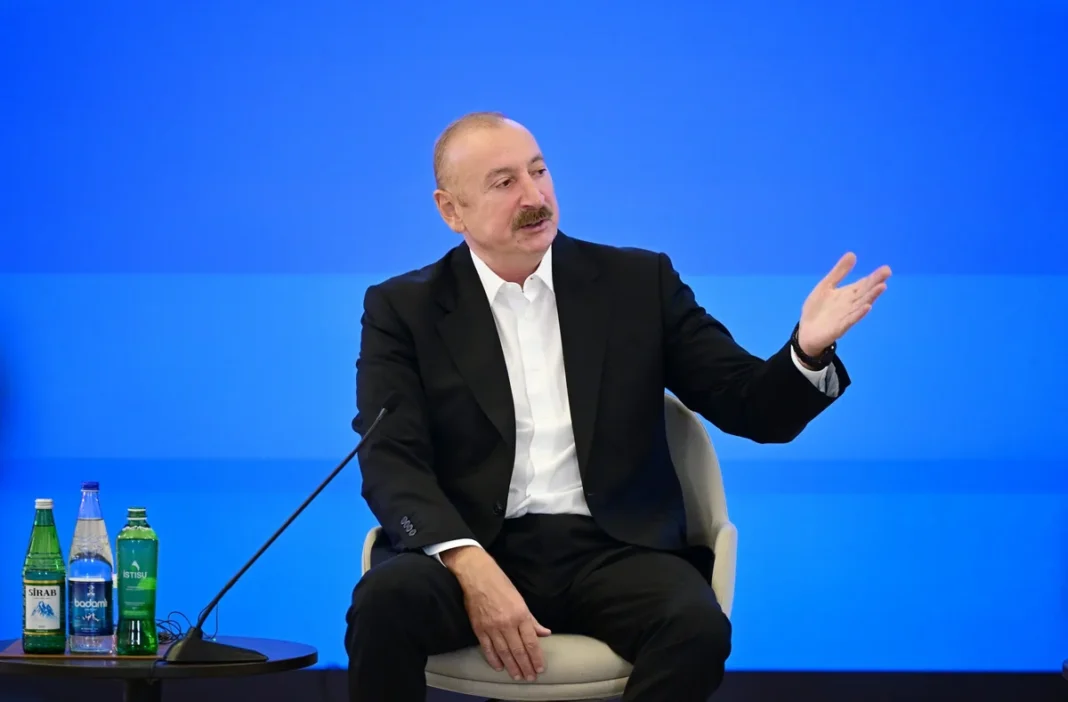
President Ilham Aliyev used the Fourth Shusha Global Media Forum to outline Azerbaijan’s position on peace with Armenia, relations with Russia and the United States, cooperation with Europe, regional security and the growing importance of the Middle Corridor.
The forum brought together media representatives, analysts and officials from dozens of countries for discussions focused on peace, trust and the role of journalism in shaping international relations.
Azerbaijan As An Independent Regional Power
One of Aliyev’s central messages was that Azerbaijan now acts as an independent regional power capable of defending its national interests without relying on outside actors.
He said a country’s influence should not be measured only by population, economic size or military strength. Its ability to conduct an independent foreign policy, resist pressure and shape developments beyond its borders is equally important.
Aliyev argued that Azerbaijan meets those criteria and will not allow itself to be used in geopolitical confrontations between larger powers.
Peace With Armenia And Regional Transit
The president devoted significant attention to the peace process with Armenia.
He said the agreement between Baku and Yerevan had been initialed at the White House with the participation of U.S. President Donald Trump, describing Washington’s role in the final stage of negotiations as important.
According to Aliyev, the U.S. administration understood the significance of restoring transport links between mainland Azerbaijan and the Nakhchivan Autonomous Republic.
He also said Azerbaijan had unilaterally lifted transit restrictions affecting Armenia. More than 40,000 tons of cargo from Russia, Kazakhstan and other countries had already passed through Azerbaijan on its way to Armenia.
Azerbaijan had also begun supplying petroleum products to Armenia, with deliveries exceeding 10,000 tons, Aliyev said.
The president presented these steps as evidence that Azerbaijan had chosen regional cooperation after restoring its territorial integrity.
He stressed that Baku had achieved its military and political objectives but had not expanded its operations beyond them.
Relations With Russia Have Normalized
Aliyev said recent difficulties in relations with Russia had been left behind and that ties between the two countries had been fully normalized.
Contacts had resumed between government institutions, foreign ministries, presidential administrations and bilateral commissions, he said.
Azerbaijan remains interested in trade, transport and humanitarian cooperation with Russia.
At the same time, Aliyev indicated that Moscow must adjust to a fundamentally different South Caucasus.
Azerbaijan has restored full sovereignty, Armenia has expanded its ties with Europe and the old regional order no longer exists.
His remarks suggested that Russia can no longer approach the South Caucasus through the political models it used before the Second Karabakh War.
Aliyev also warned against attempts to turn the region into an arena of geopolitical confrontation.
External powers, he said, should build pragmatic relations with each South Caucasus country rather than trying to use one state against another.
Ukraine Should Not Accept Occupation
Speaking about the war in Ukraine, Aliyev repeated his view that Ukraine should never accept the occupation of its territory.
At the same time, he called for an immediate end to the fighting.
The Azerbaijani president linked his position to his country’s own experience of living with occupation for decades before restoring its territorial integrity.
He recalled that Azerbaijan had faced intense international pressure during the Second Karabakh War to stop its advance and preserve the previous status quo.
Baku rejected any settlement that would have effectively legitimized occupation, he said.
Azerbaijan Is Surrounded By Regional Conflicts
Aliyev noted that Azerbaijan is located between two major zones of conflict.
War continues to the north, while tensions involving the United States and Iran affect the country’s southern neighborhood.
Azerbaijan’s priority, he said, is to protect its own territory and support peaceful settlements wherever possible.
He expressed hope for lasting stability around Iran and said Azerbaijan needs peace along its entire border.
The president identified attempts to draw Azerbaijan into external conflicts as one of the country’s most serious security risks.
Relations With The United States Reach A New Level
Aliyev said Azerbaijan’s relations with the current U.S. administration had reached an unprecedented level.
The two countries had signed a declaration on strategic partnership and established working groups covering trade, investment, artificial intelligence, digital transformation, energy, transport and defense.
He also said the United States had removed restrictions on arms sales to Azerbaijan, followed by similar decisions from Britain and some European Union countries.
Aliyev called on the U.S. Congress to permanently repeal Section 907, which restricts direct American assistance to Azerbaijan.
He described the measure as outdated, particularly after progress toward peace with Armenia and the opening of transit routes.
Azerbaijan May Reconsider Its Council Of Europe Membership
Aliyev drew a clear distinction between Azerbaijan’s relations with the European Union and its dispute with the Parliamentary Assembly of the Council of Europe.
He said cooperation with the European Commission had improved significantly, pointing to recent visits by senior European officials.
The situation with PACE was different.
Aliyev said Azerbaijan was seriously considering a complete withdrawal from the Council of Europe unless the voting rights of its parliamentary delegation were fully restored.
He argued that the European side had imposed the restrictions and therefore must make the first move toward resolving the dispute.
The Middle Corridor Raises Azerbaijan’s Strategic Value
Transport and logistics formed another major part of Aliyev’s remarks.
He said conflicts affecting the Red Sea and the Strait of Hormuz had exposed the vulnerability of maritime trade routes and increased the importance of land corridors passing through Azerbaijan.
The capacity of the Baku International Sea Trade Port is expected to rise from 15 million to 25 million tons.
Azerbaijani shipyards are also building ten new vessels to carry freight between Central Asia and Europe.
Aliyev said no major transport project in the Caspian region could succeed without close cooperation between Azerbaijan and Kazakhstan.
The two countries are expanding port infrastructure, developing energy and fiber-optic links across the Caspian Sea, digitalizing customs procedures and increasing the shipment of Kazakh oil through Azerbaijan.
Freight traffic from China is also growing, strengthening Azerbaijan’s role as a central link between Asia and Europe.
Azerbaijan Expands Gas Exports
Aliyev said Azerbaijan supplies pipeline gas to 16 countries, including 14 in Europe.
Germany and Austria joined the list of buyers in 2026.
Since 2022, Azerbaijani gas exports to the European Union have risen by 65%, he said.
Baku is prepared to increase supplies but expects long-term contracts and European participation in expanding gas infrastructure.
Aliyev warned that Azerbaijan cannot invest heavily in new gas fields and pipelines without firm guarantees of future demand.
The country is also diversifying its export markets. Azerbaijan has begun supplying gas to Syria and is exploring access to neighboring markets through Syrian territory.
The Main Message From Shusha
Aliyev’s remarks reflected Azerbaijan’s ambition to act not as a small state caught between larger powers, but as an independent center of regional influence.
Baku is seeking to maintain working relations with Russia, deepen strategic ties with the United States, cooperate pragmatically with Europe and China, expand its partnership with Central Asia and complete the peace process with Armenia.
The central principle remains unchanged: Azerbaijan intends to protect its sovereignty, avoid involvement in external confrontations and use its geography, energy resources and transport infrastructure to strengthen its political and economic position.
AZE.US