By AZE.US Editorial Team
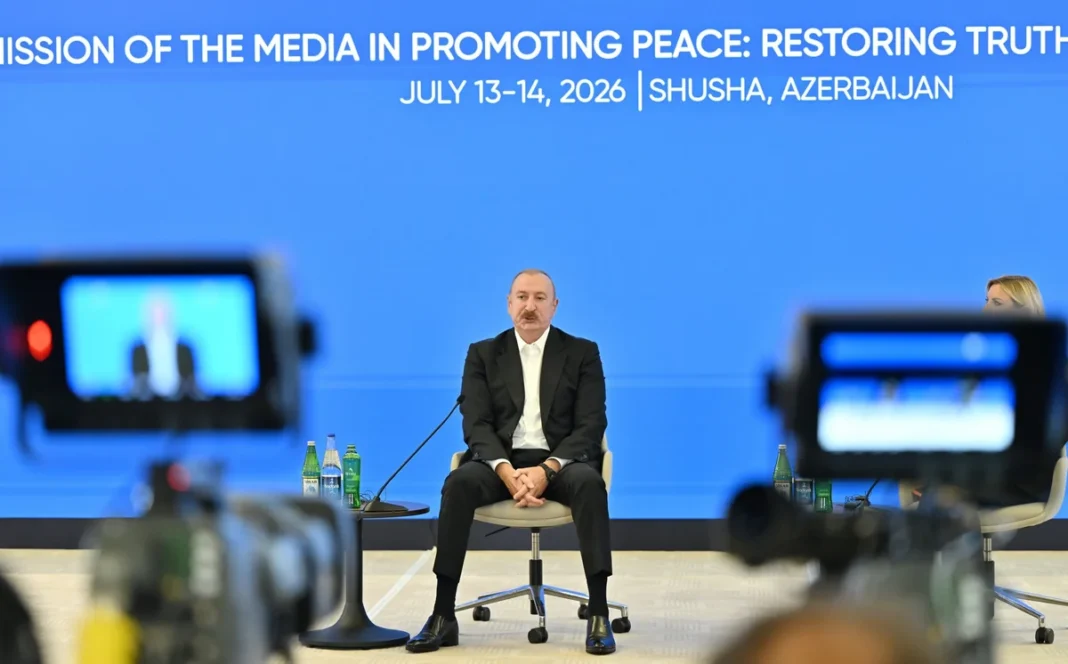
President Ilham Aliyev’s appearance at the Fourth Shusha Global Media Forum was more than a long exchange with foreign journalists. It amounted to a statement of Azerbaijan’s new regional doctrine.
Its central message was clear: the South Caucasus has changed so profoundly over the past five years that the old approaches used by Russia, Europe and other outside powers no longer work.
The region can no longer be treated as a geopolitical arena where major powers select a favored country, position it against its neighbors and use conflict to preserve influence.
Azerbaijan has shown that this model can be broken.
Baku Has Left The Old Game Behind
For decades, the South Caucasus remained a region of managed conflicts.
The Karabakh dispute allowed outside powers to retain influence over both Azerbaijan and Armenia. Some acted as mediators, others supplied weapons, while international organizations adopted resolutions that changed little on the ground.
The occupation continued. Negotiations produced no settlement. Decisions affecting the region were often made far beyond it.
Azerbaijan dismantled that structure.
First, it restored its territorial integrity. It then ended separatist rule on its sovereign territory and offered Armenia a path toward peace.
That sequence fundamentally changed the balance.
Baku no longer needs mediators who managed the conflict for decades without resolving it. Azerbaijan achieved the decisive result through its own political and military power and now intends to help shape the postwar order on its own terms.
Aliyev’s message to outside powers was unmistakable: Azerbaijan cannot be used against another country.
That may be one of the most important results of the past five years.
Azerbaijan is no longer merely an object of regional geopolitics. It has become an independent actor capable of setting limits and defining its own interests.
Russia Must Recognize A Different Region
Aliyev’s comments also carried an important message for Moscow.
He said the recent difficulties between Azerbaijan and Russia had been left behind, official contacts had resumed and cooperation continued in trade, transport and humanitarian affairs.
But normalization does not mean a return to the old relationship.
The South Caucasus that Russia knew before 2020 no longer exists.
Azerbaijan has restored full sovereignty. Armenia is expanding its ties with Europe and the United States. Georgia continues to pursue its own often complicated course. Trade and transport flows are increasingly shifting toward the Middle Corridor rather than through Russia.
Moscow can preserve a meaningful role only by recognizing these changes.
Any renewed effort to select one South Caucasus country and use it against another would likely produce the opposite result. A power that continues to divide the region into loyal and disloyal camps will steadily lose influence.
Azerbaijan is not offering Russia confrontation. It is offering a different relationship based on equal bilateral cooperation, without political dictates and without a monopoly over mediation.
That may be unfamiliar to Moscow. But the previous reality is not coming back.
Armenia Has An Opportunity, But Not An Unlimited One
Aliyev’s comments about Armenia carried a separate message.
Azerbaijan has eased transit restrictions, allowed cargo from Russia and Kazakhstan to pass through its territory to Armenia and started supplying petroleum products to the Armenian market.
These are not signs of weakness, nor do they represent the abandonment of Azerbaijan’s core conditions.
They are a demonstration of what life after a final peace settlement could look like.
Baku is showing Armenian society a direct connection between normalization and economic benefit. Peace could mean open roads, access to fuel, new markets and participation in regional transport projects.
But Azerbaijan cannot complete Armenia’s part of the process.
Baku drafted the peace principles, developed infrastructure on its own territory and took initial steps toward reopening regional communications.
Yerevan must now make its own decisions, including removing territorial claims against Azerbaijan from its legal framework and fulfilling commitments related to transport between mainland Azerbaijan and the Nakhchivan Autonomous Republic.
Armenia spent decades turning itself into a political and transportation dead end. It now has a chance to leave that isolation behind.
That opportunity will not remain open indefinitely.
Europe Risks Repeating Its Mistakes
Another audience for Aliyev’s remarks was in Brussels.
Some European political circles still appear determined to portray Armenia as the central political and transportation hub of the South Caucasus. Conferences are organized without Azerbaijan, while regional plans are sometimes presented as though the geography and economy of the South Caucasus revolve around Yerevan.
They do not.
The region’s major energy and transportation routes run through Azerbaijan. Baku links Central Asia with Europe, provides Kazakhstan with a route toward Western markets, supplies gas to European countries and operates the largest port on the Caspian Sea.
No serious regional project can be built by ignoring Azerbaijan.
The European Union has already encountered this reality. After attempts to shape regional policy without meaningful Azerbaijani participation, senior EU officials were forced to restore direct engagement with Baku.
This is not a diplomatic victory for its own sake.
It is an acknowledgment of a simple fact: no South Caucasus strategy can function without Azerbaijan.
The Middle Corridor Is About More Than Trade
The most consequential part of Azerbaijan’s emerging strategy may be the Middle Corridor.
It is often discussed in terms of railways, ports, containers and freight volumes. Its significance is much broader.
Transportation routes create political influence.
The interests of China, Kazakhstan, Central Asia, Turkey and the European Union increasingly intersect in Azerbaijan. The greater the flow of cargo, energy and digital infrastructure through the country, the harder it becomes for any outside power to disregard Baku’s position.
That is why the expansion of the Port of Baku, the construction of new vessels, the development of railways and planned cables across the Caspian Sea are not merely commercial projects.
They are infrastructure for sovereignty.
The Middle Corridor reduces the region’s dependence on Russia, provides an alternative to vulnerable maritime routes and turns Azerbaijan into a central link between East and West.
Other countries may disagree with Baku on individual issues, but they can no longer simply bypass it.
Independence Without Isolation
Azerbaijan’s new regional posture does not mean withdrawal from international cooperation.
Baku is deepening ties with the United States, maintaining working relations with Russia, expanding cooperation with China, strengthening its alliance with Turkey and building partnerships with the European Union and Central Asian states.
The difference is that none of these relationships is allowed to become exclusive.
Azerbaijan is not choosing between East and West. It is choosing its own national interests.
That is why Baku can support Ukraine’s territorial integrity, call for an end to the war, normalize relations with Russia and still insist that Moscow recognize the new balance in the South Caucasus.
This may look complicated only to those who divide the world into rival blocs and demand unquestioned loyalty.
For Azerbaijan, it is not balancing.
It is sovereignty.
The Message From Shusha
The Shusha forum showed that discussion about the future of the South Caucasus is gradually moving back into the region itself.
For years, the fate of Azerbaijan and Armenia was debated in Moscow, Washington, Paris and Brussels. Now journalists and analysts from dozens of countries travel to Shusha to hear Baku’s position directly.
The symbolism is difficult to miss.
A city that remained under occupation for decades has become a venue where Azerbaijan addresses the world not as a petitioner and not as one side in a frozen conflict.
It speaks as a sovereign state that restored control over its territory and now intends to shape the regional order that follows.
Aliyev’s message to outside powers can be reduced to one sentence: the South Caucasus is open to cooperation, but closed to the old geopolitical games.
Those who accept that reality can retain a place in the region.
Those who attempt to restore the past may find themselves left outside it.
AZE.US