By AZE.US Editorial Team
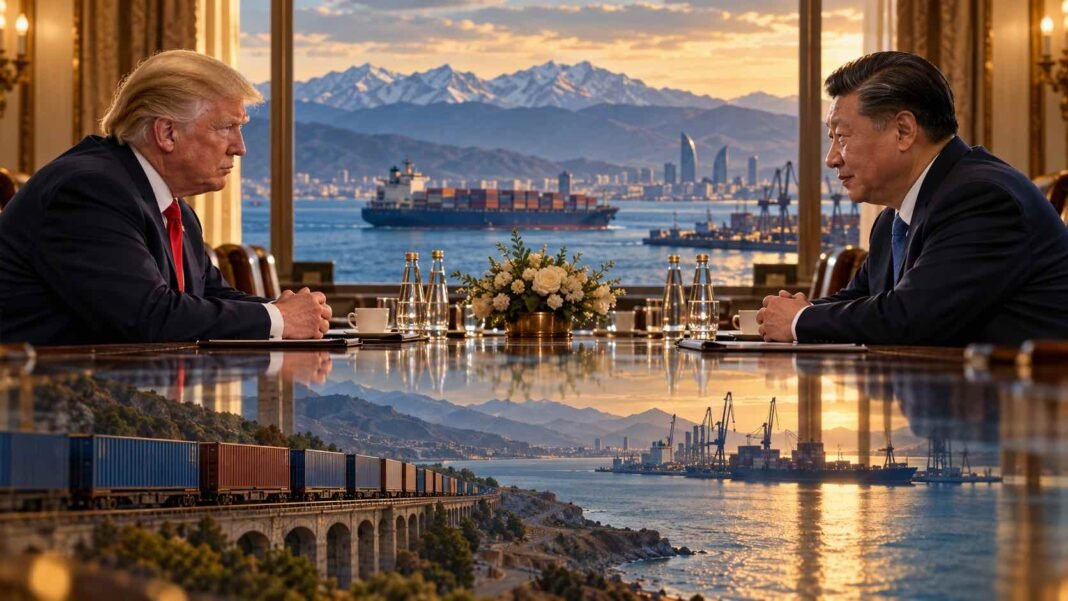
It is tempting to describe Donald Trump and Xi Jinping’s Sept. 24 White House meeting either as a diplomatic breakthrough or as an elaborate ceremony that produced little. Both judgments are premature.
Washington and Beijing did not eliminate their central disagreements. They did, however, demonstrate that they are still prepared to manage them at the negotiating table. In a world where decisions by the two largest economies shape trade, technology and security far beyond their borders, that alone matters.
The clearest result was a package of economic understandings. According to the White House, the two governments endorsed recommendations for more favorable tariff treatment covering $30 billion in nonsensitive goods in each direction. They also established structured trade and investment mechanisms and continued talks over rare-earth supply chains and other critical minerals.
China’s Foreign Ministry said the two sides agreed to extend earlier trade arrangements and implement the tariff package. That is useful breathing room, not a guarantee of lasting economic peace. Tariffs, market access, technology controls and strategic supply chains remain unresolved.
The meeting also carried a more dangerous dimension. Xi again raised Taiwan and urged Washington to oppose Taiwanese independence and handle the issue cautiously. There was no public indication that Trump accepted a change in the U.S. position. The leaders also discussed artificial intelligence and international crises, while their governments agreed to establish an AI dialogue and a channel for AI-related incidents.
None of this removes the danger of confrontation. It does preserve direct political channels through which both sides can try to prevent miscalculation during a crisis.
Why Baku, Tbilisi and Yerevan Should Pay Attention
The first reason is trade geography. The Middle Corridor links Chinese and European markets through Central Asia, the Caspian Sea, Azerbaijan and Georgia. The route has become more valuable as governments and companies seek alternatives that make supply chains less vulnerable to geopolitical shocks.
The World Bank says investments and efficiency improvements could halve travel times and triple trade flows along the corridor by 2030. Its modeling also projects a 37% increase in trade among Azerbaijan, Georgia and Kazakhstan, and a 28% increase between those countries and the European Union.
Those numbers describe an opportunity, not an automatic dividend.
If Washington and Beijing prevent another sharp escalation in their trade conflict, companies will find it easier to plan freight movements and long-term infrastructure investment. The South Caucasus could capture a larger share of those flows. If confrontation intensifies, demand for alternative routes could also rise—but so would uncertainty, making investors more cautious.
Under either scenario, the region’s success will depend less on summit rhetoric than on the capacity of ports and railways, border-crossing times, digital customs systems and predictable commercial rules.
There is a political dimension as well. Washington is involved in efforts to expand transport connectivity between Azerbaijan and Armenia, while Beijing has a strategic interest in Eurasian trade routes. Yet neither the U.S. nor Chinese accounts of the summit included an agreement on the South Caucasus.
It would therefore be a mistake to present Trump and Xi as deciding the region’s future. That future must be shaped primarily by the South Caucasus states themselves—through peace, practical agreements and transport links that actually work.
The summit’s value for the region cannot be measured by photographs from the White House. What matters is whether the United States and China can keep their competition within boundaries that allow trade to continue and prevent crises from becoming conflicts.
The South Caucasus cannot control the relationship between the two powers. It can, however, prepare for the consequences—and turn its position on the map into a source of income and cooperation rather than another arena for rivalry.
Source: Vesti Baku; White House; Chinese Foreign Ministry; World Bank.
AZE.US