AZE.US
Azerbaijan plans to increase transit freight from 16 million tons in 2026 to at least 25 million tons by 2030, while the country’s foreign-exchange reserves are already nearly 20 times larger than its external public debt.
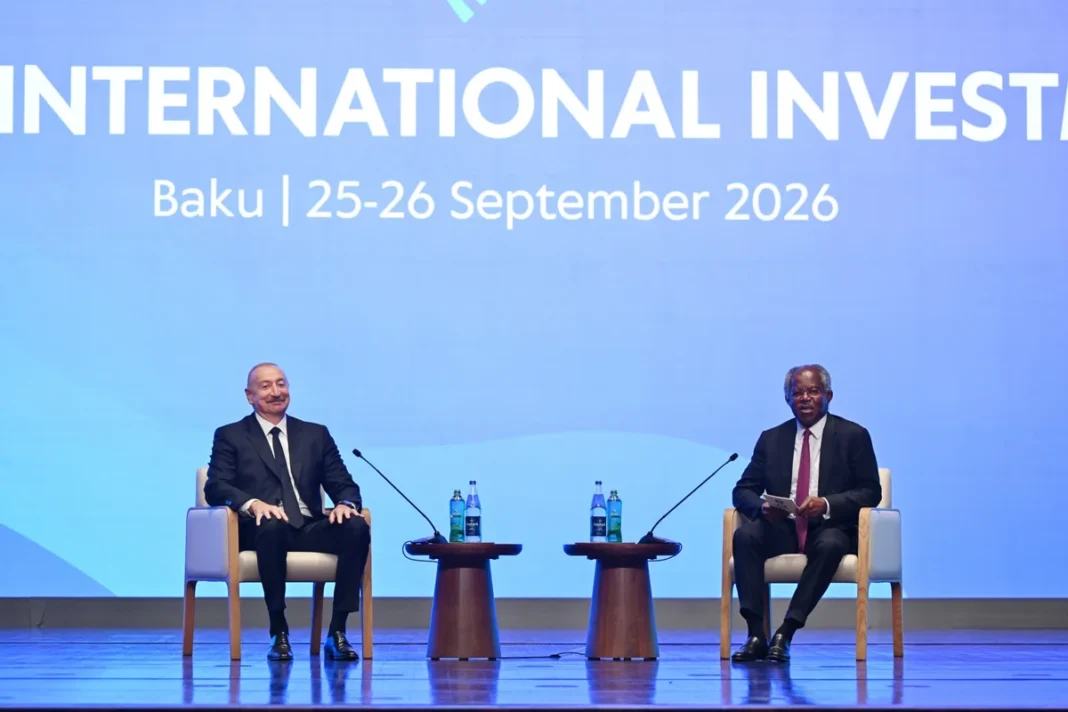
President Ilham Aliyev set out those and other economic targets on Sept. 26, the second day of the Second Azerbaijan International Investment Forum in Baku.
The remarks were separate from his address to forum participants published a day earlier. Aliyev focused on public debt, the structure of the economy, transit, energy and safeguards for investors.
Debt at 5.6% of GDP, Investment Above $360 Billion
Aliyev said external public debt stands at 5.6% of gross domestic product, while foreign-exchange reserves exceed it by roughly 20 times. He said Azerbaijan could repay the debt in one day if necessary.
More than $360 billion has been invested in Azerbaijan’s economy over the past 30 years, with foreign direct investment accounting for about half of the total.
The non-oil and gas sector now generates more than 70% of GDP. Oil and gas still account for more than 90% of exports, however, leaving further diversification as a central economic objective.
Aliyev cited the stability of oil and gas agreements as a guarantee for investors, saying contracts signed 30 years ago remain in force without changes to their terms.
Transit Freight Seen at 25 Million Tons or More
The president said transit freight will reach 16 million tons this year and is expected to rise to 25 million tons or more by 2030.
Azerbaijan has invested in railways, seaports, highways and air-cargo infrastructure to support that growth. About 60% of the country’s railways are electrified, and the work is continuing.
Aliyev said bridges, ports and ships alone would not make a route competitive. Digitalization, customs administration and faster cargo processing would also be decisive, he said.
He also said Azerbaijan and Kazakhstan expect to put a Trans-Caspian fiber-optic line into operation by the end of 2026.
New Energy Projects and Electricity Exports
Wind-power potential in Azerbaijan’s sector of the Caspian Sea alone is estimated at 157 gigawatts. Baku aims to reduce the use of gas in electricity generation, export the fuel it saves and become a major electricity supplier, particularly to Europe.
Aliyev said an agreement on the second phase of the Absheron gas field was expected to be signed. He estimated that the project could add about 5 billion cubic meters of gas a year within three to four years.
A second agreement concerns joint exploration with Exxon for unconventional oil and gas reserves. Aliyev said successful exploration could open a new phase of growth for the industry.
He added that Azerbaijan’s gasification rate had reached 96%. The share of foreign specialists at energy companies operating in the country has fallen to about 5%, compared with more than 90% during the early phase of Azerbaijan’s oil contracts.
The president described political and economic stability, security and predictable relations with all neighboring countries as essential conditions for long-term investment.
AZE.US