AZE.US
For weeks, the public narrative around the confrontation with Iran has focused on a narrow question: whether the conflict will escalate into a “full-scale war.” That framing is increasingly misleading.
The war may never arrive in the form many people imagine - columns of armored divisions crossing borders or a formal declaration of invasion. Yet the reality unfolding in the region suggests something else: the conflict is already expanding.
The shift is subtle but unmistakable. What began as pressure linked to Iran’s nuclear program has gradually broadened into a much wider military campaign. The targets now extend beyond nuclear concerns to include missile infrastructure, supply networks that support allied forces, maritime activity, and the arteries through which Iran exports energy.
In other words, the conflict’s logic has changed. The key question is no longer whether the war will formally expand. The war is already expanding - in its functions, its geography, and its consequences.
The greatest danger in the coming month is therefore not necessarily a massive invasion of Iran. A far more plausible and potentially destabilizing scenario is something slower and more diffuse: a war that spreads gradually across the region through overlapping forms of pressure.
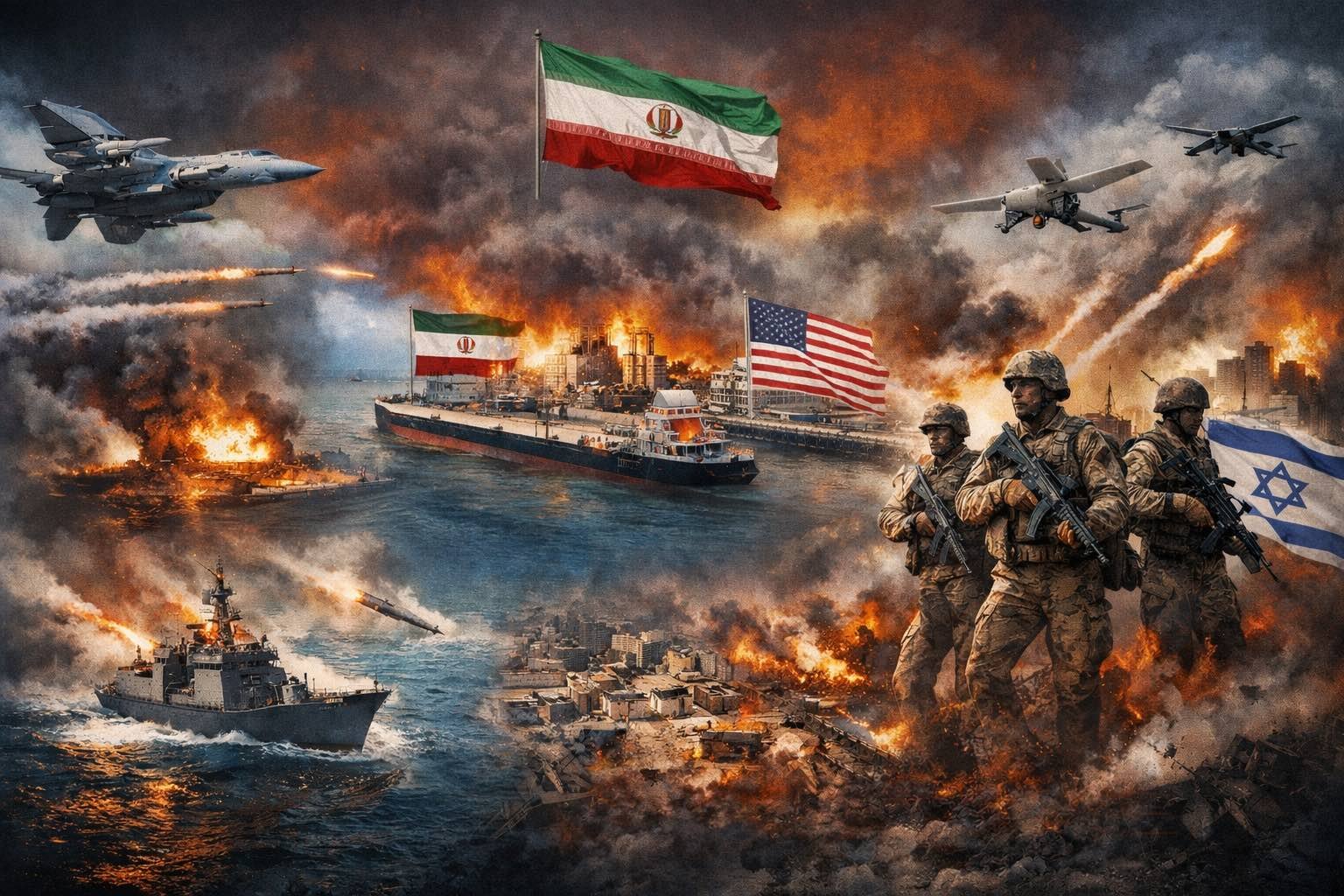
Air campaigns intensify. Missile and drone strikes continue in both directions. Energy infrastructure becomes a strategic target. Shipping routes face growing risks. Special operations occur in isolated episodes. Neighboring countries are pulled in not as full participants but as platforms - through bases, logistics hubs, air defenses and retaliatory strikes.
This is the pattern that increasingly defines the conflict.
The Most Likely Scenario
Looking one month ahead, the most realistic scenario is the continuation of a high-intensity air and missile war without a large conventional ground invasion.
Strikes deep inside Iran are likely to continue. Iran, in turn, will respond asymmetrically - through drones, missiles and regional networks capable of exerting pressure on multiple fronts.
At the same time, pressure will grow on the wider regional infrastructure that supports energy exports and military deployments. Shipping through the Strait of Hormuz will remain under constant scrutiny. Ports, oil terminals and regional bases will face heightened risk.
Neighboring countries are unlikely to enter the conflict with large armies. But they are increasingly becoming part of the operational environment - as territory hosting bases, as transit corridors, or as targets for retaliatory strikes.
This scenario requires no politically explosive decision such as launching a major ground invasion. It is simply an extension of the dynamics already underway.
Oil and the Psychology of Risk
Oil markets are reacting not only to physical damage but to the fear of disruption.
Energy infrastructure does not need to be completely destroyed to affect prices. Markets respond to uncertainty. The possibility that shipping through the Strait of Hormuz could be disrupted - even partially - is enough to send shockwaves through global energy trading.
The risk of strikes on export terminals, interruptions to shipping insurance, and the threat of repeat attacks can halt flows just as effectively as physical destruction.
For the next month, the baseline expectation is continued volatility and a persistent geopolitical risk premium in oil prices. As long as at least one of three factors remains present - active strikes against Iran, threats to the Strait of Hormuz, or the possibility of attacks on export hubs - markets will remain nervous.
A sustained drop in prices would likely require clear de-escalation and stabilization of maritime traffic. At the moment, that does not appear to be the central trajectory.
The Kharg Island Factor
Within this broader picture, one location stands out as a potential turning point: Kharg Island.
Kharg is not simply another facility in Iran’s energy system. It is the country’s primary oil export hub - a critical artery through which much of Iran’s crude reaches global markets.
The strategic question surrounding Kharg is therefore not whether a single strike might occur. The real issue is whether the conflict evolves into a systematic effort to choke off Iran’s oil exports.
At present, Kharg remains more a strategic lever than an active battlefield. But if pressure around the island were to intensify - if strikes became sustained and coordinated rather than symbolic - the nature of the war would change dramatically.
Such a shift would signal a move from military pressure to economic strangulation. That, in turn, would raise the likelihood of Iranian retaliation against energy infrastructure elsewhere in the region. Maritime trade could face deeper disruption, and oil markets could move from volatility into outright shock.
Even then, Kharg would not be a “magic switch.” Destroying or disabling the facility would require sustained pressure over time. But the decision to target it systematically would mark a new phase in the conflict.
Over the coming month, Kharg may serve as the single most important indicator of whether the war is moving toward economic warfare.
Ground War: Unlikely - But Not Impossible
A full-scale ground invasion of Iran in the next month appears less likely than many emotionally charged discussions suggest.
Such a campaign would require enormous political commitment, logistical preparation and military resources. It would represent a dramatic escalation that few actors appear ready to undertake immediately.
However, the absence of a large invasion does not eliminate the possibility of ground operations altogether.
The more realistic risk lies in limited or specialized missions - operations designed to achieve a specific objective rather than occupy territory. These might involve securing a particular facility, targeting nuclear materials, conducting a rapid raid against a command node, or extracting sensitive assets.
Such operations could be short and geographically limited. Yet politically and strategically they could raise the stakes sharply.
This is one of the most underestimated scenarios in the current debate. The future of the conflict may not resemble Iraq in 2003. Instead, it could involve brief but consequential ground episodes embedded within a broader air and missile war.
The Regional Spillover
Another misconception is that the conflict will either remain contained or suddenly expand into a formal war between multiple states.
The more likely reality lies somewhere in between.
The war is already spreading - but through infrastructure, proxy activity and indirect engagement rather than conventional fronts.
Lebanon remains a particularly volatile theater. Tensions there are already part of the broader conflict, and the risk of further escalation remains high.
In the Gulf, the danger is not large-scale invasion but vulnerability of infrastructure. Bases, ports and energy facilities may increasingly find themselves within the arc of retaliation.
Iraq and Syria present another arena where escalation can occur episodically. These territories offer space for proxy forces, logistical corridors and strikes against connected targets.
Meanwhile, the Red Sea and the approaches to the Suez corridor could become instruments of pressure on global trade, even without the declaration of a new front.
Even countries not directly involved - including Turkey and parts of the eastern Mediterranean - could face the risks of miscalculation: stray missiles, interception incidents or expanding air-defense activity.
What emerges is not a clean expansion of the war, but a gradual widening of its operational map.
The Most Dangerous Scenario
Ironically, the most dangerous path forward is not the dramatic one.
The greatest risk is a combination of developments that appear individually manageable: continued air strikes, pressure on Iran’s oil exports, disruptions in the Strait of Hormuz, limited ground operations, and growing involvement of regional infrastructure.
Taken separately, each element might look like another episode in a contained conflict.
Taken together, they would amount to something much larger: a regional war unfolding without a formal declaration.
What to Watch Next
In the coming month, several signals will reveal whether the conflict is crossing that threshold.
Pressure on Kharg Island would suggest a shift toward economic warfare. A worsening situation in the Strait of Hormuz would indicate a growing threat to global trade. Evidence of limited ground operations would signal rising stakes. Expanded strikes on Gulf infrastructure would deepen regional involvement.
And if escalation simultaneously intensifies in Lebanon and maritime theaters, the conflict’s geography could widen rapidly.
A War That Expands Without Announcement
The most likely trajectory over the next month is neither rapid de-escalation nor a massive occupation-style invasion.
Instead, the region may face something more complex: a widening military campaign that spreads across airspace, seas, energy networks and proxy arenas.
Such a conflict may never be formally declared as a regional war. Yet if its fronts continue multiplying - from Iran and Israel to Lebanon, the Gulf, the Strait of Hormuz and the Red Sea - the distinction will become largely semantic.
The war will already be there.