AZE.US
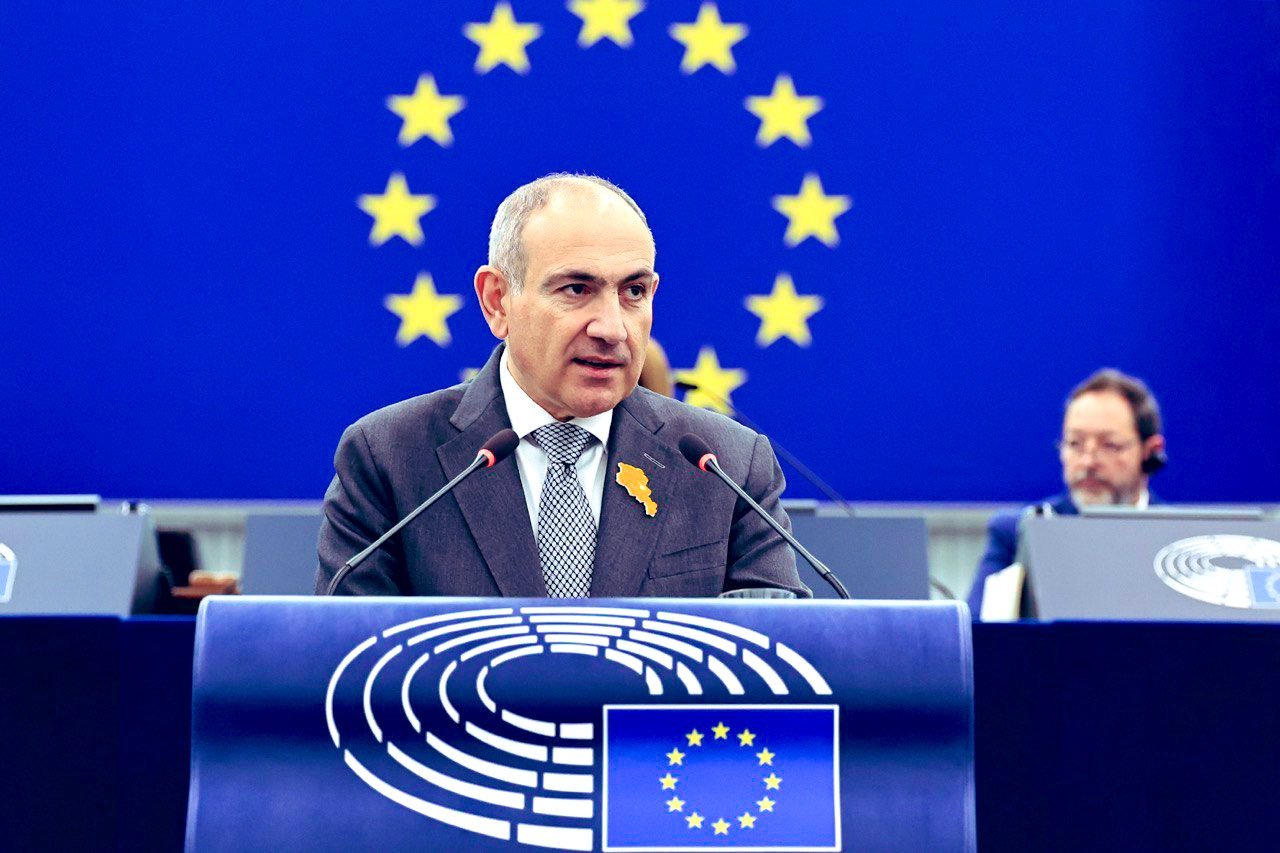
When Armenian Prime Minister Nikol Pashinyan addressed the European Parliament in Strasbourg this week, the speech was not just about Armenia’s European aspirations. It was also a carefully calibrated political message - to Brussels, to the region, and to audiences at home.
At the center of his remarks was a striking observation: one of the biggest obstacles to Armenia’s integration with the European Union, he said, is the frozen political dialogue between the EU and Georgia.
At first glance, that comment may have sounded unusual. Why would Armenia’s prime minister raise Georgia’s relationship with the EU while discussing Armenia’s own European trajectory?
In reality, the answer is straightforward. Geography dictates Armenia’s strategic options. The country has no direct access to the sea and no land border with the European Union. Any meaningful economic or logistical integration with Europe inevitably runs through Georgia - through its transport routes, ports and energy corridors.
In practical terms, Armenia cannot move toward Europe alone.
Pashinyan’s message therefore carried a broader implication for Brussels: if the EU wants Armenia to move closer to Europe, it cannot afford to ignore its strained relationship with Georgia.
A Shift In Regional Dynamics
The remark also reflects a subtle shift in the geopolitical landscape of the South Caucasus.
For years, Georgia was widely viewed as the region’s most advanced candidate for European integration. Its pro-Western orientation and reform agenda placed it firmly in the EU’s orbit.
Today, however, relations between Tbilisi and Brussels have cooled significantly. At the same time, Armenia has begun to emphasize its European course more openly, presenting itself as a country committed to reforms and democratic alignment with Europe.
The result is a quiet role reversal. While Georgia’s EU path has become more uncertain, Armenia is increasingly positioning itself as the region’s most enthusiastic pro-European voice.
Yet Pashinyan himself appears aware of the limits of that narrative. In Strasbourg he stressed that the process of reforms - rather than immediate EU membership - is the real priority for Armenia.
That is a pragmatic assessment. Armenia remains a member of the Russian-led Eurasian Economic Union, and the global geopolitical landscape is changing far too quickly to make confident predictions about EU enlargement a decade from now.
The Church Conflict Reaches Europe
Another notable part of Pashinyan’s speech concerned his government’s ongoing confrontation with the Armenian Apostolic Church.
From the European Parliament podium, the prime minister sharply criticized elements within the clergy, accusing them of fueling internal tensions and pushing the country toward renewed conflict.
The choice of venue was deliberate.
In Europe, the dispute between the Armenian government and the church is often viewed through the lens of democracy, religious freedom and political pluralism. By addressing the issue directly before European lawmakers, Pashinyan sought to frame the narrative on his own terms.
In essence, he presented a stark political contrast: his government represents the “party of peace,” while opponents - including some church figures and remnants of the former political establishment - represent forces that could drag Armenia back into confrontation.
Public Opinion Tells A More Complex Story
But domestic political realities complicate that argument.
Recent opinion surveys show that the Armenian Apostolic Church remains one of the most trusted institutions in the country. Public confidence in the church is estimated at roughly 62 percent, second only to the armed forces, which enjoy trust levels of around 74 percent.
By contrast, trust in the office of the prime minister is significantly lower.
Perhaps more surprisingly, support for the church appears relatively strong among younger Armenians - challenging the assumption that younger generations naturally align with secular or anti-clerical politics.
These numbers help explain why the government’s campaign against the church has recently become less intense. Pressure on the clergy did not produce the rapid political results some in the ruling camp may have expected.
At the same time, Armenia faces mounting external uncertainties, particularly amid escalating tensions around Iran. In such circumstances, a prolonged domestic confrontation with the church could prove politically risky.
For now, the conflict appears to have moved into a quieter phase rather than disappearing entirely.
The Regional Context
Pashinyan’s Strasbourg speech also underscored a broader transformation taking place in the South Caucasus.
For decades the region functioned largely as a geopolitical chessboard shaped by outside powers. Today, however, it is gradually becoming a more interconnected political and economic space, with growing regional interaction and shifting alliances.
For major global actors - whether the European Union, Russia or the United States - the strategic significance lies not only in individual countries but increasingly in the region as a whole.
Seen in this context, Pashinyan’s speech was not just about Armenia’s European future. It was a reminder that the future of the South Caucasus will likely be determined not by isolated national trajectories, but by how the region evolves together.