AZE.US
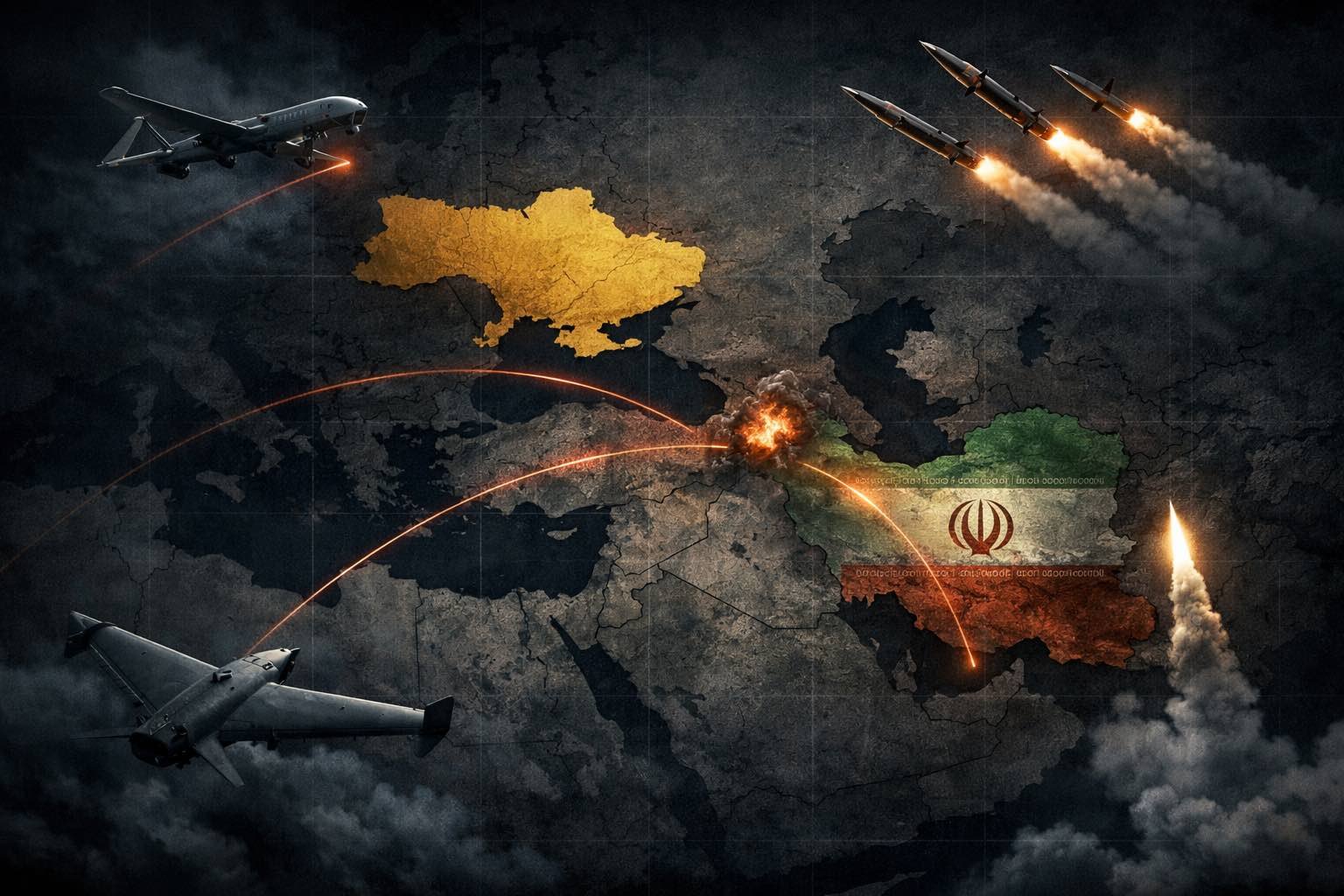
Ukraine is no longer operating within the boundaries of a regional conflict.
A recent statement from an Iranian lawmaker - suggesting that Ukraine could be considered a legitimate target due to its cooperation with Israel and the United States - reflects a broader shift already underway. Kyiv is increasingly being pulled into a wider geopolitical arena that stretches far beyond Eastern Europe.
This shift is not accidental. It is structural.
Since the escalation of the war with Russia, Ukraine has evolved from a frontline state into an active geopolitical actor. Its role now extends into domains traditionally associated with major powers: military technology exchange, security cooperation, and strategic alignment across regions.
The Middle East is becoming part of that equation.
From Regional War to Global Network
Iran’s rhetoric should not be read as an immediate military signal. It is better understood as a political message: Ukraine is no longer a distant conflict participant but a node in a broader anti-Iranian alignment.
From Tehran’s perspective, cooperation between Kyiv, Washington, and increasingly Israel places Ukraine inside an adversarial framework. In that logic, geographic distance becomes irrelevant.
This reflects a wider transformation. Conflicts are no longer contained - they are interconnected. Participation in one theater increasingly implies involvement in others.
Pragmatism and Risk in Kyiv’s Strategy
Ukraine’s growing engagement with Israel follows a clear logic. The country is seeking technological capabilities, operational experience, and diversified partnerships. Israel, in turn, has an interest in Ukraine’s battlefield-tested expertise.
This is pragmatic diplomacy under pressure.
However, not all recent moves carry the same strategic clarity.
President Volodymyr Zelensky’s meeting with Reza Pahlavi - a symbolic opposition figure with limited influence inside Iran - illustrates the risks of overextension. While the gesture signals alignment against Tehran, it offers little tangible benefit and risks escalating political friction.
In a region where symbolism carries weight, such signals are not neutral.
Expanding Reach, Expanding Exposure
The deeper Ukraine extends its diplomatic and strategic footprint, the more complex its position becomes.
Expanding partnerships inevitably means expanding the list of adversaries. Managing that balance is increasingly difficult as Kyiv operates across multiple geopolitical layers simultaneously.
This is the trade-off of becoming a broader actor: influence grows, but so does exposure.
A Region Returning to Hard Power
The Middle East itself is undergoing a parallel shift.
The logic of deterrence is returning to the center of regional strategy. Discussions around nuclear capability - once largely confined to Iran - are now influencing broader regional thinking.
Recent conflicts have reinforced a simple conclusion for many states: external guarantees are unreliable without internal capabilities.
This does not immediately translate into new nuclear programs. But it changes how states think about long-term security.
The Changing Role of the United States
The United States remains a central security actor in the region, but its position is evolving.
Military bases, long seen as pillars of stability, are increasingly viewed as potential liabilities - fixed targets in an environment of asymmetric threats. This complicates the traditional model of security guarantees Washington has relied on for decades.
At the same time, the system is becoming more fragmented. No single power fully controls the regional balance anymore.
Beyond Ukraine - Toward a New Configuration
Ukraine now occupies a dual role.
It remains a country under direct military pressure, but it is also becoming an active participant in shaping broader geopolitical dynamics. Its decisions are no longer confined to its own war - they resonate across multiple regions.
The key question is no longer whether Ukraine should expand its reach.
It already has.
The real question is whether it can manage the consequences of that expansion - in a system where every new connection also creates a new line of tension.