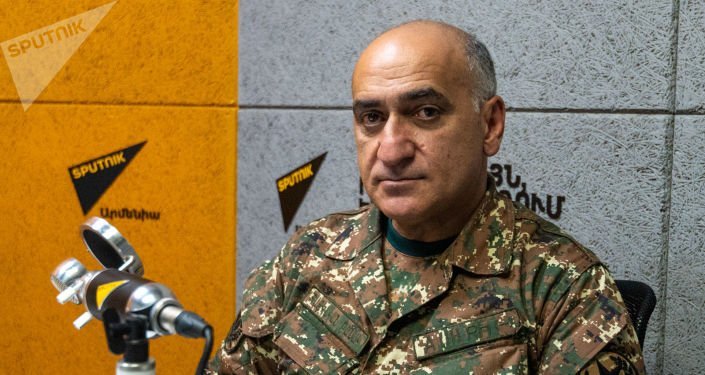
By AZE.US Editorial Team
“The score is now 1-1. The war is still ahead.”
That statement by Armenian political figure Vladimir Poghosyan explains the danger of revanchism more clearly than almost any warning from Baku.
When wars are reduced to a scoreboard, the public is prepared for another round. The cost will be borne by the people who are promised that a new conflict will restore national dignity.
In an interview with Daily Europe Online, Poghosyan - introduced as a former adviser to the chief of Armenia’s General Staff in 1992-1994 - repeatedly spoke about the need for peace. Yet the substance of his remarks raises a basic question: What kind of peace is he offering?
Peace as an Intermission
Poghosyan said there is no peace and portrayed the previous wars as battles in a larger conflict that remains unfinished. When the interviewer observed that such language could push Azerbaijan to increase military spending, Poghosyan said he would welcome an eightfold increase because Armenia would eventually seize the weapons.
Calls for a peaceful future thus sit beside promises of future trophies. That contradiction is the core of his political proposition.
Poghosyan is entitled to criticize statements by Azerbaijani President Ilham Aliyev. The rhetoric of national leaders matters: humiliating language can obstruct reconciliation and deepen distrust. But criticism of another leader’s words does not remove responsibility for one’s own. It is not credible to denounce the humiliation of Armenians while offering Azerbaijanis the prospect of another military defeat.
Rebuilding a Myth of Superiority
Poghosyan’s account of 1994 is especially revealing. He claimed Armenian forces could have entered Baku and presented the decision not to advance as an act of restraint. The interview supplied no evidence for those military and political assumptions.
The purpose of the claim is nevertheless clear: to restore a feeling of lost superiority.
That version of the past offers a convenient explanation for the present. Defeat can be described as a temporary result of poor leadership, corruption and inadequate preparation. The underlying logic of the conflict need not be reconsidered; supporters are told only to wait for different leaders, accumulate resources and try again.
Revanchism begins when society is taught to regard peace as a pause before a more successful war.
The logic also reaches into daily life. Discussing Azerbaijani gasoline, Poghosyan described it as the blood of Armenian soldiers. An ordinary commodity becomes a loyalty test, and economic ties between neighbors become grounds for accusation.
Under that approach, reconciliation can be blocked indefinitely. Trade becomes betrayal, compromise becomes weakness and negotiations are judged by whether they help restore a former balance of power.
The Diplomatic Alternative
A concrete alternative already exists. The initialed Armenia-Azerbaijan peace agreement, published in August 2025, provides for mutual respect for sovereignty and territorial integrity, the absence of territorial claims and a commitment not to use force.
The document still requires full treaty force, but its terms show the obligations around which relations between the two states can be built. Poghosyan offers a different vision: the “score” remains open.
Khojaly and Equal Recognition of Suffering
Poghosyan’s account of the 1992 killings in Khojaly is also troubling. In the interview, he repeated a version that shifts responsibility for the deaths of Azerbaijani civilians to the Azerbaijani side.
Human Rights Watch rejected that account in a 1997 response to Armenia’s Foreign Ministry. The organization placed direct responsibility for the civilian deaths on Karabakh Armenian forces and said neither its evidence nor findings by the Memorial rights group supported allegations that Azerbaijani forces blocked or fired on fleeing civilians.
Recognition of Armenian suffering is necessary. Recognition of Azerbaijani suffering is equally necessary. Remembering one’s own victims does not confer the right to erase the dead of a neighboring society.
As long as one side’s tragedies are explained solely as crimes committed by the enemy while the other side’s losses are dismissed as staging or provocation, the foundations for renewed hostility remain intact.
A Political Project, Not Just Commentary
The rhetoric also has a domestic political dimension. Poghosyan spoke of creating a third force composed of security officials and technocrats and said he intended to lead it. His claims of future military superiority should therefore be assessed not only as commentary, but also as a bid for political influence.
One speaker, however provocative, does not represent all of Armenia. Poghosyan’s words do not prove that Armenian society wants another war, and they are not a statement by the current Armenian government.
They do show the proposition being marketed to that society: wait, prepare and seek another chance to overturn the outcome by force.
For Azerbaijan, such statements are another reason for caution. For Armenia, they are dangerous because they tie the country’s future to yet another attempt to correct the past through war.
Every promised “next round” leaves dead soldiers, shattered families and another generation taught why revenge must come next.
Armenia needs a peace in which its citizens can build their lives without waiting for another mobilization. The formula “the score is 1-1” asks them to gamble those lives again.
Sources: Vesti Baku editorial; published text of the initialed Armenia-Azerbaijan agreement; Human Rights Watch response on Khojaly.