Vesti Baku Editorial Board
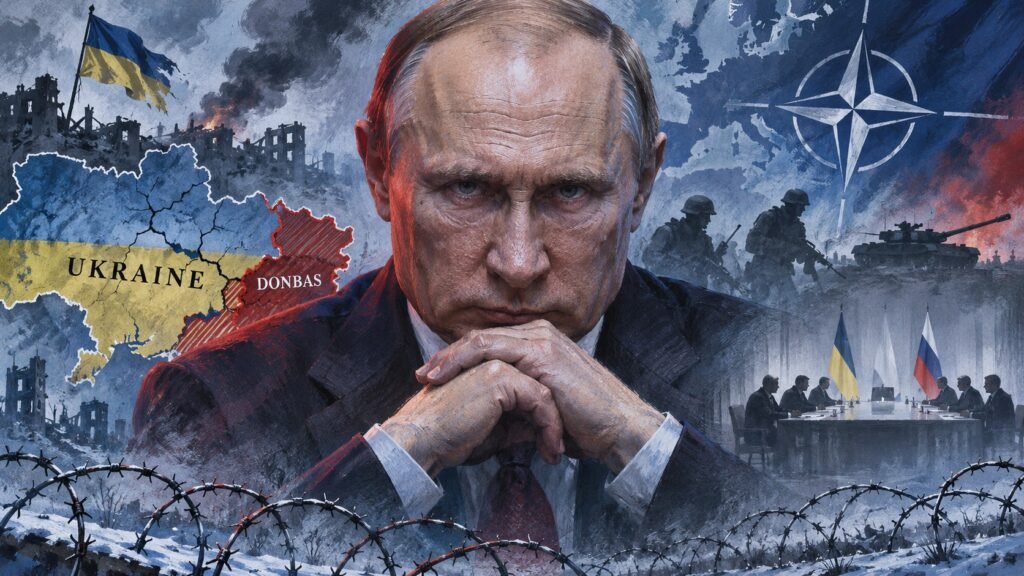
Washington has raised the possibility of trading Ukrainian-controlled territory in Donbas for Ukraine’s membership in NATO. Moscow responded by demanding what would amount to a rewrite of Europe’s entire security system. Europe, meanwhile, is still arguing over who should sit at the negotiating table and who would pay for the consequences of the war.
Peace negotiations increasingly resemble an auction in which everyone offers something that does not belong to them.
Until recently, Ukrainian membership in NATO was widely treated as a closed issue in talks aimed at ending the war. It has now returned unexpectedly.
President Volodymyr Zelenskyy said U.S. negotiators had for the first time raised a question: Would Kyiv withdraw its forces from the part of Donbas still under Ukrainian control in exchange for membership in the North Atlantic alliance?
A question should not be confused with a proposal, and a proposal should not be confused with an agreement. Washington has not publicly presented an agreed plan for such an exchange. Zelenskyy has not announced that Ukraine is prepared to surrender territory.
But the fact that the idea has surfaced says a great deal about the direction of diplomacy.
After nearly five years of full-scale war, negotiations are no longer only about how to stop the shooting. They are also about the price Ukraine may be asked to pay for its own security.
If a country must give up part of its territory to gain protection from the next invasion, what exactly is it being guaranteed in return?
The Kremlin Wants More Than Donbas. It Wants the Europe of 1997
Talks in Abu Dhabi did not produce a major political breakthrough. The sides reached an agreement in principle on a large prisoner exchange but made no meaningful progress on the central territorial and military-political questions.
Moscow instead used the diplomatic process to renew demands that extend far beyond Ukraine.
According to The New York Times, the Russian side circulated a document dated Nov. 10 calling for NATO troop deployments and bases to be rolled back to their 1997 configuration.
That means the period before Poland, the Czech Republic, Hungary and the Baltic states joined the alliance. Moscow also seeks limits on further NATO expansion, an end to Western arms deliveries to Ukraine and restrictions on alliance military activity in several regions, including the South Caucasus and Central Asia.
This is no longer a negotiation over several communities in Donbas. It is an attempt to revise the European security order established after the Cold War.
The Kremlin is not offering a symmetrical exchange. The reported terms do not commit Russia to withdrawing its forces from all occupied Ukrainian territory in return for a large-scale reduction in NATO’s presence.
The formula is revealing: Russia retains its territorial claims while demanding that other states restrict their defenses.
What does it offer in return? A promise to discuss peace.
Ukraine Is Being Asked to Surrender What Russia Has Not Captured
During an Azerbaijani program on the Russia-Ukraine negotiations, Milli Majlis member Rasim Musabekov highlighted a central contradiction in Moscow’s demands.
Russia wants the remainder of Donbas that is still under Ukrainian control even though capturing it militarily would require new large-scale offensives, heavy losses and an uncertain amount of time.
In other words, Russia would receive at the negotiating table what its army has not yet managed to take on the battlefield, without any guarantee that the war would then end.
A territorial transfer could establish a new line of control. By itself, however, it would not remove the causes of the conflict, create mechanisms to prevent another attack or answer what would happen if the agreement were violated.
Ukraine is being asked to take an irreversible step in exchange for a promise of future security. Territory can be surrendered once. Recovering it through diplomacy afterward would be far more difficult.
That is why security guarantees cannot be reduced to an elegant sentence in a final communiqué.
NATO Without Real Protection Is Only a Signboard
The formula sounds attractive: Ukraine gives up part of Donbas, joins NATO and the war ends. But it contains a fundamental obstacle.
NATO does not exist for ceremonial flag raisings. Its purpose is collective defense, common military planning and the readiness of allies to act if a member is attacked.
If Ukraine is offered membership while the central mechanisms of collective defense are restricted, Kyiv would reasonably ask how that differs from a political declaration.
Article 5 of the North Atlantic Treaty calls on allies to assist a member subjected to armed attack, although each member determines the action it considers necessary.
The issue is therefore not merely Ukraine’s legal status. It is whether alliance members would fulfill their obligations if Russia attacked again.
No diplomatic formula can answer that question. The answer must be backed by military capabilities, political decisions and response mechanisms agreed in advance.
Otherwise, Ukraine risks receiving another document whose real value becomes clear only during the next crisis.
Europe Wants a Seat at the Table. Will It Pay for Peace?
European participation poses a separate problem.
In Abu Dhabi, European representatives consulted with the American and Ukrainian sides but did not take part directly in the three-way talks with Russia. European leaders have called for Britain, France, Germany, Italy, Poland and European Union representatives to join the process.
But attending negotiations and accepting responsibility for the outcome are different things.
In the Azerbaijani discussion program, REAL Party chairman Natig Jafarli questioned whether Europe could develop a fully unified position.
He said the EU needs a group of states prepared not merely to issue a joint statement but to assume commitments to finance Ukraine’s security and reconstruction.
That matters more than another declaration of solidarity.
If Washington intends to reduce its direct involvement while Russia continues to advance maximalist demands, Europeans will have to decide how much Ukraine’s postwar security will cost.
How many weapons must be supplied? Who will fund the Ukrainian military? Who will provide air defense? Who will respond if a new agreement is broken?
The answers require billions of dollars and political resolve.
Putin Is Betting on Winter and Western Fatigue
While diplomats debate a future security architecture, Ukraine faces the immediate danger of strikes on its energy infrastructure.
Winter turns a war of attrition into a test not only for the military but for millions of civilians. Destruction of power plants and distribution networks threatens heating, water supplies, industry and hospitals.
In the same discussion, security expert Ilham Ismayilov suggested that Russia’s leadership is using the winter months to intensify pressure on Ukraine while waiting for disagreements among Western allies to deepen.
That is an assessment of the Kremlin’s strategy, but it follows the logic of a prolonged war of attrition.
The longer the conflict continues, the more resources Kyiv needs to sustain its defense. Russia also pays a price. Ukrainian strikes on oil refineries and other infrastructure add military and economic costs, and the ability to continue fighting does not mean the ability to escalate indefinitely without consequences.
Moscow is betting that it can endure the war longer than its opponent. Kyiv is betting on preserving its army, international support and its ability to impose unacceptable costs on Russia.
As long as both sides view continued resistance as preferable to the peace terms being discussed, another diplomatic round is unlikely to produce an automatic ceasefire.
Why This Matters to Azerbaijan
At first glance, a dispute over Donbas and NATO may appear to have little to do with the South Caucasus.
Russia’s reported proposals show otherwise. Moscow explicitly seeks restrictions on Western military activity in the South Caucasus and Central Asia.
At issue is the right of states to decide independently with whom they cooperate on security.
For Azerbaijan, that is fundamental. Baku has spent decades building its own foreign-policy and defense relationships, including its strategic alliance with Turkey.
A return to a model in which a major power attempts to set the rules of defense cooperation for neighboring states would directly affect the interests of independent countries in the region.
The Ukraine negotiations therefore matter not only because they may end a war. They will also show whether major powers are prepared to recognize that the security of small and medium-sized states should not be decided without them.
Peace Cannot Rest on a Promise That the Aggressor Will Not Attack Again
The value of a peace agreement is not determined by the number of signatures or the grandeur of the ceremony. It is determined by what happens afterward.
If Russia retains the ability to begin another war while Ukraine gives up defensive positions without sufficient guarantees, an agreement could become only a pause between conflicts.
If Ukraine instead receives a credible security system that Moscow treats as a serious deterrent, a more durable settlement becomes possible. That is precisely the outcome facing the strongest resistance from the Kremlin.
Russia wants Ukrainian territory and limits on NATO. Ukraine wants protection from another invasion. Europe wants to participate in decisions but must first define its own commitments. Washington wants a formula to end the war.
Those objectives do not yet form a single agreement.
The venue can change. The group of negotiators can expand. New diplomatic language can be drafted. The fundamental question remains:
Why should a country that was invaded pay with territory for guarantees that it will not be invaded again?
And who will take responsibility if those guarantees again prove inadequate?
Until there is a convincing answer, exchanging Donbas for NATO membership remains not a completed peace plan but a dangerous diplomatic hypothesis.
A war can be stopped by an agreement. Peace cannot be secured by a signature alone.
Source: Vesti Baku Editorial Board