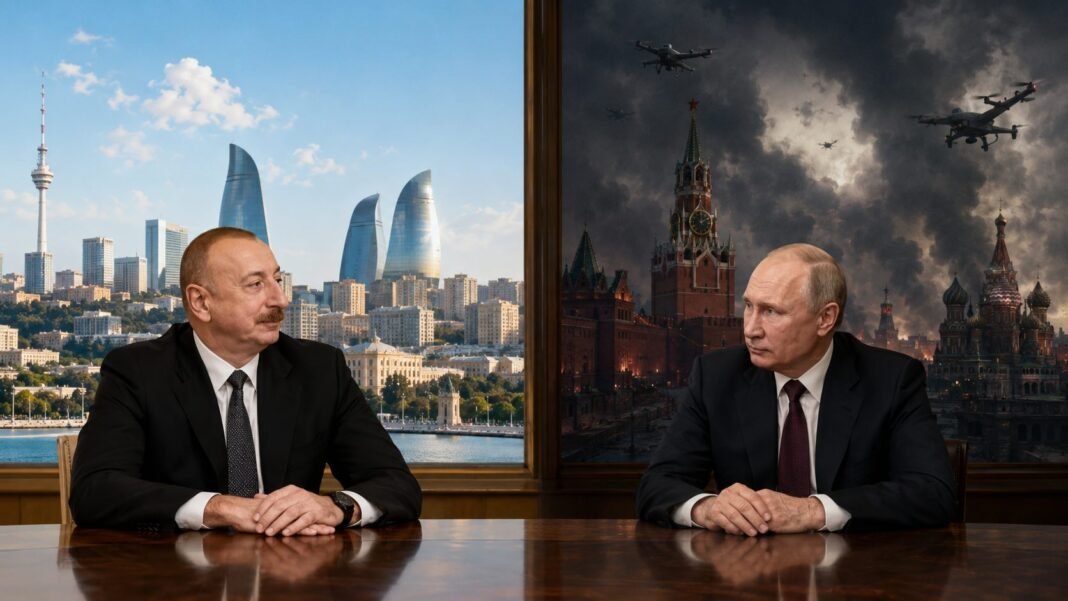
Russia called Azerbaijan’s position on Ukraine “mistaken,” then immediately assured Baku that the disagreement would not damage bilateral relations. Behind that diplomatic balancing act lies a new reality: bogged down in the war against Ukraine, Moscow no longer has the freedom to dictate terms in the South Caucasus.
By AZE.US Editorial Team
President Ilham Aliyev’s statement reaffirming Azerbaijan’s support for Ukraine’s territorial integrity clearly irritated Moscow.
Speaking at the Shusha Global Media Forum, Aliyev went beyond routine diplomatic language. He said Azerbaijan had always supported Ukraine’s sovereignty, territorial integrity and internationally recognized borders, and would continue to do so.
He also drew a clear parallel between Ukraine’s resistance and Azerbaijan’s own struggle to restore control over Karabakh.
Aliyev recalled that Baku had faced years of pressure to accept occupation as permanent. During the 2020 Karabakh war, he said, major powers demanded that Azerbaijan stop its military advance and preserve the existing situation.
His message was unmistakable: a nation defending its independence, identity and territory cannot simply be ordered to surrender its land.
For the Kremlin, this comparison is deeply uncomfortable.
Moscow has tried to portray its war against Ukraine as a struggle for security, historical justice and Russian interests. Aliyev, however, framed the conflict through the principle of territorial integrity.
And this was not a statement from a Western politician whom Russian propaganda could easily dismiss as hostile or “Russophobic.” It came from the leader of a country formally linked to Russia through a declaration of allied cooperation.
The response from Kremlin spokesman Dmitry Peskov showed how much the balance of power has changed.
Peskov called Aliyev’s position “mistaken” and said Moscow would continue explaining why it disagreed with Baku. Yet almost immediately, he added that the dispute should not cast a shadow over Russian-Azerbaijani relations.
Russia, he stressed, remained interested in developing ties with Azerbaijan.
The contradiction was striking.
The Kremlin wanted to register its displeasure, but it also feared provoking another confrontation with Baku. Its criticism was therefore wrapped in diplomatic caution: Azerbaijan’s position is wrong, Moscow strongly disagrees, but relations remain important and no broader consequences should follow.
This is what Russian power in the South Caucasus looks like today.
A decade ago, such a statement from a regional leader might have triggered threats, economic pressure, an aggressive media campaign or some form of political punishment.
Today, Moscow can only declare Azerbaijan’s position incorrect and promise to argue its case through diplomatic channels.
Russia’s language has become noticeably shorter.
The reason is obvious. The war against Ukraine has turned into a strategic quagmire that consumes Russia’s military, financial and diplomatic resources.
The Kremlin launched the invasion to demonstrate that Russia remained a great power capable of redrawing borders and imposing its will on neighboring states. Instead, the war exposed the limits of Russian power.
The South Caucasus has watched Moscow struggle to fight a major war, maintain influence across the former Soviet space, protect its allies, punish defiance and preserve its role as the region’s indispensable arbiter.
It can no longer do all of these things at once.
The erosion of Russian influence has been especially visible in Armenia.
Yerevan suspended its participation in the Russia-led Collective Security Treaty Organization and began deepening its ties with the European Union and other partners.
Even Russia’s traditional ally no longer treats Moscow as an irreplaceable security guarantor.
Azerbaijan has gone further.
Baku restored its territorial integrity through its own military and political strategy. It strengthened its alliance with Turkey, expanded ties with the United States, Europe and Central Asia, and increasingly shaped regional policy without seeking Moscow’s approval.
Russia is no longer directing developments in the South Caucasus.
At best, it is now one of several competing actors.
That is why Aliyev’s statement on Ukraine matters far beyond the Ukrainian conflict itself.
Baku is telling Moscow that normal relations do not mean political obedience.
Azerbaijan is prepared to cooperate with Russia, maintain trade and keep diplomatic channels open. But it does not accept that Moscow has the right to determine Azerbaijan’s foreign policy or dictate how Baku should describe the war in Ukraine.
Aliyev’s position was based on Azerbaijan’s own national experience.
A country that spent decades living with occupation cannot easily endorse the idea that borders may be changed by force or that territorial losses should be accepted in the name of political convenience.
The Kremlin had little choice but to swallow this bitter pill.
Moscow could not remain silent. Russian domestic audiences and the country’s propaganda establishment required at least a symbolic response.
That is why Peskov used the word “mistaken.”
But the Kremlin did not go further.
It did not threaten Azerbaijan with consequences.
It did not question the future of bilateral cooperation.
It did not announce a revision of relations.
It did not demand that Baku withdraw its support for Ukraine’s territorial integrity.
Instead, Moscow carefully emphasized that it wanted relations with Azerbaijan to continue developing.
This is no longer the language of a power issuing orders to its neighbors.
It is the language of a government trying to preserve its dignity after receiving an unpleasant but unmistakable public message.
Russia created this situation for itself.
The invasion of Ukraine was supposed to restore Moscow’s sphere of influence. Instead, it accelerated its decline.
Russia’s neighbors saw that its security guarantees could fail, its regional mechanisms were not permanent and its threats had limits.
Baku recognized this shift earlier than many others and adjusted its relationship with Moscow accordingly.
There has been no dramatic break and no unnecessary confrontation. But there is also no submission.
Aliyev can speak about maintaining normal ties with Russia while openly supporting Ukraine’s territorial integrity.
Moscow may dislike that position, but it now has to accept it.
Today’s Russia is no longer the Russia that once treated the South Caucasus as its exclusive sphere of influence.
It is trapped in a costly war, weakened across the region and increasingly unable to enforce political discipline among its neighbors.
Faced with Azerbaijan’s defiance, the Kremlin had to choose between preserving relations and creating another foreign policy crisis.
It chose to preserve relations.
Moscow called Aliyev’s position mistaken, voiced its disagreement, swallowed the bitter pill and tried to save face.
That may be the clearest sign yet of how dramatically the balance of power in the South Caucasus has changed.
AZE.US