By AZE.US Editorial Team
An ice cream commercial has become one of Azerbaijan’s hottest political and cultural debates.
Not inflation.
Not housing prices.
Not corruption allegations.
Not social inequality.
Ice cream.
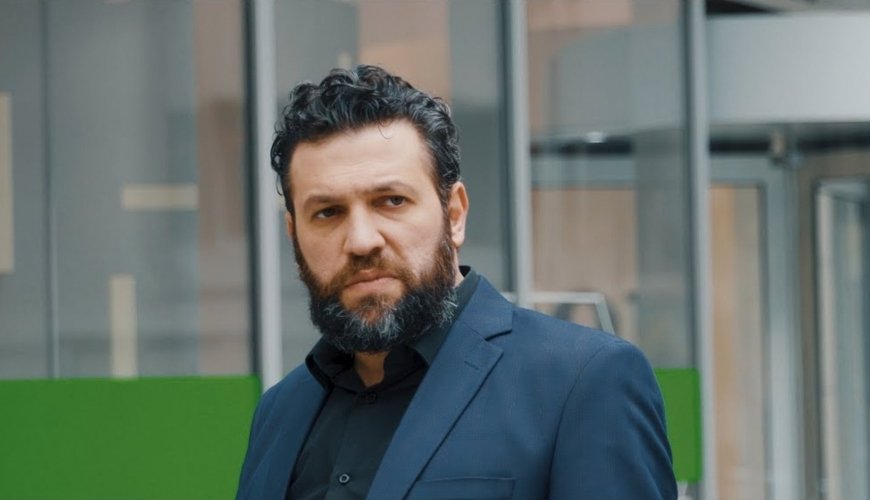
Over the past week, Azerbaijani social media has been consumed by controversy surrounding an advertisement for local dessert chain Almond Bakery featuring popular actor Taleh Yuzbeyov. The commercial contrasted the brand’s “natural” ingredients with the exaggerated appearance of a woman whose face appeared heavily altered by cosmetic procedures. Critics called the ad sexist and humiliating toward women, while supporters argued it was simply satire aimed at society’s growing obsession with artificial beauty.
The backlash quickly intensified. Almond removed the commercial and apologized, but Yuzbeyov refused to distance himself from the message, reposting the video on his own social media accounts without the company’s branding. Instead of ending the controversy, that decision fueled an even larger debate about artistic freedom and public pressure.
But perhaps the most interesting question has little to do with the commercial itself.
It is about society.
The Comfort of Safe Outrage
Some controversies demand courage.
Others demand nothing more than a keyboard.
Condemning an advertisement is easy. It carries no personal risk. Nobody loses a job for criticizing an ice cream commercial. Nobody faces political pressure for posting an angry comment.
The same cannot always be said for speaking out on more difficult issues that affect people’s daily lives.
That is why the Almond controversy raises an uncomfortable question: why are people capable of mobilizing with such passion over a 30-second advertisement, while many far more consequential issues often generate only limited public engagement?
Whether one agrees with that observation or not, it has become part of the conversation surrounding the controversy itself.
A Double Standard?
There is another contradiction that many Azerbaijanis have pointed out.
Scroll through social media whenever a celebrity or influencer posts photos after cosmetic surgery.
The comments are often ruthless.
“She ruined her face.”
“Too much plastic surgery.”
“Everyone looks the same now.”
“Natural beauty is gone.”
Many of these remarks are written not only by men but by women criticizing other women.
Few people demand apologies for those comments.
Few describe them as a national scandal.
Yet when a commercial satirizes the same phenomenon, many suddenly argue that discussing cosmetic surgery in a critical way is unacceptable.
Supporters of Yuzbeyov say this reveals an obvious inconsistency.
Critics respond that there is an important difference between random online comments and a commercial produced by a company for mass audiences.
Both arguments have found strong support online.
The Bigger Question: Who Controls Acceptable Speech?
The controversy has evolved into something much larger than a debate about beauty standards.
It has become a discussion about freedom of expression.
No one disputes that women have every right to undergo cosmetic procedures if they choose.
The more difficult question is whether others retain the right to criticize that choice through comedy, satire or advertising.
Many supporters of Yuzbeyov argue that freedom of expression protects unpopular opinions - not only those that everyone finds agreeable.
His critics counter that freedom of speech does not eliminate responsibility for reinforcing harmful stereotypes or insulting groups of people.
Those two principles increasingly collide not only in Azerbaijan but across many democracies.
A Debate Beyond Azerbaijan
For international readers, the Almond controversy may seem surprisingly intense.
Yet similar cultural battles have played out across Europe and North America, where advertising campaigns have been criticized - or celebrated - for challenging social norms.
The Azerbaijani version of the debate touches on familiar global questions:
- Where is the line between satire and insult?
- Should companies be expected to avoid controversial humor?
- Does public backlash represent accountability - or an attempt to silence unpopular opinions?
- And does freedom of expression truly exist if controversial speech survives only until social media demands its removal?
There are no easy answers.
But one thing is clear.
An advertisement that was supposed to sell ice cream has become a mirror reflecting a much larger conversation about beauty, public morality, cancel culture and the limits of free expression in modern Azerbaijan.
AZE.US