AZE.US
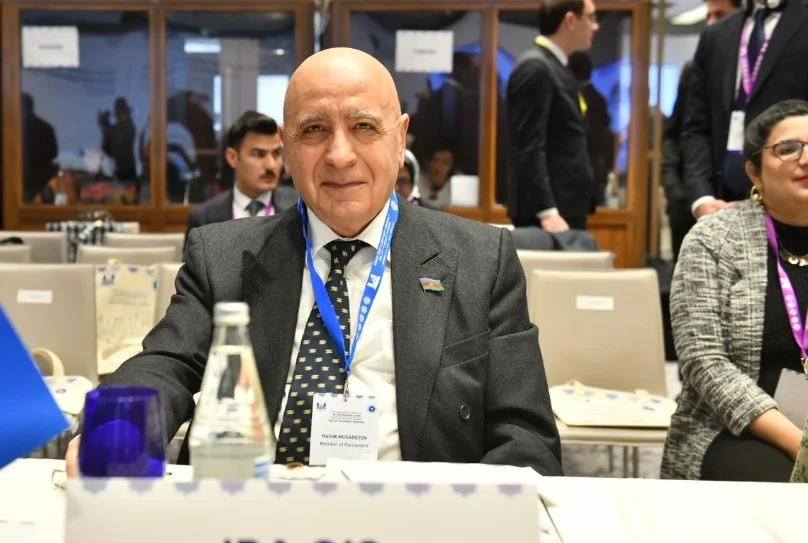
Azerbaijan has emerged as an independent regional power capable of defending its interests and compelling major geopolitical centers to take its position into account, according to Azerbaijani lawmaker and political analyst Rasim Musabekov.
Speaking on the Novosti Kavkaza YouTube channel, Musabekov commented on President Ilham Aliyev’s remarks at the Shusha Global Media Forum, saying the central political message was that Azerbaijan could no longer be treated as a small country forced to choose a foreign protector.
“Azerbaijan is an independent middle power capable of defending itself, shaping the regional environment and making major centers of power take its interests into account,” Musabekov said.
He argued that this position is supported by Azerbaijan’s strengthened armed forces, substantial financial resources and years of diplomatic work.
According to Musabekov, Azerbaijan’s regional role has steadily expanded since its victory in the 44-day war in 2020. Baku is now openly demonstrating that it intends to influence not only developments inside the country, but also the political and security environment surrounding its borders.
Musabekov said Azerbaijan enjoys greater foreign policy independence than some other countries in the region because it does not belong to organizations capable of restricting its sovereignty or dictating the direction of its foreign, economic or defense policies.
He described Azerbaijan’s active foreign policy not as a matter of ambition, but as a strategic necessity.
Baku, he said, is interested in maintaining stability in Georgia, preserving its alliance with Turkey, strengthening ties with Central Asian states and deterring possible pressure from Russia and Iran.
“It is important for us to ensure restraint toward our country from both Russia and Iran,” Musabekov said.
The lawmaker also pointed to Azerbaijan’s central role in transportation and energy routes connecting Central Asia, the South Caucasus and Europe.
He said the Middle Corridor could theoretically function without Armenia or Georgia if alternative routes were developed, but it could not operate without Azerbaijan.
Musabekov noted that Baku had pursued major pipeline, railway and transportation projects with Georgia and Turkey long before the international political environment became favorable, despite opposition and dissatisfaction from Russia and Iran.
“Azerbaijan played the long game more correctly than those who were pushing it toward different decisions,” he said.
Warning Against Ethnic Pressure
Addressing relations with Moscow, Musabekov said Russia should abandon attempts to use ethnic issues as an instrument of pressure against Azerbaijan.
He referred to organizations that, under the pretext of defending the interests of the Lezgin community, had allegedly attempted to encourage separatist sentiment inside Azerbaijan.
Musabekov also linked these concerns to the closure of the Russian House cultural center in Baku, arguing that Russian institutions had attempted to work with Lezgins living in Azerbaijan as if they were Russian “compatriots.”
“They do not understand that Lezgins are our compatriots,” he said. “In Azerbaijan, they are treated as citizens of our country, without discrimination or division.”
According to Musabekov, attempts to exploit ethnic divisions are unlikely to succeed and could trigger a response from Baku.
He stressed that Azerbaijan does not seek confrontation with Russia, but would not remain passive if political, information or ethnic pressure continued to be used against the country.
“Azerbaijan is always prepared to respond appropriately,” he said.
Russia’s War Against Ukraine
Musabekov also addressed Russia’s war against Ukraine, describing Moscow’s decision to launch the invasion as a strategic mistake.
He said the Russian leadership should end the fighting and acknowledge that the attack on Ukraine had been a serious error.
According to Musabekov, continuing the war is worsening economic and social problems inside Russia. Ending hostilities, even at a political cost to the Kremlin, could allow the Russian elite to begin searching for a way out of the current deadlock, he said.
Overall, Musabekov described President Aliyev’s statements in Shusha as a warning to external powers that still attempt to deal with Azerbaijan through pressure or coercion.
“Partnership is possible,” he said. “But no one should try to speak to Azerbaijan from above or impose someone else’s will on it. Azerbaijan will not bend.”
AZE.US