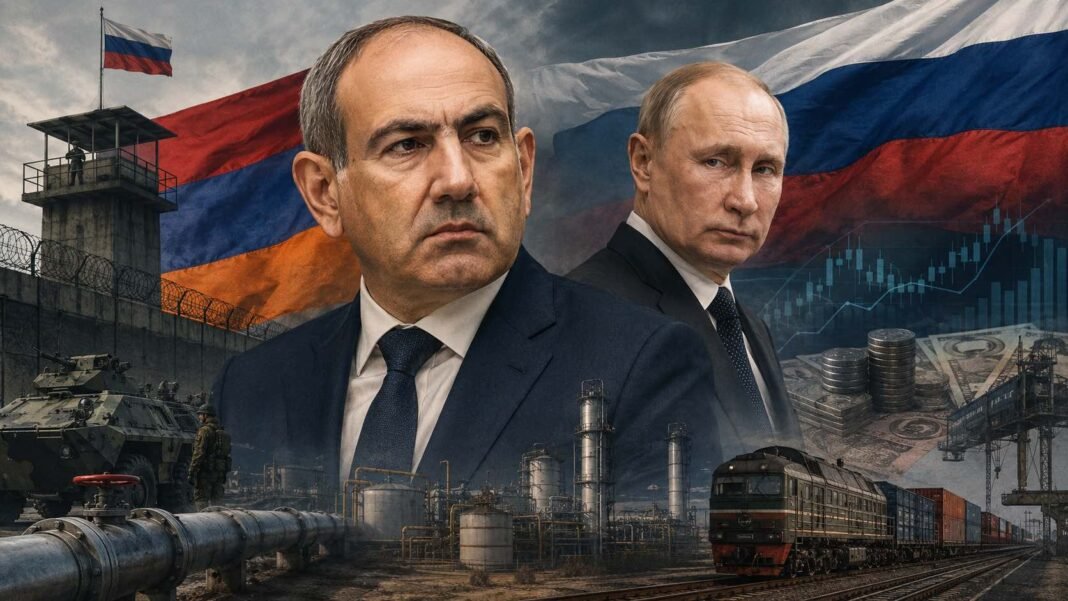
Yerevan is steadily moving out of Moscow’s political orbit, but economic dependence makes a clean break impossible. Russia, meanwhile, has lost the ability to dictate Armenia’s course, yet still possesses powerful levers of pressure.
By AZE.US Editorial Team
Armenian Prime Minister Nikol Pashinyan’s victory in the June parliamentary election did not merely preserve his government. It confirmed that Armenia’s gradual turn away from Russia has survived electoral pressure, economic threats and an opposition campaign closely associated with Moscow.
Pashinyan’s Civil Contract party received nearly 50 percent of the vote and secured enough seats to form a government. Armenia’s Constitutional Court later rejected an attempt by the pro-Russian opposition to annul the result.
But the election did not produce an immediate geopolitical divorce.
Pashinyan’s first visit to Russia after winning another term demonstrated the limits of Armenia’s Western pivot. Meeting Russian Prime Minister Mikhail Mishustin in Yekaterinburg on July 6, the Armenian leader spoke about resolving “problematic issues,” reaffirmed the importance of bilateral relations and made clear that Yerevan still wants to remain inside the Eurasian Economic Union.
That combination defines the current state of Armenian-Russian relations: the strategic alliance is disintegrating, but the economic relationship remains too important for either side to abandon.
Moscow Failed to Change Armenia’s Political Direction
Ahead of the election, Russia moved beyond verbal criticism.
Russian authorities imposed restrictions affecting imports of Armenian agricultural goods, alcohol and other products. Moscow also warned that Armenia could lose preferential prices for Russian gas if it continued moving toward the European Union. Russia remains Armenia’s main energy supplier and accounts for roughly 35 percent of its foreign trade, giving the Kremlin significant economic leverage.
The message was clear: closer integration with Europe would carry a price.
Yet the pressure failed to defeat Pashinyan. His party retained power, while the opposition forces advocating a return to closer relations with Russia remained in the minority.
That result weakened Moscow’s political position. Russia can disrupt Armenian trade, threaten energy privileges and support friendly political forces, but it can no longer assume that such pressure will force Armenian voters or the government back into its orbit.
The Kremlin’s response after the election has therefore become more cautious. Moscow continues to warn Armenia, but it has also resumed dialogue and avoided measures that could trigger a complete rupture.
The Security Alliance Has Already Collapsed
The deepest break is not economic. It is military and political.
Armenia froze its participation in the Collective Security Treaty Organization after accusing the Russia-led alliance of failing to provide support during confrontations with Azerbaijan. Pashinyan has also said that Armenia can no longer rely on Russia as its principal defense partner and must diversify its security relationships.
The Russian military base in Gyumri remains, and Russian forces continue to have a presence in Armenia. But the old arrangement, under which Moscow served simultaneously as Armenia’s protector, arms supplier and regional arbiter, has effectively ended.
The loss of Karabakh was the decisive psychological turning point. Many Armenians concluded that Russia had either been unable or unwilling to protect Armenian interests. Moscow, for its part, argued that Armenia itself had recognized Azerbaijan’s territorial integrity and that Russia therefore had no legal basis to intervene.
Whatever the competing explanations, the political result is unmistakable: Armenia no longer views dependence on Russia as a guarantee of security.
Europe Is Moving Into Russia’s Former Space
The European Union is no longer limiting its engagement with Armenia to statements of political support.
In May, Yerevan hosted its first Armenia-EU summit, marking a major expansion of bilateral relations. In July, the EU launched a new partnership mission designed to strengthen Armenia’s resilience against cyberattacks, foreign information interference and illicit financial flows. This is separate from the EU civilian monitoring mission already operating in Armenia.
European Commission President Ursula von der Leyen also announced additional financial support and tariff-free access for most Armenian agricultural exports, measures presented as assistance against Russian economic pressure.
For Moscow, this is more serious than another Western grant package.
The EU is entering areas such as national resilience, institutional security and crisis management that Russia once regarded as part of its exclusive sphere of influence. Armenia is not yet an EU candidate, but European institutions are already helping Yerevan reduce its vulnerability to Russian pressure.
The EAEU Has Become the Main Battlefield
The most immediate confrontation now concerns Armenia’s membership in the Eurasian Economic Union.
Russian President Vladimir Putin has warned that Armenia cannot ultimately belong to both the EU and the EAEU because the two blocs operate under different customs rules and economic standards. He also said leaving the Russia-led market could cost Armenia as much as 14 percent of its gross domestic product.
In May, EAEU members ordered a review of the possible consequences of suspending Armenia and called for Armenians to choose between the European and Eurasian integration projects. Pashinyan rejected the demand for an immediate referendum, arguing that Armenia has neither formally applied for EU membership nor received candidate status.
Yerevan’s strategy is therefore to delay the choice.
Armenia wants European political support, Western investment and new security partnerships while retaining access to the Russian market, cheap energy and the EAEU’s free-trade arrangements.
Economically, that approach is rational. Politically, it may become increasingly difficult to sustain.
Peace With Azerbaijan Further Reduces Moscow’s Role
The normalization process between Azerbaijan and Armenia is also changing the balance.
For decades, Russia’s influence in the South Caucasus rested partly on its role as the indispensable mediator between Baku and Yerevan. But recent negotiations, direct contacts and U.S.-supported regional transport initiatives have increasingly developed outside the traditional Russian framework.
A lasting Armenian-Azerbaijani settlement would reduce Yerevan’s need for a Russian security umbrella. Opening routes through Azerbaijan and Turkey could also give Armenia alternative trade connections, weakening Moscow’s ability to exploit Armenia’s geographic isolation.
This may be the most important long-term threat to Russian influence.
Armenia’s Western pivot can be slowed through trade restrictions and energy pressure. A transformed regional order in which Armenia has normalized relations with Azerbaijan and Turkey would be much harder for Moscow to reverse.
Neither Side Is Ready for a Final Break
Russia and Armenia are no longer genuine strategic allies. The trust that sustained their relationship has largely disappeared, and their visions of Armenia’s future increasingly conflict.
But they are not yet ordinary neighbors either.
Armenia remains deeply connected to Russia through trade, energy, labor migration, financial flows and infrastructure. Russia retains a military presence and enough economic leverage to inflict significant pain on the Armenian economy.
Pashinyan therefore wants separation without shock. He is trying to replace Russia gradually, sector by sector, rather than announce a dramatic geopolitical break.
Moscow faces its own dilemma. Excessive pressure could destabilize Armenia, but it could also persuade more Armenians that Russia is not a partner but a threat. A complete rupture would accelerate the arrival of Western institutions and further weaken Russia’s already reduced position in the South Caucasus.
The relationship has entered a transitional phase in which both governments are preserving what remains useful while preparing for a future in which they will depend on each other far less.
The political divorce has already begun. What prevents it from becoming final is not loyalty, alliance or shared strategy. It is the cost of moving out of the same economic house.
AZE.US