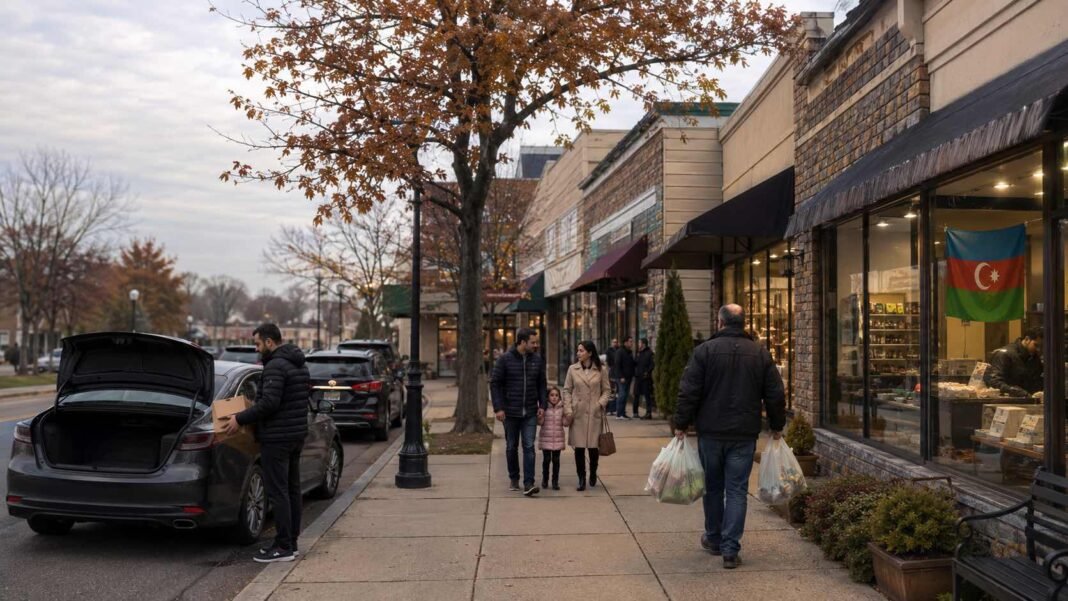
A growing Azerbaijani community in Northern Virginia was built partly by newcomers who entered through the southern border and expected time, work permits or marriage to eventually solve their immigration problems. That expectation is now colliding with a much harsher reality.
By AZE.US Editorial Team
For several years, the route through Mexico was advertised in Azerbaijani social media groups and private chats as a difficult but workable shortcut into the United States.
The formula sounded simple. Reach the southern border, surrender to U.S. authorities, claim fear of returning to Azerbaijan, file for political asylum, obtain a work permit and wait for an immigration hearing that might be scheduled years later.
During that waiting period, migrants were told, they could earn money, rent homes, buy cars, enroll their children in American schools and eventually find a way to remain permanently.
The most important part of that promise was usually left unsaid: crossing the border and filing an asylum application did not provide legal status. It only opened an immigration case that could end either in protection or removal.
For a long time, the difference seemed almost theoretical. Immigration courts were overwhelmed, hearings were repeatedly postponed and temporary employment authorization allowed many applicants to build lives that looked increasingly permanent.
Now the hearing dates are arriving, asylum approval rates have fallen, immigration enforcement has intensified and the illusion of automatic legalization is disappearing.
A Little Baku Built on Temporary Ground
Northern Virginia, particularly Fairfax County and the communities surrounding Alexandria, has become home to a visible Azerbaijani population.
There is no reliable official count of Azerbaijanis living specifically in Fairfax County, and claims that the area contains 10,000 or more Azerbaijani residents should be treated as community estimates rather than census data.
Still, the concentration is noticeable. Azerbaijani families, businesses, restaurants, service providers and social networks have created what some residents informally call Little Baku.
From the outside, it can look like an immigrant success story.
New cars stand outside suburban townhouses. Children attend strong public schools. Families post photographs from Washington, New York and Florida.
New arrivals quickly learn to navigate delivery apps, construction work, trucking, cleaning services and small business networks.
Behind that image, however, many families are living on temporary foundations.
Some have no recognized immigration status beyond a pending court case. Some lost their work authorization or never obtained it. Others remain afraid to leave the United States because departure could end their cases or trigger immigration consequences.
They may work constantly, pay rent and taxes indirectly, raise children and avoid any contact with law enforcement. Yet none of those things, by itself, creates a path to permanent residence.
That is the painful lesson now spreading through Little Baku: surviving in America is not the same as legalizing in America.
A Work Permit Is Not Legal Status
An asylum applicant may generally file for employment authorization after the asylum application has been pending for 150 days. The document cannot normally be issued until the case has been pending for at least 180 days, excluding delays attributed to the applicant.
Receiving an Employment Authorization Document can transform daily life.
It may allow someone to work legally, obtain a Social Security number, open accounts, establish credit and present an apparently normal American identity.
But a work permit is not a green card. It is not asylum approval. It does not prove that the applicant’s claim is credible, and it does not guarantee the right to remain in the country.
It is temporary authorization linked to an unresolved case.
That distinction mattered less when immigration hearings appeared to be years away. It matters enormously when the government begins completing cases at a faster pace.
At the end of May 2026, approximately 3.24 million active cases remained pending in U.S. immigration courts. More than 2.31 million people in that backlog had filed formal asylum applications and were awaiting hearings or decisions. During the first eight months of fiscal year 2026, immigration courts completed more than 583,000 cases.
In May alone, immigration judges completed 75,497 cases tracked by TRAC. Removal or voluntary departure was ordered in 84.5% of them.
The era in which applicants could treat the backlog itself as an immigration strategy is ending.
False Political Asylum Claims Are Becoming a Trap
Political asylum was never designed as a general response to unemployment, corruption, limited opportunity or dissatisfaction with life in one’s home country.
Under U.S. law, asylum protection is intended for people who have suffered persecution or have a well-founded fear of persecution based on protected grounds such as political opinion, religion, race, nationality or membership in a particular social group.
Azerbaijan has genuine political prisoners, persecuted journalists, opposition activists and civil society figures. Some Azerbaijani applicants can present serious, documented claims.
But those cases are damaged when asylum becomes a mass-produced story sold to people who were never politically active.
For years, migrants were coached to create social media posts, attend a demonstration after arriving in the United States, obtain letters from acquaintances or repeat narratives used by earlier applicants.
The assumption was that an overloaded system would not examine every contradiction.
That assumption is increasingly dangerous.
Immigration authorities can compare asylum testimony with previous visa applications, border interviews, travel records, public posts, employment history and documentary evidence. A story that changes between the border, the written application and courtroom testimony can collapse under questioning.
The overall asylum grant rate in immigration courts fell sharply before 2026. TRAC reported that only 19.2% of asylum cases decided in August 2025 resulted in grants, down from 38.2% in August 2024.
A deliberately fabricated asylum application carries risks far beyond losing the case. USCIS instructions warn that a person formally found to have knowingly filed a frivolous asylum application can become permanently ineligible for immigration benefits under the Immigration and Nationality Act.
In other words, a false asylum claim may destroy the very legal alternatives an applicant hopes to use later.
No lawyer can transform an invented political biography into a genuine history of persecution.
Lawyers can defend rights, present evidence and challenge government claims. They cannot manufacture facts without exposing both their client and themselves to serious consequences.
The Marriage Exit Is Closing Too
When asylum looked uncertain, another piece of advice often followed: find an American spouse.
A genuine marriage to a U.S. citizen can provide a lawful immigration path for an eligible applicant. A marriage arranged primarily to evade immigration law is fraud.
The difference is not determined by wedding photographs or the existence of a marriage certificate. Immigration authorities examine whether the couple actually intended to build a life together.
Investigators may review shared housing, finances, insurance, tax filings, communications, family knowledge and the consistency of answers given during interviews.
Federal prosecutors continue to pursue organized sham-marriage cases. In February 2026, the Justice Department announced charges against 11 people accused of participating in a conspiracy that recruited U.S. citizens to marry foreign nationals for immigration purposes. The charges remain allegations unless proven in court, but the case demonstrates that marriage fraud is not treated as a harmless administrative shortcut.
Federal law allows penalties of up to five years in prison and a fine of up to $250,000 for knowingly entering a marriage to evade immigration laws. A formal finding of marriage fraud may also block the approval of future family or employment-based visa petitions.
For someone whose asylum record already contains false statements, a sham marriage does not repair the first problem. It adds a second layer of fraud.
Survival Jobs and the Underground Account Market
When legal work authorization is unavailable, many migrants move into what are often called survival jobs.
They clean houses, paint walls, install flooring, wash cars, move furniture, work in restaurant kitchens or accept day labor paid in cash.
The work is often exhausting, insecure and poorly protected. An undocumented employee may be less likely to report wage theft, dangerous conditions or abuse because any dispute can lead to threats involving immigration authorities.
Others turn to gig platforms such as Uber, Lyft, DoorDash or Uber Eats.
Those without valid documents, driver eligibility or access to the platforms sometimes rent or buy accounts registered to other people.
The account owner may take a percentage of the earnings or charge a fixed weekly fee.
A 2026 CBS News investigation found online markets offering rented or stolen rideshare and delivery accounts, including advertisements aimed at people who could not pass normal licensing or background-check requirements. Uber, Lyft and DoorDash told CBS that account sharing and account sales are prohibited and can lead to permanent removal from their platforms.
Uber said its drivers and couriers must provide identification, a Social Security number and pass screening, while its real-time identity system periodically uses selfies to confirm that the worker matches the approved account holder.
For migrants using someone else’s account, the arrangement creates another form of dependency.
The worker does the driving, pays for gas, absorbs vehicle expenses and accepts the risks. The registered account holder controls access to the income and may disappear, change the password or withhold payment.
One identity check can end the arrangement instantly.
This is not economic freedom. It is a digital version of informal labor in which the person doing the work remains invisible and replaceable.
Even Legal Immigration Channels Are Narrowing
The broader U.S. immigration system has also become more restrictive for Azerbaijani nationals.
Effective January 21, 2026, the U.S. State Department paused the issuance of immigrant visas to nationals of 75 countries, including Azerbaijan, while reviewing screening rules related to the public-charge standard. Applicants may still submit applications and attend interviews, but immigrant visas covered by the policy are not being issued except in limited circumstances. Tourist visas are not included in that specific pause.
This measure does not automatically determine the outcome of asylum cases already being heard inside the United States, and it does not eliminate every possible immigration category.
It does, however, reinforce the central message of the current policy environment: access to permanent immigration benefits is being narrowed, scrutinized and delayed rather than expanded.
For families whose lives depend on a pending asylum application, a borrowed delivery account and hope that another legal door will eventually open, the margin for error is disappearing.
A Quiet Return May Be Beginning
There is no official dataset showing how many Azerbaijani migrants are leaving Fairfax County and returning to Azerbaijan.
Government statistics do not provide a real-time count of voluntary returns from a particular ethnic community in a specific Virginia county. Claims of a large-scale Azerbaijani exodus would therefore be premature.
But the mood inside parts of the community is changing.
The questions once centered on how to reach the Mexican border, how to find a sponsor, which state offered better work and how quickly an asylum applicant could receive employment authorization.
Now conversations increasingly turn to what happens after a denial, whether a case can be withdrawn, how to leave without being detained, how to sell a financed vehicle and whether children who have spent years in American schools can readjust to life in Baku.
For some, returning remains psychologically unbearable.
Families sold homes, borrowed money and told relatives that America was a one-way journey. Social media accounts presented every new car, apartment and vacation as evidence that the gamble had succeeded.
Admitting that the legal foundation never existed can feel more painful than continuing to live in uncertainty.
Yet returning home is not always failure.
A person who cannot practice a profession, travel freely, obtain stable insurance or plan beyond the next immigration hearing may eventually conclude that life in legal limbo is not the future that was promised.
The comparison is no longer between America and Azerbaijan in the abstract. It is between a real life in Azerbaijan and a shadow life in the United States.
America Did Not Promise Legalization. The Smugglers Did.
The hardest truth is also the simplest.
The United States never promised permanent residence to everyone who crossed its southern border and filed an asylum application.
That promise came from smugglers, unlicensed consultants, social media personalities and acquaintances whose own cases had not yet reached court.
Many confused temporary survival with permanent success. A work permit looked like status. A delayed hearing looked like safety. A rented app account looked like employment. A large suburban Azerbaijani network looked like protection.
None of those things resolved the underlying immigration case.
America remains a country of extraordinary opportunity for people who arrive through lawful employment, education, family reunification, business investment or legitimate humanitarian protection.
It is also a country whose immigration system can be unforgiving when an applicant builds a case on fabricated persecution, false documents or a commercial marriage.
Little Baku will not disappear. Northern Virginia will continue to have a strong Azerbaijani community made up of citizens, permanent residents, professionals, entrepreneurs, students and families with legitimate immigration cases.
But the most recent wave is confronting a reality that many preferred not to discuss.
The American dream is not dead. The shortcut through Mexico was never a reliable road to it.
AZE.US